Last updated: August 10, 2026
- Medication errors are among the most common preventable harms in home caregiving; a written master list on the fridge door is the single highest-leverage item on any caregiver checklist.
- A 7-day refill buffer is the minimum runway before a prescription gap creates a care crisis.
- Pressure injuries can develop in as little as 2 hours in bed-bound patients; daily skin inspection belongs on every checklist for immobile recipients.
- Dehydration in older adults often presents as confusion before thirst — a fluid intake log catches this before it becomes a hospital visit.
- Caregiver burnout affects an estimated 40–70% of family caregivers (Family Caregiver Alliance, 2023); a monthly wellbeing check is a care-quality measure, not a luxury.
- A checklist reviewed and updated monthly reduces documentation gaps; one left static for 6 months creates false confidence about the current care level.
- Dedicated multi-caregiver apps (CareZone, CaringBridge, Lotsa Helping Hands) add coordination features but only outperform paper if every caregiver actually uses them.
Caregiving doesn’t fall apart because you don’t care enough — it falls apart because there’s no system. A caregiver checklist solves a specific problem: when you’re managing medications, appointments, hygiene, meals, and emotional support for another person — often while holding down your own life — something will slip unless it’s written down. This piece gives you the structure to build a caregiver checklist for your actual situation, not a generic household. It covers what the checklist must include at each care level, how to make it survive shift handoffs, and what standard advice misses in harder scenarios.
What a Caregiver Checklist Actually Needs to Cover
Most printable checklists you find online are aspirational. “Check in with care recipient” appears as a single task — which is like writing “fix the car” on a to-do list. The real version breaks down into specifics, and those specifics hinge on one thing: how much care your person actually needs right now.
Before building your caregiver checklist, answer three questions honestly — and wherever they touch on medical decisions, talk through the answers with a licensed healthcare provider who knows the individual’s case:
- Is the care recipient medically complex — multiple diagnoses, specialist visits, prescription management? (Consult a physician or care coordinator if you’re unsure how to categorize the complexity.)
- Are they cognitively impaired (dementia, brain injury, severe mental illness), or physically limited but mentally intact?
- Are you the sole caregiver, or is there a rotating team, paid help, or family sharing shifts?
Those three answers change everything about what goes on your list and how granular it needs to be. A cognitively impaired recipient with five providers and three family caregivers needs a fundamentally different document than an aging parent who is independent but occasionally needs help with medications.
Stop and check: A “yes” to question 2 means your checklist needs behavioral prompts and observation notes alongside the physical tasks. A “yes” to question 3 means you need a shared log, not a personal list — because your caregiver checklist is also a handoff document.
Managing Medications: The Section You Can’t Skip
Medication errors are one of the most common and preventable problems in home caregiving. Every professional caregiver resource — including guidance from the Family Caregiver Alliance — names medications as the area where informal caregivers are most exposed to harm. A structured approach to this part of your checklist is non-negotiable.
Your medication section of the caregiver checklist should cover four distinct layers:
- Identify every medication by name, dose, and time of day. Keep a printed master list — not just in your head or an app — somewhere visible in the home, usually the fridge door. Emergency responders look there first.
- Confirm morning medications were taken, not just dispensed. A pill in a cup is not a pill taken. For cognitively impaired recipients, this distinction matters every single time.
- Note refill dates. Seven days is the minimum buffer before you’re scrambling to a pharmacy. Mark refill days on a physical calendar as a backup to any app reminder.
- Track PRN (as-needed) medications separately. Pain medication, anti-anxiety medication, rescue inhalers — log the time and dose each use. With more than one caregiver involved, this logging practice reduces the risk of double-dosing; for specific guidance on safe PRN administration in your situation, consult the prescribing physician or a licensed pharmacist. (ISMP medication safety guidelines are a useful reference.)
- Watch for side effects on a regular schedule, not just when something looks obviously wrong. Changes in appetite, sleep, or balance can be medication effects that go unreported for weeks. How often to review depends on the individual’s regimen — ask the prescribing physician or pharmacist what interval makes sense, and document what you observe so you have something concrete to report at the next appointment.
Anyone caring for a person on more than five medications should ask their doctor or pharmacist about a formal medication review. Many pharmacists will do a brown-bag review for free — bring every bottle. The American Pharmacists Association can help you locate a pharmacist who offers medication therapy management services.
Still missing something? Can you recite the name and dose of every medication without looking? No? Then the written master list isn’t done yet.
The Daily Caregiver Checklist — Organized by Care Level
Once the medication layer is solid, the rest of the daily caregiver checklist structure depends on where the care recipient falls on the care-need spectrum. The table below maps common situations to the right approach — and explains why simpler alternatives tend to break down.
| Situation | Best Path | Why Other Options Fail |
|---|---|---|
| Low-support needs (independent but aging, occasional help) | Weekly checklist with daily medication and one wellbeing check-in | Daily task lists create dependency and under-report capacity |
| Physical care needs, cognition intact | Daily task list co-created with the care recipient; they know what they want and in what order | Imposed routines cause resistance and don’t account for preference |
| Cognitive impairment present | Caregiver-managed daily checklist with behavioral notes section; share with anyone providing relief care | Mental shortcuts and memory-based systems fail at shift handoffs |
| Post-surgical or acute recovery | Time-stamped checklist tied to care plan from discharge instructions; escalation triggers included | Generic lists miss clinical benchmarks (wound appearance, mobility milestones) |
| Pediatric or complex developmental care | Checklist aligned with therapy team’s goals; progress notes section attached | Task-only lists miss developmental context and don’t support multi-provider coordination |
Beyond the level-specific structure, a few tasks that generic checklists consistently omit belong on almost every list:
- Skin inspection, especially for bed-bound or wheelchair-using recipients. Pressure injuries can develop in as few as 2 hours and become serious fast. The National Pressure Injury Advisory Panel has free educational materials on what to look for.
- Fluid intake log. Dehydration in older adults and in people with certain neurological conditions is underrecognized — it often presents as confusion before thirst, and catching it early is far simpler than managing what comes next.
- Emotional check-in. Not a wellness platitude. A one-sentence note — “seemed anxious today, wouldn’t eat lunch” — gives you a pattern to show a physician at the next visit.
One thing to confirm: Does your daily list include at least one observation task — something you’re noticing and recording, not just doing?
Building a Caregiver Checklist That Survives Shift Handoffs

Those observation tasks only have value if the next caregiver can read and act on them. Whether it’s a family member on a weekend, a paid aide, or a neighbor in a pinch — your caregiver checklist must work as a handoff document without you in the room to explain it.
Five structural changes make the difference between a list and a handoff document:
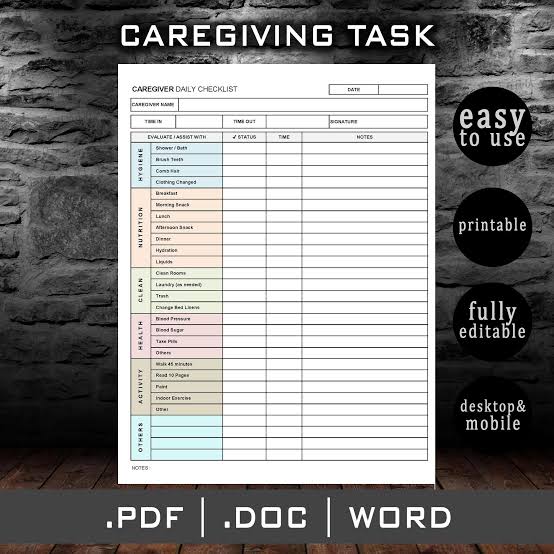
- Write every task as a verb with an object. Not “morning routine” but “wash face, brush teeth, apply prescription cream to left shin.”
- Add a ‘Done by / Time’ column. This single addition converts a list into a log.
- Include one escalation note per shift. “Call me if she refuses more than one meal” or “call the on-call nurse line if pain is above 6/10 after medication.” The number should be on the sheet, not just in your phone.
- Mark preferences as clearly as clinical tasks. “He prefers the TV off during meals” is as real a care need as “give 10mg with food.”
- Date every entry in the log section. When you’re trying to identify when a decline started, undated notes are nearly useless.
The Family Caregiver Alliance maintains a practical library of free care management tools — including handoff templates — that I’d direct any new caregiver toward before they try to build from scratch. The American Association of Caregiving Youth also maintains free downloadable documentation templates for family situations involving younger caregivers.
Try this test: Hand your checklist to someone who doesn’t know your care recipient and ask whether they could complete a full shift using only that sheet. The gaps they find are the gaps that will bite you.
When Standard Caregiver Advice Breaks Down
Even a well-structured caregiver checklist runs into situations where normal advice doesn’t hold. These five scenarios come up often enough that they deserve direct treatment.
Scenario 1: The care recipient refuses the routine. Standard advice says build consistency. That advice assumes cognitive flexibility — it breaks down with dementia. When someone becomes agitated by a rigid sequence, the checklist needs to become a list of outcomes, not steps. “Teeth clean by 10am” rather than “brush teeth at 8am, 9am reminder, second attempt at 9:30.” Flexibility in method, firmness on outcomes.
Scenario 2: You’re caregiving across distance. A checklist for a parent you check on via phone twice a week is a different document. Specifically, it becomes a script for the calls — “ask about appetite, ask if anyone called, ask if pain medication is running low” — and a calendar for organizing remote logistics. Distance caregivers often under-document because they’re not in the room; honestly, the checklist discipline matters more here, not less.
Scenario 3: The care recipient has fluctuating capacity. Someone with a relapsing condition — MS, lupus, bipolar disorder — may need intensive support some weeks and minimal support others. A static checklist fails here completely. Build a two-column version: “Good day tasks” and “Hard day tasks,” and let the morning assessment determine which list you’re running.
Scenario 4: You’re also the person with medical authority (healthcare proxy or POA). Your caregiver checklist now includes legal-administrative tasks that don’t appear on any standard template: reviewing advance directives annually, keeping benefit enrollment dates, tracking insurance preauthorization windows. These have hard deadlines. Missed deadlines carry real consequences that no amount of attentive daily care can undo.
Scenario 5: There are multiple caregivers who don’t coordinate well. Family caregiving with unresolved conflict is one of the most common hidden problems in home care. A shared caregiver checklist in a neutral digital tool — a Google Doc everyone can access, or a dedicated app like CareZone or CaringBridge — creates an objective record that reduces “I thought you did it” cycles. The honest drawback: it only works if everyone commits to using it, and no checklist fixes a family dynamic issue.
Worth asking yourself: Does your current system have a plan for the two most likely disruptions — you being sick, and the care recipient having a significantly worse week?
The Weekly and Monthly Tasks That Fall Off Every Caregiver Checklist
Daily tasks are easy to habitualize. Weekly and monthly tasks are where things get dropped — and where the gaps most often show up as preventable crises.
Weekly:
- Review the week’s observation notes for patterns
- Confirm the next week’s appointments and arrange transport
- Restock supplies (disposables, skincare, medications approaching refill)
- Check in with any secondary caregivers or paid help about concerns
Monthly:
- Review the master medication list for any changes from the previous month’s appointments
- Check equipment (wheelchair, walker, hospital bed, feeding pump) for wear or malfunction
- Reassess whether the current care plan still matches the person’s current status — people improve and decline, and a checklist written six months ago may be over- or under-serving them now
- Your own wellbeing. This isn’t a platitude: caregiver burnout affects an estimated 40–70% of family caregivers (Family Caregiver Alliance, 2023), and it accumulates gradually. Not having spoken to anyone outside the caregiving role in the past week is a signal worth acting on.
The honest limitation of any caregiver checklist: it can’t make you take the break you need, and it can’t replace clinical judgment. A checklist is an organizational tool, not a care plan. When something clinical is changing — new symptoms, new behaviors, declining function — that conversation belongs with a physician, not on a task list.
What It Costs to Build a Caregiver Checklist System — and What Affects the Price
Building a basic caregiver checklist costs nothing. A Google Doc everyone can access, a printed paper binder, or a free notes app handles the core job for solo or two-person caregiving teams. The cost curve rises when you add coordination features for larger teams.
Dedicated apps range from free (CaringBridge, basic tier) to roughly $10–20 per month (CareZone premium, Lotsa Helping Hands organizational features). A paper-based system with printed templates costs under $5 in materials and is often more reliable in households where not every caregiver is comfortable with apps. Both the Family Caregiver Alliance and the National Alliance for Caregiving offer free downloadable templates that cut setup time to under an hour.
Three factors genuinely drive up the cost and complexity of a caregiving documentation system: the number of active caregivers (each additional person multiplies coordination overhead), the number of medications being managed (more medications means more logging surface area), and whether the care recipient has fluctuating capacity — which requires version-controlled checklists rather than a single static document.
Alternatives to a Caregiver Checklist — and How They Compare
The main alternatives to a structured caregiver checklist are memory-based systems, whiteboard task boards, and professional care management software.
Memory-based systems work for a single, low-complexity recipient with one caregiver and no shift coverage. They fail at handoffs, fail under cognitive load, and fail when the caregiver is sick. They’re also the default for most family caregivers — and the source of most avoidable errors.
Whiteboard task boards are better than memory. Visible to everyone in the home. No technology required. But they don’t preserve history; once a task is erased, the record is gone. For stable situations with in-home coverage, a whiteboard combined with a separate paper log addresses most needs at zero cost.
Professional care management platforms (CareSmartz360, AlayaCare, Homecare Homebase) are designed for agency use — shift scheduling, billing integration, compliance documentation. For a family caregiver, they’re over-engineered and expensive, typically $50–200 per month, unless you’re coordinating paid home care workers across multiple shifts and need audit-ready documentation.
In practice, the right tool is the simplest one that everyone involved will actually use consistently. A polished app that two out of three family caregivers ignore performs worse than a paper binder on the kitchen counter that all three check every morning.
Frequently Asked Questions
How do I start a caregiver checklist if I’ve never made one before?
Start with one day, not an ideal system. Write down everything you actually do tomorrow, in the order you do it. That is your draft. Edit it the following day. A real list built from one real day beats a perfect template you never use.
What app or tool works well for a caregiver checklist?
There’s no single right answer — the best tool is the one your whole caregiving team will actually use. Solo caregivers can get by fine with a shared Google Doc or a basic notes app. Multi-caregiver teams tend to benefit from dedicated tools like CareZone, CaringBridge, or Lotsa Helping Hands, which add task assignment, shift logs, and a message board. To be fair, apps require everyone to actually use them — a paper binder on the kitchen counter that all three family members consult each morning outperforms a polished app that two people ignore.
Should the care recipient be involved in building the checklist?
Yes, if their cognition allows it. A list built without their input will have gaps and friction. They know things about their own preferences, pain, and routines that you don’t. And honestly, being cared for doesn’t mean losing input into your own daily life — that matters for dignity as much as anything else.
How often should a caregiver checklist be updated?
After every significant change: a new diagnosis, a hospital stay, a change in living situation, or a new medication. Outside of changes, monthly reviews are enough for stable situations. A list that’s six months out of date is creating false confidence.
What if I’m burning out and the checklist feels like one more demand?
That feeling is the checklist telling you it’s doing the wrong job. A caregiver checklist should reduce your cognitive load, not add to it. When it’s adding to it, the list is too granular, too long, or covering tasks that should be delegated. The Family Caregiver Alliance caregiver health resources include specific guidance on caregiver stress that are worth reading before the burnout becomes a crisis.