
Last updated: November 18, 2026
Caregiver stress management techniques that can be used in the moment are small, fast actions that lower tension while the person you care for still needs you. If you are overwhelmed in the middle of a task, the goal is not to become calm forever; it is to get steady enough to think clearly for the next 2 to 5 minutes.
The fastest thing to do when stress spikes
The quickest way to reduce caregiver stress in the moment is to interrupt the stress loop with one short physical action, one grounding cue, and one concrete next step. That combination works better than trying to “relax” on command.
Start with this 3-step reset:
- Stop your hands for 10 seconds. Put the medication cup down, set the phone on the counter, or hold the laundry basket still. A brief pause tells your nervous system the task is not escalating right now.
- Exhale longer than you inhale for 1 minute. Try breathing in through your nose for a count of 4, out for a count of 6. The longer exhale is the point; it often slows the racing, tight feeling in the chest more reliably than “deep breaths” alone.
- Name the next action out loud. Say, “I am getting water,” “I am checking the pillbox,” or “I am calling the clinic after this.” One named task cuts down mental spinning.
This works well during interruptions because it does not require privacy, a mat, or 20 spare minutes. It is also why generic advice like “take care of yourself” fails in a hallway, hospital room, or kitchen at 7:40 a.m. A caregiver usually needs something that fits between two demands, not a full reset.
If you want a broader foundation after this article, the hub on caregiver support basics can sit next to it without repeating the same steps, and caregiver coping strategies can help you build a longer-term routine.
What breathing exercise helps during a caregiving interruption?

Paced breathing helps during a caregiving interruption because it is quick, discreet, and easy to repeat while you are still on duty. The goal is not a perfect meditation state; it is to lower the body’s alarm response enough to think and speak normally.
Use this simple pattern:
- Inhale through the nose for 4 counts
- Exhale for 6 counts
- Repeat for 6 rounds, which takes about 1 minute
If counting is distracting, use a fixed phrase instead: inhale on “in,” exhale on “out.” If your body feels wound too tight for a slow breath, start with 3 counts in and 4 counts out for the first minute, then lengthen it.
This technique is useful in real caregiving settings because it can happen while you stand at a sink, sit beside a bed, or wait for a kettle to boil. It does not require a special app, and it does not ask you to empty your mind. A beginner often makes the mistake of taking huge breaths. That can make some people feel lightheaded. Smaller breaths are usually steadier.
A second mistake is stopping after two breaths and deciding it “didn’t work.” Breathing tools often need 60 to 90 seconds before the body settles. The point is not instant peace; it is a noticeable drop in pressure.
If stress keeps flipping back on as soon as you finish, pair the breathing with one sensory cue, such as feeling both feet on the floor or touching a cool mug. That gives the breath somewhere to land. For more on paced breathing, the National Center for Complementary and Integrative Health explains how breathing practices can help the body settle: NCCIH relaxation techniques.
Grounding techniques that work with one free hand
Grounding techniques work best when they use the room you are already in, not a perfect quiet space. They pull attention away from spiraling thoughts and back to the body, the floor, or a single object for about 30 to 90 seconds.
A caregiver-friendly grounding set includes:
- 5-4-3-2-1 sensing: notice 5 things you see, 4 you feel, 3 you hear, 2 you smell, 1 you taste
- Texture focus: hold a spoon, washcloth, or doorknob and describe its temperature and shape
- Foot press: push both feet into the floor for 10 seconds, release, and repeat 3 times
- Cold cue: run cold water over your hands for 15 to 20 seconds if you are near a sink
The most useful version is the one you can do while still watching the person you care for. You do not need all five senses every time. One sense is enough if that is what the moment allows. If the person you care for is agitated, a visible technique like foot press or holding a mug is usually less distracting than closing your eyes.
A common mistake is trying to “think positively” instead of grounding. Positive statements can help later, but in the heat of a moment they often feel fake. Another mistake is choosing a technique that requires too much privacy. If you cannot step away, use a method that can happen while standing still.
This is also where a therapist can help over time. A therapist can help you find which grounding cues actually settle your body, not just what sounds good on paper. If stress includes panic symptoms, frequent crying, or trouble sleeping for several nights, a primary care physician should also know, because the body can run on stress chemistry for too long. The Centers for Disease Control and Prevention has a useful overview of stress and coping here: CDC coping with stress.
How do you use timeboxing when there is no time?

Timeboxing means giving a task a fixed, short window so it does not swallow the whole day. For caregivers, that usually means 5, 10, or 15 minutes, not a vague “later.”
Use it like this:
- Pick one task, not three. Choose the thing that matters most right now, such as refilling water, sorting pills, or answering one message.
- Set a timer for 5 to 15 minutes. Use a phone, kitchen timer, or watch. The exact tool matters less than making the limit visible.
- Work only on that task until the timer ends. If another request appears, write it on paper or say, “I will come back to that in 10 minutes.”
- Stop when the timer ends, even if the job is unfinished. This is the point. You are training your brain not to treat every task like an emergency.
- Decide the next 5-minute block. Either continue, switch, or pause.
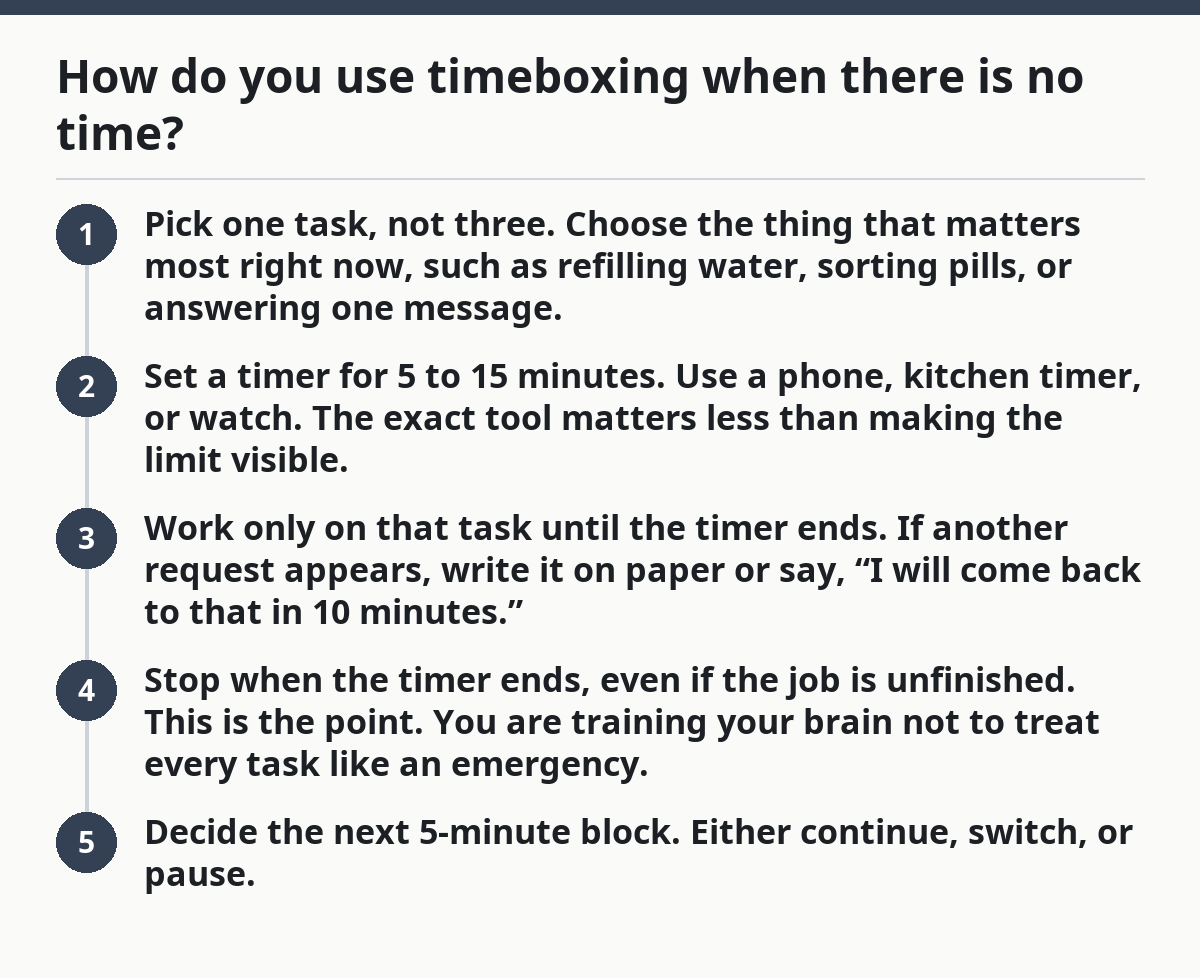
Timeboxing helps because caregiver stress often comes from task pileup, not just emotion. When everything feels equally urgent, the brain stays on high alert. A timer makes the next move visible.
The trade-off is that timeboxing can feel rude at first, especially if you are used to jumping every time someone asks. It is not a cure for a crisis, and it is not the right tool if the person needs immediate medical attention. It works best for ordinary interruptions: calls, paperwork, meals, laundry, or medication routines.
A practical tip: use a piece of paper beside you and write “not now” items on it. That keeps the brain from treating forgotten tasks as failures. If you want a more general guide to limits and routines, the caregiver support basics page can provide that structure without repeating the same steps.
How to ask for help in the moment without starting a whole conversation
Asking for help in the moment works best when the request is narrow, specific, and timed. People are much more likely to respond to “Can you sit with Mom for 10 minutes while I step outside?” than to “I need help.”
Use this structure:
- Name the task
- Name the time
- Name the length
- Say what success looks like
Example: “Can you bring the prescription bottle from the counter to the kitchen table in the next 2 minutes?”
Example: “Can you stay with him for 15 minutes while I make a phone call?”
This works because many caregivers hesitate to ask until they are already overloaded. By then, the request comes out in frustration, and the other person hears panic instead of direction. A specific request is easier to say and easier to answer.
If you are asking a family member, keep the first request small. A 10-minute favor is often more successful than a broad plea for support. If the person says no, that does not mean the request was wrong; it may mean the request was too large for that moment. Shrink it. Ask for one job, not a role.
A helpful fallback is the “if-then” request: “If you cannot stay, then can you make the call for me?” That gives you a second path without restarting the whole discussion.
This is one place a primary care physician or therapist can be useful indirectly, too. They can document stress-related strain, recommend support around caregiving limits, or help you think through what kind of help you actually need. That does not solve tonight’s dinner, but it can make the load more manageable over time. For a broader overview of caregiver roles and support, the National Institute on Aging has a practical starting point: NIA caring for an older adult.
What not to do when stress is already high
Do not try to solve the whole caregiving problem while your body is in alarm mode. When stress is high, big decisions get noisy, and the cost is usually a mistake, a sharp word, or a missed step with medication or safety.
Common mistakes include:
- Long self-lectures. They cost time and usually increase shame. Use one short cue instead: “Breathe, then one task.”
- Checking your phone for relief. It often adds more input, more messages, and more guilt. If you need a pause, use the 1-minute breathing pattern instead.
- Skipping food or water until the task is done. Even a few sips of water can make you less shaky; a full meal can wait, but not all day.
- Trying to be “strong” by doing everything alone. That usually turns a short bad stretch into a longer one.
- Using breathing so aggressively that you feel dizzy. Smaller, slower breaths are safer and easier to repeat.
This section is not about blame. Caregivers often default to overfunctioning because the alternative feels impossible. Still, a stress move that costs you more energy than it saves is not a good tool.
Do not use these techniques as a substitute for medical care if the person you care for has an urgent change in symptoms, or if your own stress comes with chest pain, fainting, or thoughts of harming yourself or someone else. In that case, contact emergency services or a primary care physician right away. A therapist can help with ongoing stress patterns, but emergencies need faster help.
A simple 2-minute sequence to keep on repeat
A 2-minute sequence gives caregiver stress management a script you can reuse instead of improvising under pressure. The point is to make the next response automatic enough that you do not have to think from scratch.
Here is a workable sequence:
- Set both feet down for 10 seconds. This gives your body a physical base.
- Exhale longer than you inhale for 6 breaths. Aim for about 1 minute total.
- Name one object in the room. Example: “chair,” “sink,” or “pillbox.”
- Choose one next action. Example: “fill the water cup,” “call back after lunch,” or “sit for 2 minutes.”
Keep this sequence where you will see it: on a fridge note, inside a cabinet door, or as the lock-screen text on your phone. If you need a cue, use a 3-word prompt such as “Feet, breath, next.” Short cues are easier to remember when your head is full.
The advantage of a repeatable sequence is that it reduces decision fatigue. The disadvantage is that it can feel too simple when the situation is emotionally intense. That is normal. Simple tools are not weak tools; they are useful because they still work when you are tired, interrupted, and short on time.
If you want to build beyond this, pair the sequence with one planned support step each day, such as asking for a 15-minute break or preparing a second water bottle. But for the moment, the job is smaller: lower the stress enough to stay functional for the next task.
Key takeaways
- The quickest caregiver stress move is a short reset: pause, lengthen the exhale, and choose the next task.
- Breathing and grounding work best when they take under 2 minutes and do not require privacy.
- Timeboxing stops one errand from becoming the whole day.
- Asking for help works better when the request is specific, timed, and small.
- If stress is tied to safety, severe symptoms, or thoughts of self-harm, get professional help right away.
How do caregivers relieve stress quickly?
Caregivers relieve stress quickly by using a short physical reset, not by trying to force calm. A 1-minute pattern of longer exhale breathing, feet on the floor, and one named next step often works better than advice that needs 20 minutes of quiet. The most effective method is the one you can repeat during a real interruption.
What is the fastest way to calm down as a caregiver?
The fastest way to calm down as a caregiver is to slow the body first. Exhale for longer than you inhale for about 60 seconds, then ground yourself with one thing you can see or feel. If possible, add a 5-minute timebox so your brain stops treating everything as urgent at once.
What stress management works during a crisis?
During a crisis, only the simplest tools count: breathing, grounding, and direct help requests. Skip long reflection, journaling, or anything that needs privacy. Focus on the next 1 minute, the next sentence, and the next safe step. If there is immediate danger or a medical emergency, call emergency services or a primary care physician right away.
Drafted with AI; not yet reviewed by a person.