
Power of attorney vs guardianship: what caregivers need to know

Last updated: November 18, 2026
Key Takeaways
- Power of attorney is usually the better starting point when the person still understands what they are signing.
- A durable power of attorney can avoid court if the person still has legal capacity to sign it.
- Guardianship may be needed when no valid power of attorney exists, or the existing authority cannot be used.
- Power of attorney usually wins on speed and control; guardianship wins on authority after incapacity.
Power of attorney vs guardianship is the core choice many caregivers face when planning ahead or responding to a crisis. One lets an adult choose someone to act for them, and the other is a court process that gives legal authority when that choice is no longer possible or has not been made. For caregivers, the key question is not which sounds easier; it is which one the person still has the legal capacity to use.
This is general information, not legal advice. A qualified lawyer should be consulted, because the rules and labels vary by jurisdiction. For a U.S. overview, see the National Institute on Aging and your state court or bar association resources.
If you are sorting out caregiver legal and financial planning, this comparison will help you decide which path fits a person’s actual condition, not just the family’s urgency.
The short answer: which one is better for caregivers?

Power of attorney is usually the better starting point when the person still understands what they are signing. Guardianship becomes relevant when a court must step in because that person can no longer manage personal or financial decisions safely, or no valid authority exists.
That is the practical divide. A durable power of attorney is private, faster, and easier to set up while the person still has capacity. Guardianship is slower, more intrusive, and supervised by a court, but it can supply authority when no other lawful option exists. The wrong choice is often to wait until the crisis removes the easier option.
Here is the plainest way to think about it: if the person can still make a knowing decision, power of attorney usually wins. If the person cannot, guardianship may be the path left. In many places, conservatorship is the term used for property and money decisions, while guardianship is used for personal care, but some jurisdictions use those terms differently.
What a durable power of attorney actually does
A durable power of attorney wins when the person can still sign it, because it turns future caregiving chaos into a document-based process instead of a court case. It is a legal document in which a person, called the principal, gives another person, the agent or attorney-in-fact, authority to act on their behalf.
“Durable” matters because it usually means the authority continues if the principal later loses capacity. That is the feature caregivers care about most. A non-durable power of attorney may end when capacity ends, which is useless for dementia planning or progressive neurologic disease.
The strengths are practical. A properly drafted durable power of attorney can cover banking, bill payment, insurance, real estate transactions, tax matters, and other financial tasks, depending on the document and local law. It usually avoids immediate court involvement, which means less delay and less public exposure of family matters. It can also be tailored: one agent, successor agents, limited powers, or powers that start immediately or only upon incapacity, depending on the jurisdiction.
The weakness is just as important. A power of attorney only works if it was created while the person still had capacity and signed the right form for the jurisdiction. If the person no longer understands the nature of the document, the family cannot fix that by signature alone. The document can also be abused by a dishonest agent, which is why banks, title companies, and other institutions sometimes ask for copies, certifications, or notarization before honoring it.
This option is not for families who have already missed the window. It is also not a cure for disagreement among siblings; one agent can still make a bad decision, and multiple agents can create deadlock if the document is badly written. If family conflict is already active, consult a lawyer or elder-law professional.
When guardianship is the right tool

Guardianship wins when the person can no longer make legally effective decisions and no valid power of attorney exists, or the existing authority is unusable. It is a court-supervised arrangement that gives a guardian authority over personal care, and in some jurisdictions a conservator or similar fiduciary authority over money and property.
The main advantage is power that third parties must recognize because the court granted it. That matters when a person is already incapacitated, is being exploited, refuses needed care because of impaired judgment, or never signed a durable power of attorney in time. A court order can let someone consent to treatment, arrange placement, manage benefits, or protect assets, depending on the scope of the order and local law; a lawyer can explain what the order can cover in your jurisdiction.
The trade-off is heavy. Guardianship usually requires petitions, notice to interested parties, evidence of incapacity, and ongoing court supervision. That means time, legal cost, reporting duties, and less privacy. It can also take away more rights than the family expected if the order is broad. A person under guardianship may lose the ability to make choices in areas covered by the order, even if they can still handle some tasks.
Guardianship is not the first choice for a person who still has capacity. It is also not a shortcut around family conflict. If the real problem is that relatives disagree, the court process may expose the conflict rather than solve it quickly.
For families using the term conservatorship, the practical question is the same: what decision-making power is needed, and does the court need to create it?
Power of attorney vs guardianship: the real differences that change the decision
Power of attorney usually wins on speed and control; guardianship wins on authority after incapacity. The choice turns on capacity, timing, and how much court involvement the family can avoid or cannot avoid.
| Criteria | Power of attorney | Guardianship | Winner for this condition |
|---|---|---|---|
| Who chooses the decision-maker | The person chooses the agent in advance. | The court appoints the guardian. | Power of attorney when the person can still choose |
| Capacity needed | The person must have capacity at signing. | The person is usually found unable to manage some decisions. | Power of attorney if capacity still exists |
| Court involvement | Usually none at setup. | Central to the process and ongoing supervision. | Power of attorney for lower friction |
| Speed of use | Can be ready as soon as the document is signed. | Often takes much longer because of filings and hearings. | Power of attorney for urgent planning before incapacity |
| Scope of authority | Whatever the document and law permit. | Whatever the court orders. | Power of attorney for customization |
| Oversight | Limited unless challenged or monitored by institutions. | Regularly supervised by the court in many places. | Guardianship for stronger oversight |
| Privacy | More private. | More public because of court filings. | Power of attorney for privacy |
| Risk of abuse | Depends heavily on the agent and document safeguards. | Depends on the guardian, but the court adds checks. | Guardianship for added review |
| Best timing | Before the crisis, while the person can still sign. | After incapacity has made private planning impossible. | Power of attorney for advance planning; guardianship after loss of capacity |
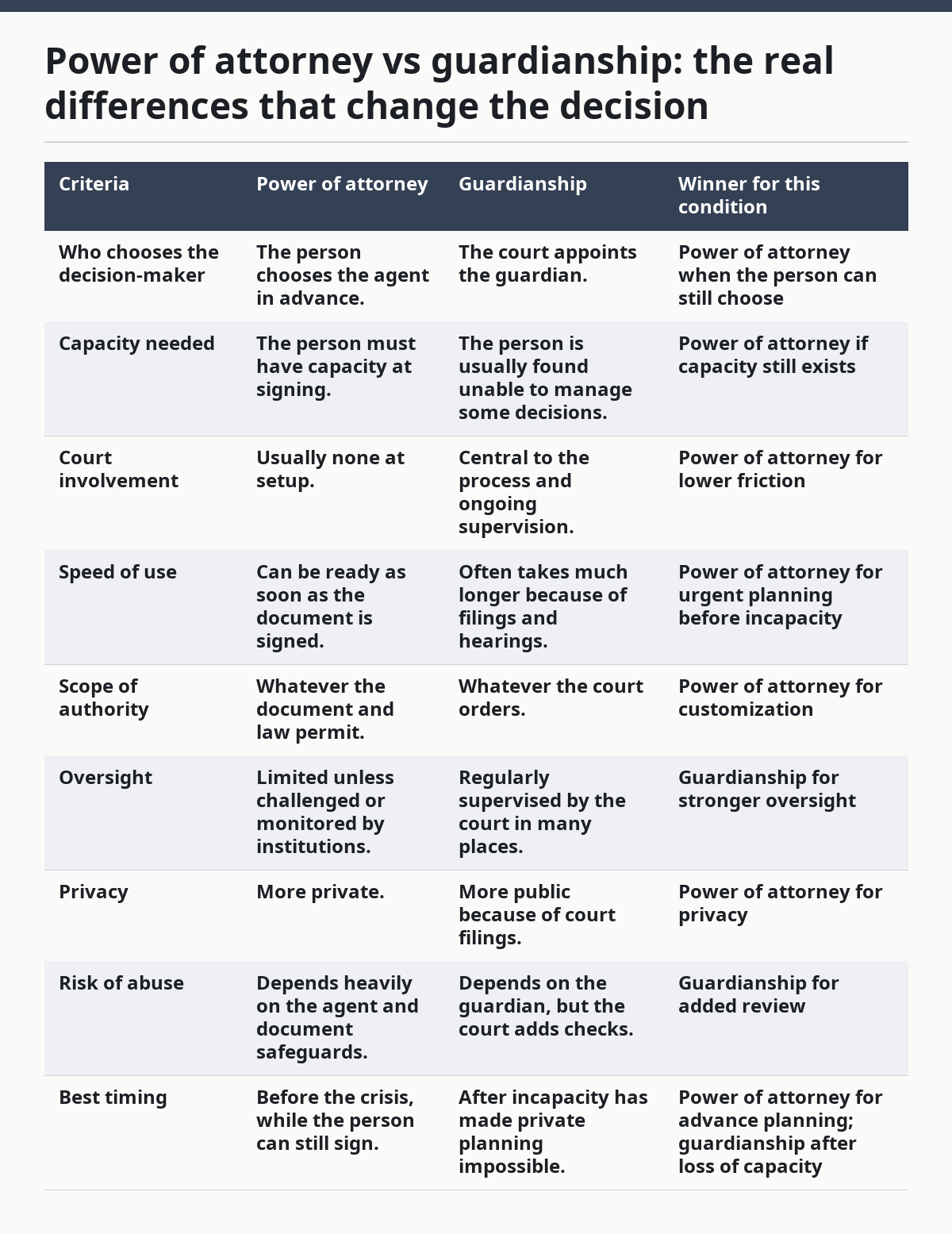
That table hides the biggest practical point: these are not interchangeable. A durable power of attorney is preventive planning. Guardianship is a corrective legal remedy. If a family waits too long, the preventive tool may be gone.
What makes power of attorney attractive to families
Power of attorney wins for families that want the least disruption, because it keeps decision-making inside the family’s chosen structure instead of handing it to a judge. It also works well when the person’s needs are likely to evolve gradually, as with early-stage dementia or a serious but stable diagnosis.
The strongest practical benefit is flexibility. The document can be narrow or broad. It can authorize one child to handle banking while another handles real estate. It can name successors in case the first agent cannot serve. In many settings, that is enough to keep bills paid, property maintained, and insurance paperwork moving without court.
The downside is that the whole system depends on the document being valid and accepted. Institutions may be cautious. Some will want the original or a certified copy; some will review the exact language; some may reject an outdated form. Those delays are not the same as a court contest, but they can still slow caregiving in the middle of a crisis.
A durable power of attorney is also not a blank check. The agent owes duties under the applicable law, but that does not stop every misuse. Families should treat it as a serious fiduciary role, not a convenience form. An estate planning attorney can help, because a badly drafted document is often worse than no document at all.
This option is not for caregivers who are already trying to act after incapacity has clearly begun. It is also not enough if the person needs a decision that only a court can authorize under local law.
When guardianship is unavoidable
Guardianship wins when there is no valid authority left to use and the person cannot now create one. That includes situations where the person never signed a durable power of attorney, signed one too late, or signed one that is not accepted for the specific decision at issue.
The legal process generally asks the court to determine incapacity and then appoint a suitable person. In many jurisdictions, the court can limit the appointment to certain decisions rather than taking away every right. That limited approach matters. A person might need help managing money but still be able to decide where to live or what social contact they want.
The honest drawback is the loss of autonomy. Once the court is involved, the person’s preferences matter, but they are filtered through the court order. Families sometimes expect guardianship to be a fast handoff of control. It is not. It is a formal legal process with notice, evidence, and oversight, and that is one reason it exists.
Guardianship is also a poor substitute for planning. It can repair a missing authority gap, but it cannot recreate the control a person would have had if they had set things up earlier. For many families, that is the painful lesson.
If a person is still able to understand the choice, the better move is often to get the right planning document in place now, not later. If capacity is already gone, the family is in a different legal world, and the question becomes how to protect the person through the court system.
What a caregiver should do first
The first move is to find out whether the person still has capacity for the document or decision at issue. That is the hinge point, because capacity is task-specific and may vary by the type of decision. A person may be able to understand a simple authority document even if they cannot manage complex finances, but only local legal standards and a lawyer can sort that out for the specific situation.
Next, check whether a durable power of attorney already exists and what it actually covers. Assuming there is a POA somewhere does not solve everything. The document may name the wrong powers, the wrong agent, or no successor. It may also need to be paired with other planning documents, depending on the family’s goals and the jurisdiction.
If there is no usable document, guardianship may be the path left. If there is time, an estate planning attorney can help assess whether the family still has a valid planning window or has already crossed into court territory. That is the point at which the caregiver stops guessing and starts documenting.
For a broader planning map, this is the right place to connect upward to the site’s caregiver legal and financial planning hub, because this decision often sits beside bills, benefits, and long-term care choices.
The verdict: which one should caregivers choose?
Choose power of attorney if the person still has legal capacity and can voluntarily appoint an agent now. Choose guardianship if the person lacks capacity, no valid durable power of attorney exists, or the existing authority cannot legally cover the needed decisions. Neither if the family is guessing about capacity; get a qualified lawyer involved before acting.
That is the clearest rule of thumb across jurisdictions that use these concepts. It is not perfect, but it is the one most likely to keep a family from spending months in the wrong process.
When the choice flips
The overall answer changes in a few situations. First, if a person has already lost capacity, power of attorney is usually off the table and guardianship becomes the realistic route. Second, if the person still has capacity but wants to preserve control and privacy, guardianship is the wrong starting point because the court process is more intrusive than necessary.
Third, if a family needs authority over only one narrow issue and the local law allows a limited appointment, guardianship may be narrower than the family fears. Fourth, if there is evidence of financial abuse or serious conflict, guardianship may be preferred because the court can supervise the decision-maker more closely than a private agent arrangement.
The right answer is not the one that sounds most protective in the abstract. It is the one the law actually permits for the person’s current capacity and the decision that needs to be made.
Is power of attorney better than guardianship?
Power of attorney is better when the person still has capacity and can choose an agent voluntarily. It is usually faster, more private, and less disruptive than going to court. Guardianship is not “better” in that setting because it is more intrusive and usually unnecessary.
When is guardianship necessary?
Guardianship is necessary when the person cannot legally make or maintain the authority decision themselves and no valid power of attorney can fill the gap. That usually means there is no usable prior document or the document does not cover the needed area.
Drafted with AI; not yet reviewed by a person.