
How to Set Expectations With the Person Receiving Care

Last updated: November 18, 2026
Set the expectations in a care expectations conversation before the routine hardens into resentment. The goal is simple: name what help will happen, when it will happen, what stays private, and what choices the care recipient still gets to make. This article focuses on how to set expectations with the person receiving care, so the plan is practical from the start. A quick answer: one short written care agreement, reviewed every 2 to 4 weeks when care is changing, is often enough to keep expectations clear.
Key takeaways
- Start with the daily realities, not a speech about “needs” and “roles.”
- Put the biggest decisions on the table first: bathing, meals, medication prompts, errands, and privacy.
- A short written care agreement helps prevent “I thought you meant…” arguments later.
- The person receiving care should know what is fixed, what is flexible, and who gets the final say on each item.
- If the conversation turns into a fight, narrow it to one routine at a time instead of trying to solve everything in one sitting.
What should be agreed on first?

The first things to agree on are the tasks that affect dignity, safety, and the day’s rhythm. That usually means wake-up time, meals, medication reminders, bathing, toileting help, sleep schedule, and when a home health aide or family caregiver will be present.
Start with the most concrete items because abstract promises fail under pressure. “I’ll help when you need it” sounds kind, but it leaves too much room for mismatch. “I’ll arrive at 8:30 a.m. on weekdays, and breakfast will be at 9:00” gives the care recipient something real to expect.
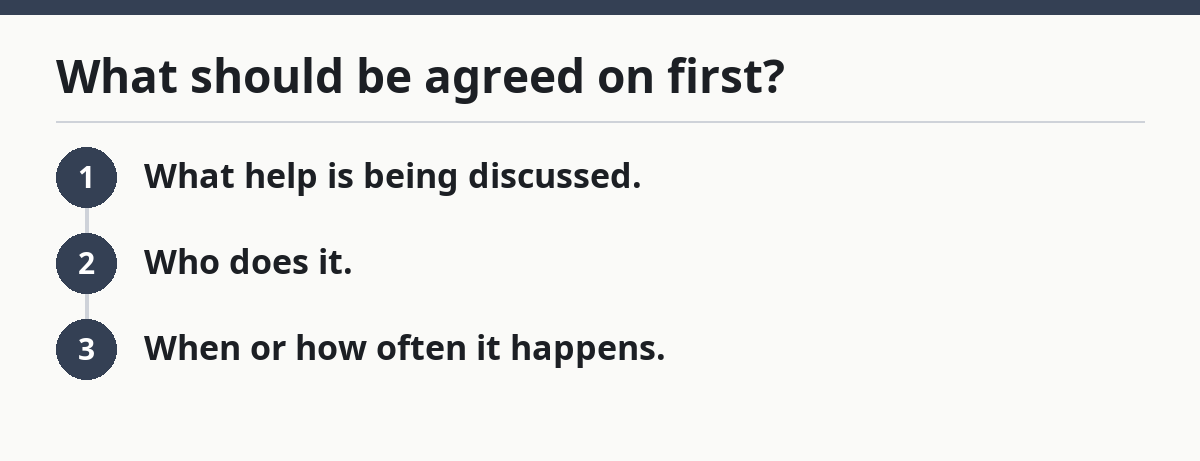
Use a simple three-column list on paper or in a notes app:
- What help is being discussed.
- Who does it.
- When or how often it happens.
A good first conversation covers one day, not the whole future. If you can map out a typical Monday from wake-up to bedtime, the rest is easier to adjust. If the care recipient needs a lot of reassurance, keep the first meeting under 30 to 45 minutes. Longer than that, and people start agreeing just to end the talk.
The result you want is not perfect agreement on every detail. It is a shared picture of what the next 24 hours will look like. If both of you can repeat the same schedule back without correcting each other twice, the conversation worked.
How do I start the care expectations conversation?
You start by naming the topic plainly and asking for a calm 15-minute talk. Say “I want to go over a care expectations conversation so we both know what to expect each day,” then narrow it to one practical setting, like the kitchen table after breakfast or before a home health aide shift change.
Choose a time when nobody is tired, rushed, hungry, or in pain. That matters more than having the “perfect” wording. A conversation at 10 a.m. usually goes better than one at 9 p.m. when everyone is drained. If the care recipient is more alert after lunch, use that window instead.
Use a sentence that signals partnership rather than control:
- “I want to make sure help feels predictable.”
- “I want to hear what feels okay and what does not.”
- “I want us to agree on the day-to-day so there are fewer surprises.”
Then set the frame in one minute. Cover these four points:
- What help is being offered.
- What the care recipient can still choose.
- What needs to happen every day.
- What will be written down.
A care agreement can be as simple as one page. It does not need legal language to be useful. If a written note feels too formal, a shared checklist on the refrigerator or in a phone note can still reduce confusion.
The conversation is working if the care recipient stops guessing what will happen next and starts responding to specific choices: “Tuesdays are okay for the shower,” or “I want to choose my own clothes in the morning.” That kind of response means the talk has moved from vague worry to real planning.
Which house rules need to be said out loud?

House rules need to be said out loud when they affect privacy, access, noise, visitors, and shared spaces. Silent assumptions are where most friction starts.
Name the rules that matter in the home, even if they feel awkward to say. For example:
- Knock before entering a bedroom or bathroom.
- Ask before moving personal items.
- Keep certain drawers, documents, or devices off-limits.
- No medication changes without checking first.
- Quiet hours start at 10:00 p.m., or whatever time fits the household.
- Visitors should call before coming over.
If the care recipient lives in the same home as the caregiver, the line between “shared space” and “personal space” gets blurry fast. A clear rule like “This chair is yours, this desk is mine” sounds small, but it can prevent a dozen tiny arguments. If the boundary feels hard to set, a professional care manager, social worker, or other qualified clinician may be able to help you frame it in a way that fits the situation.
Privacy is a big one. Many people receiving care feel embarrassed about bathing, toileting, dressing, or being talked over in front of others. Say what kind of help will be given and what words or actions preserve dignity. That may mean closing the door, asking before touching personal items, or stepping out while a routine is handled by a home health aide.
The standard to aim for is simple: explain before you act unless there is a safety emergency. If the care recipient knows what will happen in the next 5 minutes, trust goes up. If not, even a helpful action can feel like being managed.
This section is also where you mention what is not okay. If the care recipient does not want decisions made in front of visitors, or does not want medications discussed at the dinner table, say so now. Who this is not for: anyone hoping to “keep the peace” by avoiding every uncomfortable rule. Avoidance usually buys 2 days of calm and 2 weeks of confusion.
How much choice should the care recipient keep?
The care recipient should keep as much choice as safely possible, especially in routines that happen every day. Choice is not a reward; it is part of care.
Separate decisions into three buckets:
- The care recipient decides.
- The caregiver decides.
- The decision is shared.
Examples help:
- The care recipient decides what clothes to wear, which meal to eat, and whether a blanket stays on.
- The caregiver decides timing for safety tasks, like a transfer or medication reminder.
- Shared decisions include shower days, appointment times, and whether to use a walker during short trips.
When you say this aloud, it lowers tension fast because it removes the hidden fight over control. A person who is used to making their own decisions can usually tolerate help better when the limits are clear. A person who feels every small choice is being taken away often resists even necessary support.
Use specific language instead of broad promises. “You can choose your breakfast” is better than “You’ll still have control.” “I need the lights off by 10:30 so I can sleep” is better than “We’ll just make it work.”
If the care recipient has trouble deciding under pressure, give two or three options, not ten. “Tea or coffee?” works better than opening a whole discussion about the morning routine. Fewer choices keep the conversation moving and reduce frustration.
The result you want is visible: the care recipient starts making the choices they still own without needing permission for everything else. That is the difference between supportive care and constant negotiation.
What should go in a daily routine?
A daily routine should spell out the repeatable parts of the day in the order they happen, because repeated tasks are where confusion spreads fastest. Breakfast, pills, bathing, errands, rest, and bedtime all become easier when the pattern is fixed.
Build the routine as a simple numbered plan:
-
Write the wake-up window.
State the earliest and latest time someone will check in, such as 7:00 to 8:00 a.m. If this works, the care recipient knows when the day starts. -
List the first 3 tasks.
Keep it small: bathroom, breakfast, medications, or stretching. If the plan is too long, people stop following it by day 3. -
Set the help level for each task.
Say whether the caregiver will remind, prepare, supervise, or physically assist. A “remind” is not the same as a “do it for you.” -
Place hard stops on the day.
Mark things like lunch at noon, a rest period after 2:00 p.m., or no calls after 9:00 p.m. A routine needs boundaries or it becomes a wish list. -
Add one backup plan.
If a shower is missed, will it move to the evening or the next morning? If the ride falls through, who gets called? A routine without a backup collapses the first time something changes.
A written routine works best when it is short enough to read in under 2 minutes. Long checklists tend to sit in a drawer. If the care recipient can point to the plan and say, “This is what happens next,” the routine is doing its job.
How do I handle pushback without turning it into a fight?
You handle pushback by slowing the conversation down to one issue, one reason, and one next step. Most conflict in caregiving is not about the whole plan; it is about a single rule that feels unfair, rushed, or insulting.
When the care recipient resists, do not answer with a full lecture. Use this sequence instead:
- Repeat the concern in plain language.
- Say why the expectation exists.
- Offer one alternative if there is room for it.
For example: “I hear that you do not want a morning shower. The shower is important because it helps with skin care and the schedule. If mornings are bad, we can move it to after lunch twice a week.” That keeps the conversation anchored to a real routine instead of personalities.
Avoid these common mistakes:
- Changing the subject to gratitude. That costs trust because it sounds like you are dismissing the concern.
- Making every rule nonnegotiable. That costs cooperation because the care recipient feels cornered.
- Explaining for 10 minutes straight. That costs attention and usually makes the other person more defensive.
- Agreeing now and hoping it sticks. That costs clarity because the same issue returns tomorrow.
Use a pause if the tone sharpens. A 20-minute break can prevent a bad conversation from becoming a lasting pattern. If the issue is still stuck after that, write down the exact point of disagreement and return to it later.
This section is not about winning. It is about making the daily plan durable enough that both sides can live with it. If the care recipient can disagree without derailing the whole routine, the expectations are probably specific enough.
When should the care agreement be updated?
The care agreement should be updated whenever the routine changes for more than a day or two, or when the care recipient’s needs shift in a way both people can feel. A new medication, a different sleep pattern, more pain, or a change in mobility are all reasons to revisit it.
Set a regular review point every 2 to 4 weeks if care is changing quickly. If things are steady, a monthly check-in is enough. The point is not to rewrite the plan constantly; it is to keep it truthful.
Use updates for concrete changes only:
- A different wake-up time.
- A new person helping on certain days.
- New privacy concerns.
- A revised decision-making rule.
- A changed meal or bathing schedule.
If the care recipient starts saying “That is not what we agreed to,” the problem may be the agreement, not the person. A good plan should survive a real week, not just a hopeful first day.
Link the written note to the bigger caregiving picture by tying it back to the day-to-day work described in the guide to what a caregiver does day to day. This keeps the expectations conversation from floating apart from the real tasks.
The best sign that the agreement is current is that both people can go through the routine without having to re-explain the same steps every time. If the plan saves repeating yourself, it is doing its job.
How do I talk about what help I can give?
Say what you can do in concrete terms, then name the limit. “I can help with breakfast and the 8:00 a.m. medications, but I cannot stay past 9:30 on weekdays” is clearer than a vague promise. That kind of answer gives the care recipient something real to plan around and reduces last-minute disappointment.
What expectations should be discussed at the start?
The first expectations should cover daily routines, privacy, house rules, and who decides what. Start with the basics: wake-up time, meals, bathing, medication reminders, and visitors. A 1-page care agreement works better than a long discussion because it keeps the conversation tied to actual daily life.
How do I handle disagreements about care routines?
Handle disagreements by separating the routine from the emotion and addressing one issue at a time. State the concern, explain the reason, and offer one adjustment if possible. If the same disagreement keeps returning, revise the routine in writing so the next 7 days are clearer than the last 7.
Drafted with AI; not yet reviewed by a person.