
Last updated: November 18, 2026
Key Takeaways
- Safety boundaries for caregivers mean knowing when a second person, transfer aid, or licensed professional is needed.
- A caregiver should not do medical tasks alone when judgment, sterile technique, or dosing decisions are involved.
- Finances should not be managed solo when confusion, conflict, or large accounts could create risk.
- Unsafe driving should not be done alone, and sometimes it should be avoided entirely.
A caregiver should not do alone any task that can injure the care recipient, injure the caregiver, or create a legal or financial mistake that is hard to undo. In this article, “What tasks a caregiver should not do alone” means the jobs that need another person, a device, or a licensed professional. That usually means heavy transfers, medical tasks that need a licensed professional, unsafe driving, and handling money without clear safeguards.
The fast rule for caregiver safety boundaries
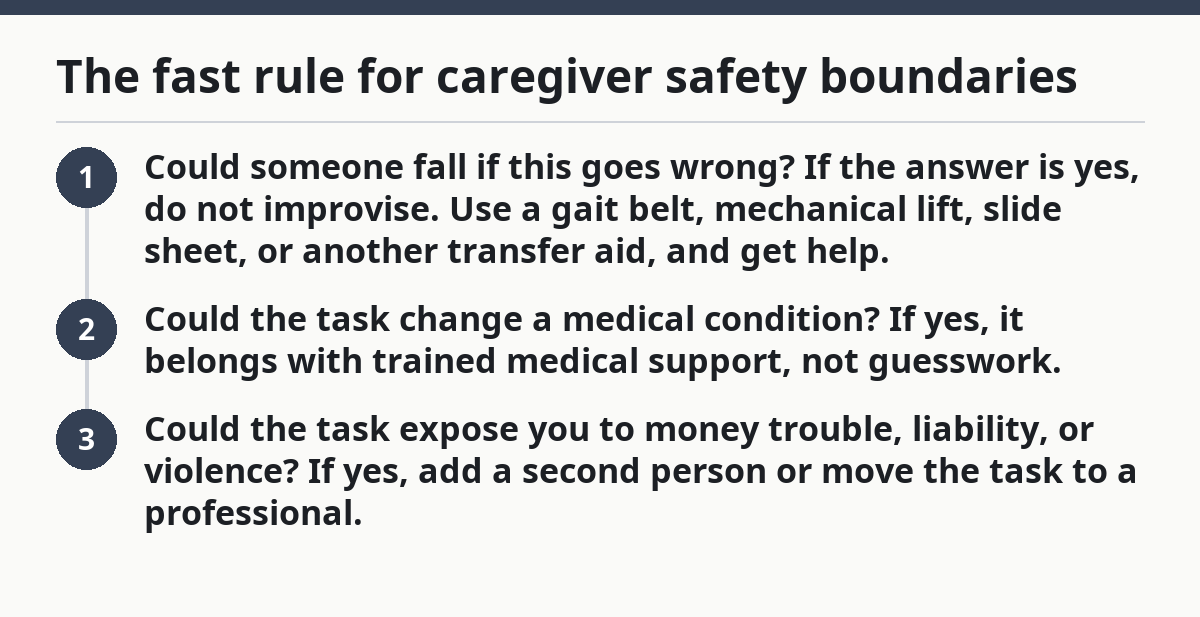
The fast rule for caregiver safety boundaries is this: if the task could cause a fall, a medication error, a financial loss, or a physical injury, do not do it solo. Caregiver safety boundaries are not about being cautious for the sake of it; they are about knowing which jobs need a second person, a transfer aid, or a licensed professional.
A useful shortcut is to ask three questions before starting any task:
- Could someone fall if this goes wrong? If the answer is yes, do not improvise. Use a gait belt, mechanical lift, slide sheet, or another transfer aid, and get help.
- Could the task change a medical condition? If yes, it belongs with trained medical support, not guesswork.
- Could the task expose you to money trouble, liability, or violence? If yes, add a second person or move the task to a professional.
This matters most when the care recipient is weak, confused, unstable on their feet, or resistant to help. A 20-pound lift can be manageable on paper and dangerous in a hallway, on stairs, or in a bathroom where there is no room to shift stance. A single bad turn can strain a back, drop a person, or tear a shoulder.
I would not treat “I can probably manage it” as a plan; if the situation is unclear, a caregiver should consult a nurse, therapist, or other licensed professional. That is the safer approach recommended in fall-prevention guidance from the National Institute on Aging and the CDC. It is a guess. A better plan is to match the task to the risk level and call for help before strain, panic, or anger takes over.
What tasks a caregiver should not do alone?
A caregiver should not do alone any transfer, move, or physical task that puts the care recipient’s full weight on one person or requires lifting from the floor, tub, toilet, bed edge, or car seat. That includes pivot transfers, stair assists, shower assists, and any move where the care recipient cannot bear weight reliably.
The problem is not only strength. It is timing. One person cannot control balance, reposition a trunk, and protect both knees and shoulders at the same time if the care recipient suddenly slips or stiffens. Even a well-meant grab can twist a spine or drag an arm out of position.
A practical way to decide is this:
- If the care recipient needs more than a light steadying touch, get a second person.
- If the person cannot stand for 30 seconds without swaying, use a transfer aid or trained help.
- If the move happens on stairs, in a bathtub, or across a slick floor, do not do it alone.
- If the person is larger than the caregiver can reposition without straining, do not test it “just this once.”
The cost of getting this wrong is immediate: a fall, a back injury, a wrist injury, or a fear of future help that makes both people more tense next time. The fix is not heroic lifting. It is planning for mechanical support, a wider transfer space, or a licensed professional such as a physical therapist or occupational therapist who can teach safer methods.
The National Institute on Aging has plain-language guidance on falls and safe movement for older adults, and the CDC’s fall prevention resources are useful when a transfer starts to look like a fall risk rather than a routine assist. I would use those sources as a checkpoint, not as a substitute for hands-on training.
Which medical tasks should never be done solo?
A caregiver should not do alone any medical task that requires clinical judgment, sterile technique, or dose decisions the caregiver is not licensed to make. That includes changing complex wound dressings, handling injections without training, managing oxygen equipment without instruction, and making medication changes based on guesswork.
The line is not “medicine is scary.” The line is “medicine has consequences.” A missed dose, the wrong route, or a contaminated dressing can turn into an emergency that was avoidable. If the care recipient has a feeding tube, catheter, ostomy, IV line, or wound that is deep, draining, infected, or reopening, the task needs clear training from a licensed professional before anyone tries it alone.
A careful caregiver should pause when a task involves any of these:
- A prescription label that is unclear or has changed recently
- A medication that looks different from the last fill
- Blood sugar, blood pressure, or oxygen numbers that are outside the care plan
- A wound that is redder, warmer, more swollen, or smelling different
- Any equipment the caregiver cannot name, set up, or clean correctly
The right move is to ask for demonstration, written instructions, and a return demonstration from a nurse, pharmacist, or other licensed professional. “I think I remember” is not enough for insulin, anticoagulants, tube feeding, or any device that can injure the care recipient in minutes.
This is also where a caregiver should refuse to bluff. A task that is slightly uncomfortable to ask about is still safer than a task done wrong. The trade-off is time: getting proper instruction can take a visit, a call, or a wait. The benefit is fewer emergencies later. For medication safety, authoritative guidance from the U.S. Food and Drug Administration on medicines and the MedlinePlus medication pages are more reliable than internet forums. See also our medication safety page and wound care basics.
Should a caregiver handle finances alone?
No, a caregiver should not handle finances alone when there is any chance of confusion, family conflict, or access to large accounts. Money is one of the fastest ways caregiving goes wrong because a small shortcut can look harmless and then become a legal problem.
This does not mean a caregiver can never help pay a bill or sort mail. It means the work needs guardrails. A caregiver should not be the only person who sees bank statements, cash, checkbooks, debit cards, PINs, insurance forms, or online account passwords if the care recipient can still participate or if another trusted person can audit the records.
Good safeguards are concrete:
- Keep a written list of bills, due dates, and payment methods in one folder.
- Use separate receipt storage for fuel, pharmacy, and medical purchases.
- Have a second person review any one-time transfer, large withdrawal, or account change.
- Avoid mixing the caregiver’s money with the care recipient’s money.
- Do not sign documents the caregiver does not understand.
The risk is not only theft. It is accidental self-dealing, missed payments, duplicate payments, and bad recordkeeping that makes later review impossible. If the care recipient has dementia, delirium, or fluctuating decision-making, financial tasks should move toward a licensed professional such as an attorney, accountant, or fiduciary who understands the relevant legal standard in that state. For broader planning, see elder law basics and power of attorney.
A common mistake is treating the caregiver role as permission to improvise; if the records are unclear or the person’s capacity fluctuates, consult a professional. That can cost more than money: it can strain family trust and create accusations that are hard to prove or disprove. The safer choice is transparency, one record system, and a second set of eyes.
Unsafe driving is not a one-person job
Unsafe driving should not be done alone, and in some cases it should not be done at all. If the caregiver is tired, distracted, emotionally upset, unfamiliar with the route, or responsible for a care recipient who may wander, panic, or need urgent help, the driving plan needs to change.
The danger comes from two directions. The driver may be unsafe, and the care recipient may become unsafe inside the vehicle. A person with dementia may unbuckle a seat belt, open a door at the wrong time, or resist getting in and out of the car. A caregiver who tries to manage that while also navigating traffic is split between the road and the passenger.
A safer approach is to decide before the trip whether the ride needs:
- A second adult in the car
- A wheelchair-accessible vehicle
- Door-to-door medical transport
- A delay until a licensed professional has cleared travel after an illness or procedure
A caregiver should also avoid driving alone when the care recipient needs a transfer from wheelchair to seat and back again without help. That move can be awkward even in a driveway. In a parking lot or on a curb, it becomes more hazardous.
If the issue is vision, medications, alcohol, sleep loss, or a recent medical event, the caregiver should not treat “I can make it” as adequate; consult a clinician or DMV medical review guidance when driving safety is unclear. Driving is not just transportation; it is a safety system. When that system is unstable, the right move is to share the load or hand the task off.
The AARP Driver Safety resources and state DMV medical review pages are useful starting points when a caregiver is not sure whether driving has crossed into unsafe territory. If transportation is changing often, compare medical transport options before the next trip.
When personal protection means stopping and getting help
A caregiver should not stay alone in any task where personal safety is threatened by aggression, threats, or loss of control. That includes physical striking, sexual boundary violations, repeated verbal abuse escalating into intimidation, and situations where the care recipient is too agitated or confused to accept care without force.
This is a safety issue, not a patience issue. A caregiver who is being grabbed, cornered, shoved, or threatened is already past routine caregiving. The next step is to leave the room if possible, call for backup, and contact emergency services when there is immediate danger. If the care recipient has delirium, dementia, psychosis, intoxication, or a sudden change in behavior, a licensed professional needs to assess what is driving the behavior.
A useful threshold is simple: if the caregiver would not ask a stranger to enter the room alone, do not stay alone in the room either. If the care recipient is larger, stronger, or more agitated than the caregiver can safely manage, the answer is not to “try harder.” It is to get a second person, call a crisis line or clinician, or step out and wait for help.
This category also covers tasks that feel routine but become risky because of emotional escalation. Bathing, toileting, dressing, and moving a person after midnight can all turn volatile when pain, confusion, or embarrassment is high. A caregiver who notices clenched fists, shouting, pacing, or repeated refusal should not push through alone.
The trade-off here is obvious: pausing can delay care. But the cost of ignoring danger can be a fall, injury, or police involvement. Personal protection is part of caregiver safety boundaries, not an optional extra. For urgent situations, see caregiver crisis steps.
A practical 5-step check before you do the task
A caregiver should use a 5-step check before starting any high-risk task so the decision is based on risk, not urgency. The check takes about 2 minutes and can prevent a bad transfer, a medication error, or a money mistake.
- Name the task out loud. Say, “This is a bed-to-chair transfer,” or “This is a medication refill,” so the risk is specific, not vague.
- Look for a second person need. If the task involves full body weight, a stair, a tub, a vehicle, or a confused care recipient, stop and get help.
- Check for a tool. A gait belt, slide sheet, walker, wheelchair brake, or transfer aid may change the task from unsafe to manageable.
- Check for a professional boundary. If the task changes a dose, opens a wound, changes a route, or needs legal authority, it belongs with a licensed professional.
- Decide the fallback now. If the task cannot be done safely, call, reschedule, or hand it off before anyone starts moving.
The common mistake is waiting until halfway through the task to realize it is too much. By then, the caregiver is already bent, the care recipient is already unstable, and the safest choice has become harder. A quick pre-check keeps the decision clean.
This page connects with the larger picture of what a caregiver does day to day, but the point here is narrower: not every caregiving task belongs in one pair of hands. Some jobs need a second adult, better equipment, or a licensed professional from the start. For a broader overview, see caregiver duties and home safety.
What a caregiver should refuse to do alone
A caregiver should refuse any task that would be unsafe even if it feels “urgent” or “temporary.” That includes lifting a person from the floor, handling a hard-to-control behavior episode, changing complex medical equipment without training, managing money without oversight, and driving when alertness or safety is in doubt.
The refusal should be calm and specific. The caregiver does not need a long explanation. “I can’t safely move you alone” is enough. “I need another person for this transfer” is enough. “I need a nurse to show me that wound step first” is enough.
A few tasks are especially poor candidates for solo work:
- Floor lifts after a fall. These often need trained technique and a transfer aid.
- Bath transfers. Wet surfaces and awkward angles raise the risk sharply.
- New or changed medical tasks. New equipment and new dosing are where errors happen.
- Cash handling under pressure. Speed and secrecy are a bad combination.
- Driving with distress or confusion in the car. The road is not the place to troubleshoot.
The hardest part is often not the task itself. It is the feeling that refusing means failing. It does not. Refusing a solo unsafe task is part of competent caregiving. It protects the care recipient, the caregiver, and everyone else around them.
What caregiving tasks are unsafe without training?
Tasks that involve lifting, medication changes, wound care, feeding tubes, catheters, oxygen, and post-fall recovery are unsafe without training. The risk is not only doing the task wrong; it is not knowing when the task has crossed into an emergency. If training has not happened, a licensed professional should teach it before the caregiver tries it alone.
When should a caregiver ask for professional help?
A caregiver should ask for professional help when the task involves a fall risk, a change in medical condition, a device the caregiver does not understand, or behavior that feels unsafe. Help should also be sought when the caregiver’s body is strained, the care recipient is too heavy to move safely, or the situation keeps recurring. A nurse, therapist, or other licensed professional can often make the next step clear.
What should a caregiver refuse to do?
A caregiver should refuse to do alone anything that risks a fall, a medication error, a financial mistake, or physical harm. That includes solo lifts, dangerous medication tasks, unsupervised money handling, and driving that feels unsafe.
Drafted with AI; not yet reviewed by a person.