
Last updated: November 18, 2026
Quick answer: A workable care team usually starts with 5 roles: a primary care doctor, one or more specialists, a home health aide if needed, a care manager, and a family caregiver. For how to build a care team and know who does what, the goal is to assign one primary contact and one backup for each major responsibility so care does not depend on one person alone.
A care team works best when one person knows who is on it, who leads it, and who handles each task. Start by naming the primary care doctor, the specialist, the home health aide, the care manager, and the family caregiver, then assign one primary contact and one backup for each major responsibility.
Build the care team around the person who needs care
A care team starts with the person’s needs, not the titles of the people involved. The right team might be 3 people or 8 people, but each person should have a clear role tied to a specific need such as medical decisions, daily help, transportation, or symptom changes.
Begin by writing down the 4 areas most people need covered: medical care, daily care, coordination, and family support. Then list the people already involved. In many homes, that list includes a primary care doctor, one or more specialists, a home health aide if the person qualifies for one, a care manager, and a family caregiver. If the person has complex needs, a pharmacist, therapist, social worker, or wound nurse may also belong on the team.
A useful care team is not a crowd. It is a small, named group with separate jobs. If two people are doing the same task, one will assume the other has it. If nobody owns a task, it gets missed. That is why the first job is to map the team before you start dividing duties.
What to do first
- Write the person’s main needs on one page, using plain words such as “diabetes,” “dressing changes,” “rides,” or “meals.” The needs should be short enough to sort into 4 buckets without guessing.
- List everyone already helping, including the primary care doctor, any specialist, the home health aide, the care manager, and the family caregiver. Then the list shows who is already in the loop.
- Mark the person who sees the whole picture, even if that person is not the most medically trained. If there is one person who can do that, put one name beside “main coordinator.”
- Note which tasks are medical and which are daily support. Then you can see which roles overlap and which do not.
- Name one backup for each essential role. As a result, a sick day or vacation does not break the plan.
A care team that starts this way is easier to manage than one built around whoever happens to answer the phone first.
Who does what on a care team?

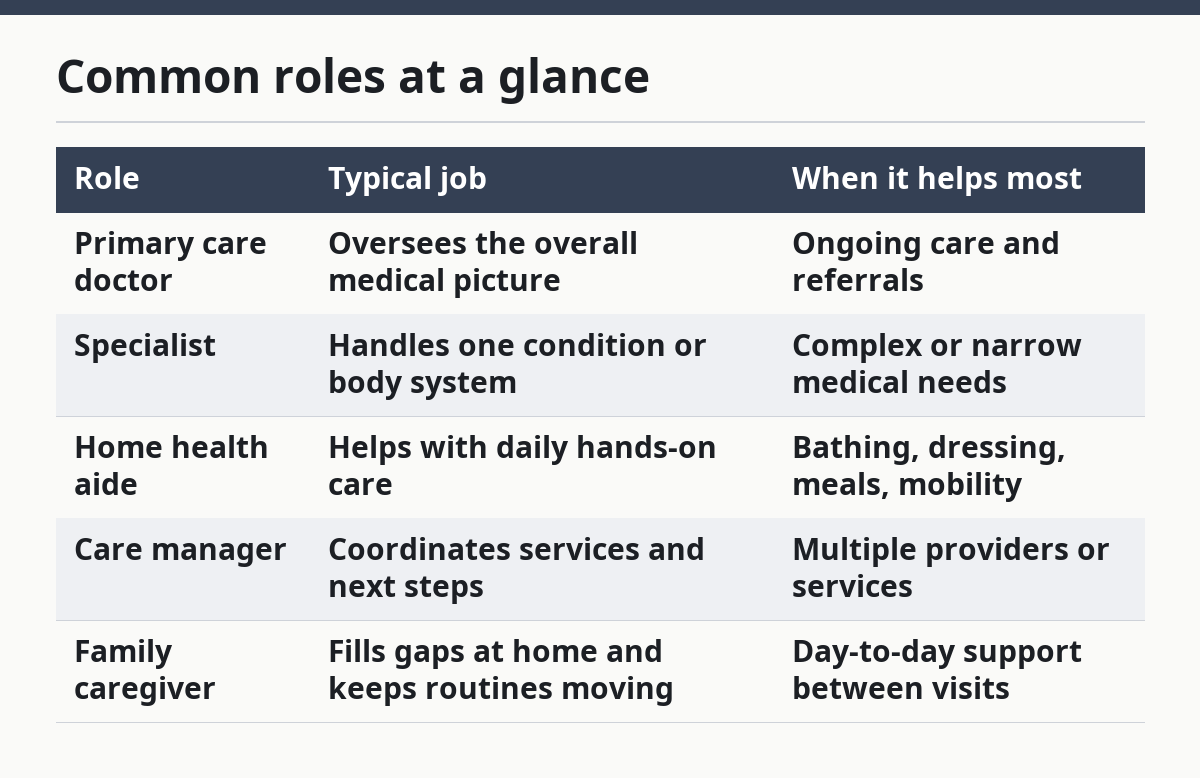
Each person on a care team should own a different kind of work, and the role should be simple enough to explain in one sentence. The primary care doctor usually oversees the overall medical picture, the specialist focuses on one body system or condition, the home health aide helps with hands-on daily care, the care manager organizes the bigger plan, and the family caregiver fills gaps at home.
The primary care doctor can be a strong anchor for the medical plan because that doctor often sees the full history and can help connect the pieces. A specialist should own decisions inside one narrow area, such as cardiology, neurology, or oncology. The specialist is not usually the person to coordinate everything else, and that is where confusion starts.
The home health aide is not there to make medical decisions. That role usually covers bathing, dressing, moving safely, meals, and other daily tasks allowed by the care plan. The care manager is the person who helps organize services, clarify next steps, and reduce gaps between providers. The family caregiver often fills the space between visits and appointments, but that role needs limits or it turns into an invisible full-time job.
A useful division of labor looks like this: one person makes the medical plan, one person handles condition-specific care, one person manages daily support, one person coordinates, and one person keeps the home routine moving. If a role cannot be named in one sentence, it is too vague to work well.
Common roles at a glance
| Role | Typical job | When it helps most |
|---|---|---|
| Primary care doctor | Oversees the overall medical picture | Ongoing care and referrals |
| Specialist | Handles one condition or body system | Complex or narrow medical needs |
| Home health aide | Helps with daily hands-on care | Bathing, dressing, meals, mobility |
| Care manager | Coordinates services and next steps | Multiple providers or services |
| Family caregiver | Fills gaps at home and keeps routines moving | Day-to-day support between visits |
How do I decide who coordinates medical care?
The best medical coordinator is usually the person who can follow the whole plan, communicate with the doctor, and notice when something changes, not necessarily the person with the most medical knowledge. For many families, that is the primary care doctor for clinical oversight and a care manager or family caregiver for day-to-day coordination.
To decide, look at three things: who knows the most about the conditions, who has the most contact with the person, and who can respond quickly when symptoms change. In a simple situation, the primary care doctor may be the lead medical contact and the family caregiver handles logistics. In a complex situation, a care manager may become the point person because that role is built for coordination across services.
This step matters because “everyone coordinates” usually means no one coordinates. Medical coordination needs a single name even when several people contribute. The coordinator does not have to do every task. The coordinator makes sure tasks are assigned, priorities are clear, and changes reach the right people.
A good test is this: if the person needs a medication change, who hears about it first, who tells the specialist if needed, and who checks that the change happened? If you cannot answer that in 30 seconds, the care team is not organized enough yet.
The coordinator is not always the oldest child, the spouse, or the person who lives nearest. Those can be good choices, but only if they can keep up for months, not just during a crisis. A coordinator who is overwhelmed will miss handoffs, and handoffs are where care often breaks.
Divide responsibilities so nobody duplicates or drops tasks

The cleanest way to divide responsibilities is to assign one owner per task and one backup per task, then write the handoff point next to each one. That keeps the care team from doubling up on the easy jobs and skipping the hard ones.
Start with the tasks that happen every week: medication pickup, bathing help, meal prep, rides, supply refills, symptom check-ins, and appointment follow-through. Then decide which role owns each one. A home health aide may own bathing and mobility support during scheduled visits. A family caregiver may own evenings, weekends, or meal planning. A care manager may own service referrals and cross-checking the plan. The primary care doctor and specialist own medical decisions in their respective areas.
Use a simple rule: if a task requires clinical judgment, it belongs with the doctor or nurse; if it requires repeated household support, it belongs with the home caregiver side of the team; if it requires linking services, it belongs with the care manager. That rule is not perfect, but it keeps the team from pushing everything toward the family caregiver by default.
The handoff is where the assignment becomes real. For example, the specialist orders a change, the family caregiver hears the instruction, the care manager confirms the service plan, and the home health aide adjusts the daily routine. Once that change is set, the person’s day-to-day care can follow it without a long delay.
A common mistake is giving two people the same responsibility “just in case.” That sounds safe, but it often creates confusion about who acted first, who followed up, and who is still waiting. A better backup plan is to name one owner and one backup, then say when the backup steps in.
Keep family coordination simple enough to use every day
Family coordination works when the team uses the same role names and the same chain of responsibility every time, not when everyone tries to stay “loosely informed.” The goal is not perfect harmony; it is fewer missed steps.
Family members usually want to help in one of four ways: hands-on care, errands, emotional support, or money management. Those are different jobs. If every family member tries to do all four, the plan gets noisy. If each person takes one lane, the person receiving care gets steadier help and less second-guessing.
A practical family setup is to choose one family caregiver as the day-to-day lead, even if several relatives help. That person does not carry the whole burden. That person just keeps the home side of the plan from splintering. Other relatives can take specific jobs such as rides on Tuesdays, dinner twice a week, or weekend respite. When this works, the main caregiver stops being the only person who knows what is going on.
Set one 15-minute check-in each week if the situation is active. That is enough time to name changes, new needs, and upcoming handoffs without turning every update into a long meeting. If the care team needs a family conference for a bigger decision, schedule it separately. Short weekly check-ins work better than emergency-style conversations that happen only after something goes wrong.
The hard truth is that some families are not suited to shared coordination. If one person ignores the plan, overrides decisions, or creates conflict around every change, the care team should narrow who gets decision-making power. That is not punishment. It is a way to protect the person receiving care from constant friction.
Watch for handoff problems before they become care gaps
Handoff problems show up when a task changes hands but nobody confirms the next step. They are common between appointments, after hospital discharge, when a home health aide starts or stops, and when a specialist changes the plan.
The warning signs are plain: two people think someone else ordered supplies, nobody knows which doctor approved the change, or the family caregiver is hearing different instructions from different people. When this happens, the problem is usually not effort. It is role confusion.
The fix is to slow the handoff down until three facts are clear: who decided, who carries it out, and who confirms completion. That can be written in one sentence. For example: “The specialist decides, the family caregiver relays, and the care manager confirms the service change.” If a handoff cannot be summarized that neatly, it is not ready.
Another common failure is role creep. A home health aide may start covering tasks outside the care plan. A family caregiver may take on clinical judgment out of necessity. A care manager may be asked to do household errands. These workarounds can help in a pinch, but they should not become the default. Over time, role creep burns people out and blurs accountability.
Therefore, revisit responsibilities every time the person’s condition changes. A new medication, a fall, a hospital stay, or a new diagnosis often means the care team needs a different split. In a stable situation, review the roles every 3 to 6 months. In a changing one, review them sooner.
For more formal guidance on care roles and coordination, the National Institute on Aging and the Family Caregiver Alliance both publish useful material on caregiving roles and support planning. See the National Institute on Aging’s caregiving resources and the Family Caregiver Alliance’s Caregiver.org guidance for practical checklists.
A simple care team map you can finish in 30 minutes
A one-page care team map is enough to make the roles visible and prevent a lot of confusion. The page should list the people, their jobs, the main contact for each area, and the backup if that person is unavailable.
Use four columns: name, role, main responsibility, and backup. Under role, write plain terms such as primary care doctor, specialist, home health aide, care manager, or family caregiver. Under main responsibility, write the exact job, such as “med changes,” “daily bathing help,” or “service coordination.” Under backup, write the person who steps in if the main contact is out for a day or two.
Keep the map short enough to read in under 2 minutes. If it grows to a full packet, it stops being useful in a real moment. This is not the place for a long history or a detailed care plan. It is the place for a clean map of who does what.
The map should be updated whenever one of three things changes: the person’s health, the people involved, or the services being used. That may sound basic, but many families keep using an outdated version for months. Then one person moves away, a home health aide leaves, or a specialist takes over a new part of care, and the old roles no longer fit.
A care team is strongest when the roles are boringly clear. The right names, one clear coordinator, and a simple handoff plan will do more than a big list of helpers with no jobs attached.
Key takeaways
- A care team works best when each person has one clear lane, not a vague sense of “helping out.”
- The primary care doctor, specialist, home health aide, care manager, and family caregiver usually cover different parts of the plan.
- One person should coordinate the overall picture, even if others handle specific tasks.
- Handoffs need a named sender, receiver, and confirmer or the plan falls apart.
- A one-page role map is often enough to make the team usable day to day.
Who should be on a care team?
The care team should include the people who cover medical decisions, daily support, coordination, and family backup. In many cases, that means a primary care doctor, one or more specialists, a home health aide if needed, a care manager, and a family caregiver. The exact mix depends on the person’s condition and how much help is needed at home.
How do I decide who coordinates medical care?
The best coordinator is the person who can keep the full picture together and respond when things change. For many families, that is a care manager for logistics and a primary care doctor for medical oversight, with one family caregiver acting as the day-to-day point person. The right choice depends on complexity, availability, and who can follow through consistently.
How do I keep everyone informed?
Keep everyone informed by giving each person a defined role and one main contact point. A short weekly check-in and a one-page role map are usually enough for routine changes. If the situation becomes medically complex, ask the care team to clarify who receives updates first so the same information does not get passed around in circles.
Drafted with AI; not yet reviewed by a person.