
Last updated: November 18, 2026
When family caregiving is not the right fit, a caregiving fit assessment helps decide that before anyone commits to a role that needs 24/7 judgment, lifting, driving, medication tracking, or emotional steadiness. Quick Answer: if 2 or more of the core fit areas are poor fit, direct caregiving is usually not the right role. This article on When family caregiving is not the right fit — how to decide shows how to compare the care plan against your real life.
Key takeaways
- A family caregiver should say yes only when time, distance, physical ability, and emotional capacity line up with the care plan.
- A fit assessment is not about love or loyalty; it is about whether the role can be done safely and consistently.
- If the care recipient needs hands-on help, memory support, or frequent supervision, the gap between need and capacity matters more than good intentions.
- Some people are better suited to coordinate the care team than to provide direct hands-on care.
- Saying no to a direct caregiving role can protect both the care recipient and the family relationship.
Start with the fit question, not the guilt question

A caregiving fit assessment starts with one blunt question: can I do this specific job, at the level the care recipient actually needs, for the amount of time it will take? That question is more useful than “Should I help?” because “help” can mean anything from a 20-minute grocery run to full-time support with bathing, transfers, meals, and medication reminders.
The wrong way to decide is to begin with family duty and hope the details work out later. The right way is to compare the care plan against your real life. If the care recipient needs 3 daily medication prompts, a 2-person lift, or rides to appointments 4 days a week, those are not abstract tasks. They are time blocks, physical demands, and repeat obligations.
A useful fit check has 5 parts:
- Time availability. Count the hours you can give every week, including travel. If the need is 2 hours a day and you can only spare 4 hours total from Monday to Friday, the math already fails.
- Physical demands. If the role includes lifting, transfers, stairs, wound care, or long periods on your feet, match those tasks to your current strength and mobility, not to what you think you “should” be able to do.
- Emotional capacity. Some care work involves confusion, repetition, grief, refusal, or conflict. If you cannot stay calm through 10 interruptions in one morning, that matters.
- Distance. A 90-minute drive each way can turn an “occasional check-in” into a daily burden.
- Skill mismatch. Some tasks require more than kindness: dementia supervision, insulin timing, safe transfer technique, or home oxygen awareness.
If the answer is no in 2 or more of those areas, direct caregiving is probably not the right fit. That does not mean abandoning the care recipient; it means looking for a different role in the care team.
How do I know if I can handle caregiving?
You can handle caregiving only if the care plan fits your schedule, body, and nerves in a repeatable way. One good day does not prove fit; the real test is whether you can do the work on a Tuesday after a bad night’s sleep, a work deadline, and a missed train.
The easiest way to judge is to map the actual care tasks for 7 days. Put the care recipient’s needs on paper in 15-minute blocks if you can. Include meals, bathing, toileting, medication reminders, transportation, overnight checks, phone calls to clinicians, and cleanup. Then compare that list with your own fixed obligations: work hours, childcare, commute, sleep, and any standing commitments.
If you can cover the care plan without wiping out the basic pieces of your own life, the role may fit. If the care plan keeps colliding with your job, your sleep, or your physical limits, it does not. That is true even when your motivation is high.
A useful threshold question is: what happens when the care recipient has a bad day? If the answer is “I can absorb one bad day a week,” that is different from “I can absorb 4 bad days every week for 6 months.” Most caregiving roles are not temporary errands; they become routines.
This is also where the care team matters. If other family members, a home health aide, or an adult day program can cover the hardest pieces, you may fit as a coordinator or backup instead of the primary family caregiver. That is a real role, and it can be the safer one.
The best sign that the fit may be poor is repeated mismatch: missed tasks, growing resentment, unsafe rushing, or a schedule that only works if everything else in your life disappears. For a more detailed checklist, see what a caregiver does day to day.
When physical demands make family caregiving a poor fit

When physical demands make family caregiving a poor fit, the work requires strength, stamina, or mobility that you do not have on an ordinary day. This is especially true for transfers, bathing, dressing, stair use, and any task that risks a fall for you or the care recipient.
A family caregiver often underestimates how much body mechanics matter. A 150-pound person who needs help standing is not “just a little help.” Without the right technique or equipment, that task can strain a back, slip a shoulder, or drop both people into an emergency. The same is true for repetitive bending at a low bed, kneeling on hard floors, or standing for hours during toileting and meal support.
This is where “I can manage” is not enough. Managing one transfer in a calm setting is different from doing it 6 times a day after the care recipient is dizzy, confused, or resistant. If the care plan includes anything that would normally call for training or equipment, such as a gait belt, walker, transfer board, or hospital bed, the question is not whether you are willing. The question is whether you are the right person to do it.
Red flags for poor physical fit include:
- You have your own lifting restriction, chronic pain, balance problem, or fatigue that makes repeated care tasks risky.
- The home has stairs, narrow hallways, or a bathroom that makes safe movement hard.
- The care recipient needs 2-person help, but you are the only available person.
- You cannot safely drive the vehicle needed for appointments or errands.
If the answer is yes to any of those, direct caregiving may be the wrong fit unless the care plan changes. The safer choice can be to handle phone calls, paperwork, or scheduling while someone else takes the hands-on tasks.
A common mistake is to let family pressure override physical reality. That mistake can cost a fall, a strain injury, or a care recipient being handled roughly in a rush. The better move is to name the limitation early and use it as input to the care plan, not as a moral failing.
What if the care recipient needs skills I do not have?
If the care recipient needs skills you do not have, family caregiving may still be possible, but only after the care team closes the gap with training, supervision, or another person in the role. Some tasks are not intuitive, and pretending otherwise puts the care recipient at risk.
The mismatch usually shows up in one of 3 places: medical tasks, behavior support, or safety monitoring. A person may need help with diabetes management, catheter care, oxygen safety, dementia redirection, fall prevention, or recognizing when symptoms are changing. Those are not the same as doing laundry or dropping off groceries.
The key question is whether the missing skill can be learned quickly enough for the actual risk level. If a task is low-risk and occasional, a short training from a clinician or home care agency may be enough. If the task is high-risk and daily, such as medication timing for a complex regimen or safe mobility support after a recent hospitalization, the better fit may be a different caregiver entirely.
Use this simple check:
- Learnable in a few hours? Maybe you can fit.
- Requires repeated practice? You may need another caregiver in the main role.
- Needs licensed or specialized judgment? You should not assume family caregiving alone is enough.
The care plan should spell out what tasks are required, who does them, and what happens if that person is unavailable. If the plan does not exist yet, that is a warning sign. People often say yes to caregiving before anyone has named the actual work.
The honest limitation here is that love does not replace competence. A devoted sibling, child, or spouse can still be the wrong person to manage a complicated care routine. That is not disloyalty. It is a recognition that the care team needs the right mix of skills, not just the nearest relative.
For a fuller picture of the daily work involved, the guide to what a caregiver does day to day can help you compare the role against your real schedule and limits. See also caregiver responsibilities and home care vs family caregiving.
How distance and schedule can make caregiving unrealistic
Distance and schedule can make caregiving unrealistic even when the relationship is strong. A person who lives 10 minutes away and works nights has a very different fit from a person who lives 2 states away and works a fixed 9-to-5.
Distance is not just mileage. It is travel time, traffic, weather, parking, and the cost in energy of getting there. A 45-minute drive each way can become a 3-hour block once you add loading supplies, waiting for an appointment, and returning home. That matters if the care recipient needs help 5 days a week or at unpredictable times.
Schedule is equally unforgiving. Caregiving that fits only on weekends usually fails when the care recipient needs weekday continuity. A family caregiver with rotating shifts, frequent travel, or evening childcare may be able to help occasionally but not hold the primary role. If the need is daily, the role has to be daily.
A practical way to test fit is to look at the care plan in a 168-hour week. Ask:
- How many of those hours are truly available to me?
- Which tasks happen at fixed times?
- Which tasks can wait 24 hours, and which cannot?
- What happens if I am late by 30 minutes?
If the care recipient needs time-sensitive tasks and you cannot be there reliably, the fit is poor. That does not mean you are unhelpful. It means your best contribution may be in a role that is less time-sensitive: phone check-ins, bill management, medication pickup, or coordinating with the care team.
A common mistake is to say yes because the role sounds “close enough.” Distance and schedule problems do not improve with good intentions. They usually worsen as the care recipient’s needs increase.
What happens when family caregiving is the wrong fit?
When family caregiving is the wrong fit, the right move is to redesign the role before the situation breaks down. That may mean stepping out of direct hands-on care and taking a smaller, clearer job in the care team.
A clean handoff usually works better than an all-or-nothing collapse. Start by naming which tasks are unsafe or unworkable for you. Then identify the work you can still do consistently for the care recipient or the care team. For example, you may not be able to provide bathing help, but you can coordinate appointments, manage paperwork, or visit on Sundays for 1 hour.
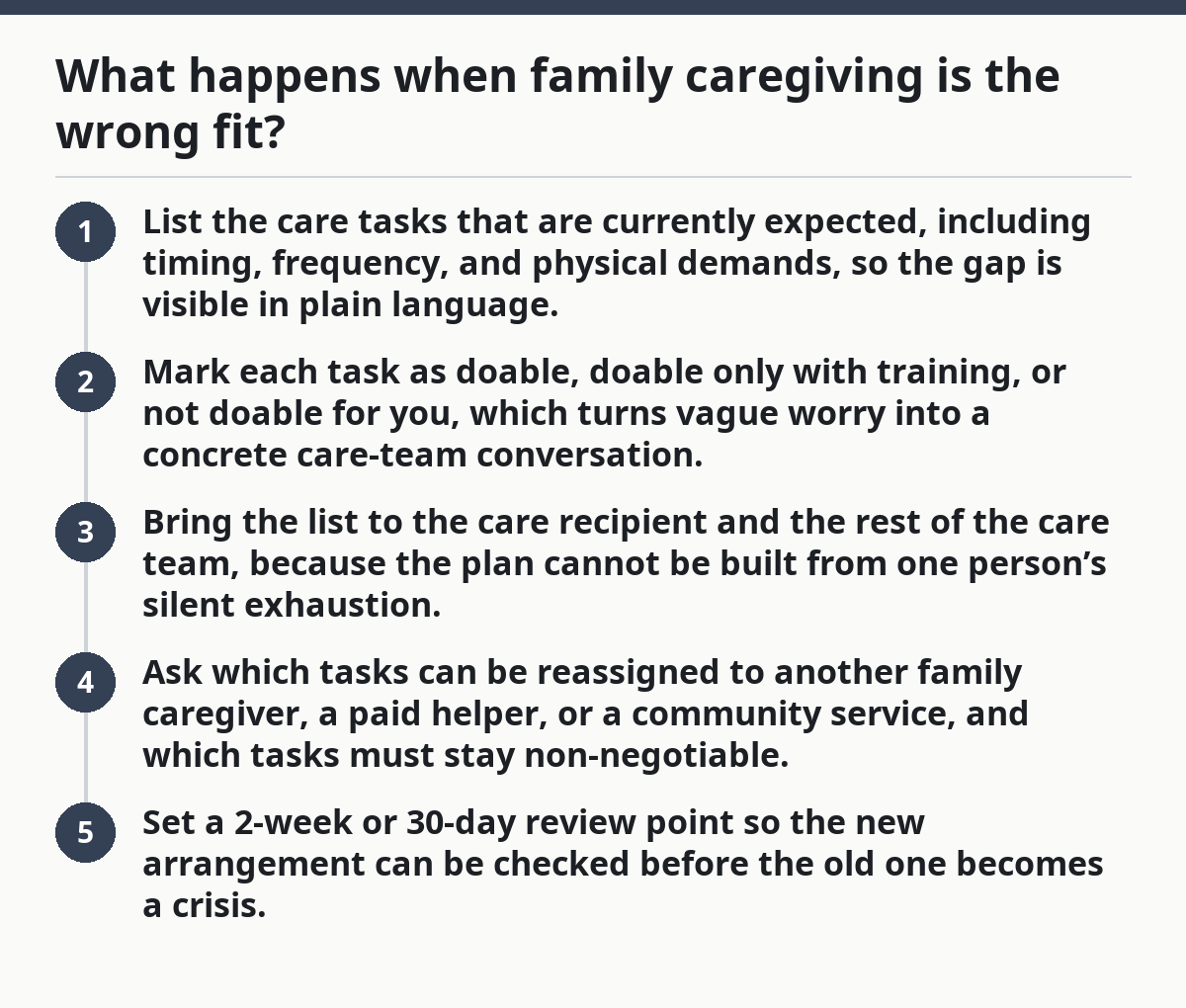
A simple handoff process looks like this:
- List the care tasks that are currently expected, including timing, frequency, and physical demands, so the gap is visible in plain language.
- Mark each task as doable, doable only with training, or not doable for you, which turns vague worry into a concrete care-team conversation.
- Bring the list to the care recipient and the rest of the care team, because the plan cannot be built from one person’s silent exhaustion.
- Ask which tasks can be reassigned to another family caregiver, a paid helper, or a community service, and which tasks must stay non-negotiable.
- Set a 2-week or 30-day review point so the new arrangement can be checked before the old one becomes a crisis.
The goal is not to “win” the decision. It is to build a care plan that matches reality. If the care recipient’s needs are beyond what the family can provide safely, outside support has to be part of the answer. If the care recipient resists that answer, the family still has to be honest about the limit.
This is the point many articles skip: saying no to direct caregiving can be the most responsible choice in the room. It can prevent unsafe transfers, missed medications, resentment, and a relationship that gets damaged by a role it was never built to hold.
A simple caregiving fit assessment you can do today
A caregiving fit assessment can be done in 20 minutes if you use the right questions. You do not need a perfect plan; you need a realistic one.
Take a blank page and write 4 columns: time, body, skill, distance. Under each column, answer one sentence only.
- Time: How many hours per week can I reliably give for the next 3 months?
- Body: Which care tasks can I do safely without injuring myself or the care recipient?
- Skill: Which tasks do I know how to do, and which would need training or another person?
- Distance: Can I get to the care recipient fast enough for the tasks that matter?
Then score each column with one of 3 labels: fit, partial fit, or poor fit. If 2 or more columns are poor fit, direct caregiving is not the right role right now.
Next, compare your answer with the care plan, not with the family’s hope. If the care plan needs 2 hours of morning help, 1 evening check, and a weekend outing, but you can only provide 3 scattered hours from afar, the fit is off even if you care deeply. If the care plan is simple and another relative handles the heavy lifting, you may fit well as a backup or coordinator.
The point of the assessment is not to produce guilt. It is to produce clarity before commitment. A clear no is kinder than a yes that turns into missed needs and strained relationships.
How do I know if I can handle caregiving?
You can handle caregiving if the daily tasks fit your real time, strength, and stress limits for months, not just a few days. Since family caregiving is not the right fit for everyone, the better test is consistency, not goodwill.
The easiest way to judge is to compare the care recipient’s routine with your own fixed obligations. If you can absorb the work on paper, then check the harder question: can you still do it after a bad night, a work deadline, or a difficult appointment? If the answer keeps turning into “only if everything else goes perfectly,” that is a warning sign.
For more guidance on the role, see caregiver burnout signs and family caregiver support. The real answer is not whether you care enough. It is whether family caregiving is not the right fit on a normal week, with ordinary pressure and ordinary limits.
Since the care recipient’s needs can change, revisit the fit after hospital stays, medication changes, or a new diagnosis. The same role that worked in January may not work in April.
Drafted with AI; not yet reviewed by a person.