
Last updated: November 19, 2026
Quick Answer: A caregiver handoff between family members works best with one shared sheet, a 10-minute overlap, and one person clearly on duty before the other leaves. This article on how to run a caregiver handoff between family members shows the sequence, notes, and timing that keep care moving without gaps. The goal is simple: the next family caregiver should know what happened, what changed, and what must happen in the next 8 to 24 hours.
Key Takeaways
- Use one current sheet, a quiet 10-minute exchange, and a clear transfer point for responsibility.
- Follow the same 6-step handoff every time and keep the written notes in use.
- Keep shift notes and the checklist focused on what the next caregiver must do next.
- Include the last dose time, the next dose time, and the late-dose rule in medication handoff notes.
What a caregiver handoff needs before the switch

A caregiver handoff needs one current sheet of information, a quiet 10-minute exchange, and a clear start and stop time for responsibility. If you are passing care for an older adult, a post-surgery patient, or someone with dementia, do not rely on memory or a quick text thread. The handoff is the moment mistakes get made, so it deserves the same structure every time.
Have these items ready before the next family member arrives:
- A current list of medications, including dose, timing, and any “as needed” medicines
- The home care routine for meals, toileting, mobility, bathing, and sleep
- Shift notes from the last 8 to 24 hours
- Open issues, such as pain, a missed meal, constipation, a fall risk, or a bruise
- Escalation points, meaning the exact signs that mean “call the doctor,” “call the pharmacy,” or “go to urgent care”
- Phone numbers for the clinician, pharmacy, and one emergency contact
- The keys, codes, supplies, and devices needed for the next shift
A generic update like “He was fine today” is not enough. The next caregiver should be able to answer three things within 1 minute: What changed? What is due next? What should trigger a call? If those answers are fuzzy, the handoff is not done yet.
This is the same coordination problem covered in the broader caregiver coordination and communication hub, but here the focus stays on the family-to-family transfer itself.
How do I hand off care smoothly?
You hand off care smoothly by using a repeatable 6-step sequence and not skipping the written notes. The sequence should take about 10 to 15 minutes for a normal day and longer if the care is complex.
-
Set the handoff time and location before the shift ends.
Pick a specific minute, such as 7:00 p.m. at the kitchen table, or 6:30 a.m. by the bedside. A defined handoff keeps both people from assuming the other already knows the plan. -
Open the shift notes and read the last update first.
Start with what happened during the last 4 to 12 hours, not with a long story. The next caregiver should see the most recent medication taken, any symptoms, meals eaten, fluids offered, and sleep quality. -
Review the medication timing out loud.
Say the next dose time, the last dose time, and whether a medicine is scheduled, held, or as needed. If a pill was delayed by 2 hours or more, say so clearly, because timing mistakes are one of the easiest ways to create a gap. -
Walk through the home care routine for the next block of time.
Cover the next meal, bathroom help, walk, injection, dressing change, or bedtime step in the order it will happen. The result should be a plan that matches the next 4 to 8 hours of care, not just a list of tasks. -
Name the open issues and the escalation points.
Say what needs watching and what would count as a problem. For example: “If the pain rises above the usual level after 30 minutes, call the nurse line,” or “If there is no urination by bedtime, note it and escalate.” The next caregiver should be able to repeat the threshold back to you. -
Hand over the supplies and confirm the start of responsibility.
Give the next person the medications, phone, keys, glasses, charger, incontinence supplies, or wound-care items they need. Then say plainly, “You are on duty now,” so there is no overlap and no gap.
A good handoff ends with both people looking at the same checklist and the same clock. A bad handoff ends with “I think you know everything.”
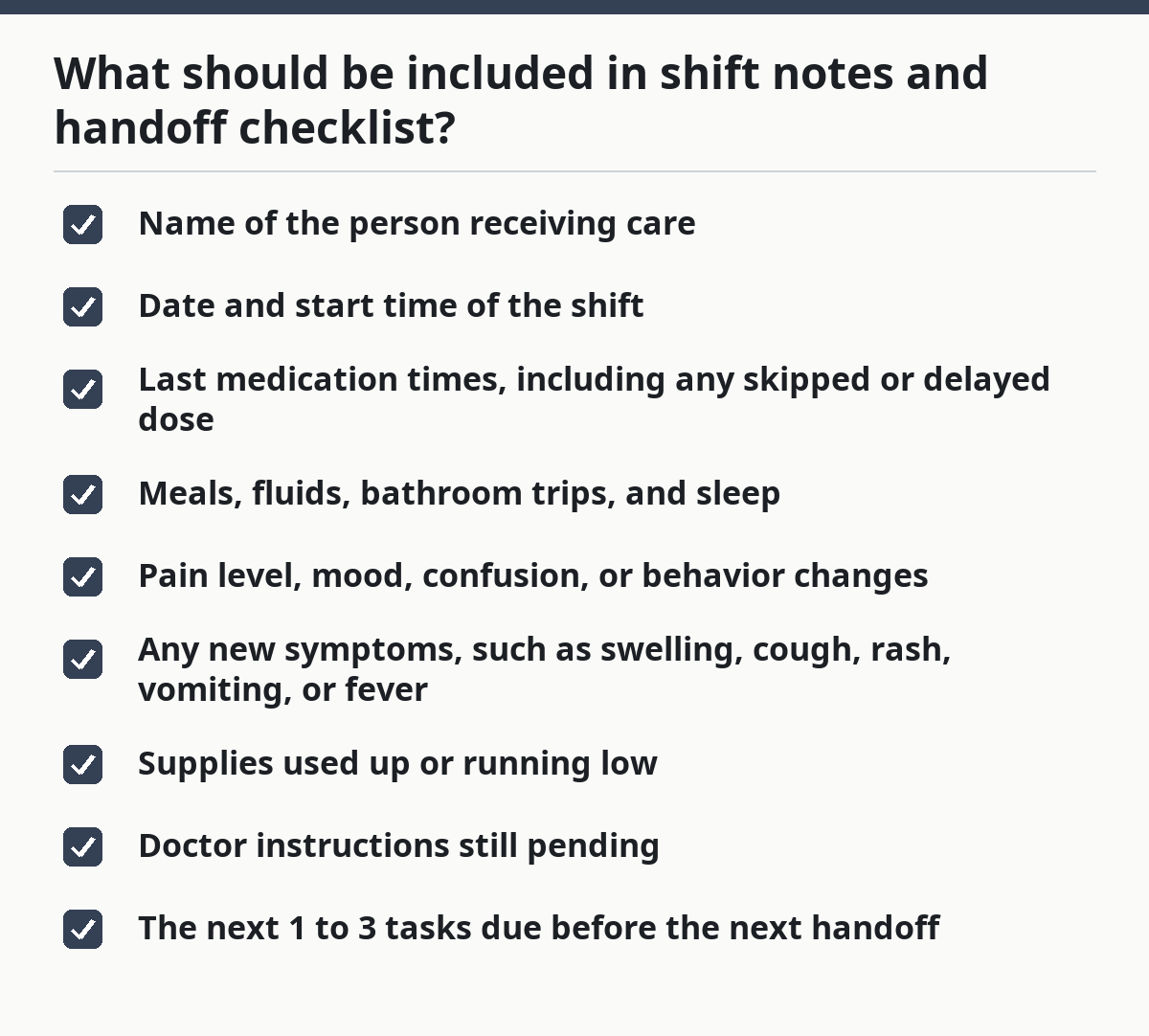
What should be included in shift notes and handoff checklist?

Shift notes and a handoff checklist should include only the details the next family caregiver needs to act in the next shift, not a life story. A useful checklist is usually one page, or one screen, and it should be easy to read in under 2 minutes.
Put these items on the checklist:
- Name of the person receiving care
- Date and start time of the shift
- Last medication times, including any skipped or delayed dose
- Meals, fluids, bathroom trips, and sleep
- Pain level, mood, confusion, or behavior changes
- Any new symptoms, such as swelling, cough, rash, vomiting, or fever
- Supplies used up or running low
- Doctor instructions still pending
- The next 1 to 3 tasks due before the next handoff
Shift notes work best when they are factual and dated. “Ate half a sandwich at 1:15 p.m.” is better than “ate okay.” “Refused evening medication” is better than “being difficult.” The exact wording matters because the next caregiver may need to repeat the note to a clinician or pharmacy.
The biggest mistake is turning the notes into a running complaint log. That makes the record hard to use, and it hides the one thing that matters: what comes next. Another mistake is leaving the checklist on a counter where no one checks it. Keep it in one fixed place, like a binder by the charger, on a whiteboard in the kitchen, or in a shared note on a phone that both family members actually open.
A strong handoff checklist should fit the care setting. A person after a same-day procedure may only need 6 items. A person with diabetes, dementia, or a new wound may need 15. The right length is the one the next caregiver can finish without guessing.
How to handle medication timing without missed doses
Medication timing stays accurate when the next caregiver gets the last dose time, the next dose time, and the rule for what to do if a dose is late. This is one of the most important parts of a caregiver handoff because “almost on time” can still become a missed dose if nobody owns it.
Use this order:
- Check the medication list against the actual bottles or blister packs.
- Mark the last taken time on the list.
- Mark the next scheduled dose time.
- Separate routine medicines from as-needed medicines.
- Note any medicine that is waiting for food, waiting for a refill, or being held for a reason.
If a medicine has a narrow timing window, say that plainly during the handoff. Even without getting into disease-specific rules, the family should know which medicines are time-sensitive and which can wait until the next meal. If the care plan includes blood thinners, insulin, seizure medicine, pain medicine, or antibiotics, the handoff should be especially careful and may need a pharmacist or clinician to confirm the schedule.
A common error is saying, “I already gave it sometime after lunch.” That forces the next caregiver to guess and may lead to a double dose. Another error is assuming the other family member knows the pill by shape. Bottles, labels, and dosage times beat memory every time.
If a medicine was refused, vomited up, dropped, or taken late by more than a brief delay, note it in shift notes immediately and tell the next caregiver whether it needs follow-up. When in doubt, ask a pharmacist or prescriber before changing the schedule. Medication errors are one place where a short professional call is worth the time. For timing guidance, see the NIH MedlinePlus Medicines page and the FDA Medication Safety page.
What counts as an open issue or escalation point?
An open issue is anything that is not resolved by the end of the shift, and an escalation point is the exact sign that means the next caregiver must get help. The handoff should name both, because “watch it” is too vague to be useful.
Examples of open issues include:
- A new rash that has not been checked
- Poor appetite at the last 2 meals
- No bowel movement for several days
- Confusion that is better in the morning and worse at night
- A wound that looks wetter than yesterday
- A supply that will run out before morning
Escalation points turn those issues into action. For example: call the nurse line if the wound drainage increases, call the pharmacy if the medication bottle will empty before the next refill, or call urgent care if the person cannot stand safely or has a sudden change in alertness. The exact threshold should be written down, not improvised at 11 p.m.
A family caregiver handoff is not the place to debate whether a symptom is “bad enough.” The handoff should already state the action level. If the family has been told by a clinician to use a certain standard, such as “call for any new shortness of breath” or “report blood sugar outside the target range,” write that standard into the notes and repeat it aloud.
The trade-off is usually simple, but if you are unsure about the right threshold, ask a clinician or other professional before relying on the note alone: writing down escalation points takes 2 or 3 extra minutes, but it prevents the next caregiver from freezing or overreacting. It also keeps family members from giving different advice to the same person, which is how small problems become bigger ones.
What usually goes wrong during a family caregiver handoff?
The usual failures are missing timing, unclear ownership, and notes that are too vague to act on. These problems cost time first, then create extra work, and sometimes create real safety risk.
The most common mistakes are:
-
Two people think the other person gave the medication.
Cost: double dosing or a missed dose.
Do this instead: write the dose on one shared sheet before the handoff ends. -
No one says when the next task is due.
Cost: meals, toileting, or wound care get pushed back by hours.
Do this instead: put a clock time next to every task. -
Shift notes describe opinions instead of facts.
Cost: the next caregiver cannot tell what changed.
Do this instead: record what was seen, heard, or measured. -
The handoff happens while one person is already leaving.
Cost: there is no chance to ask follow-up questions.
Do this instead: schedule a 10-minute overlap, even if the day is busy. -
Important items live in three places: a text thread, a notebook, and someone’s memory.
Cost: family members compare different versions of the truth.
Do this instead: keep one master handoff checklist in one place. -
No one names the backup caregiver if the next shift falls through.
Cost: a last-minute scramble.
Do this instead: keep the back-up contact visible, even if another page on the site handles the larger backup plan.
The hard truth is that a handoff fails less from lack of love than from lack of structure. Family members often know the person well and still miss one critical detail because they assume the other person “must have seen it.” A checklist closes that gap. For a practical checklist approach, see the AARP caregiving resources and the NIH caregiver support guidance.
How do family members pass updates without confusion?
Family members pass updates without confusion when they use one shared format, one source of truth, and one time stamp on every update. A handoff works badly when one person texts “all good” while another writes a paragraph in a notebook and a third person stores the medication list in a phone photo from 3 months ago.
Use a simple update format every time:
- Date and time
- What changed
- What was done
- What is due next
- Who should respond if something worsens
A message like “Tue 6:40 p.m. — ate 60% of dinner, took evening meds, pain higher than usual after walking, next dose due at 10:00 p.m., call me if pain stays high after rest” is more useful than a thumbs-up emoji. It gives the next caregiver a complete picture in one glance.
If multiple family members are involved, the handoff should still have one primary person for the shift. That person does the final check on the checklist and decides whether the issue is resolved or needs escalation. Too many voices create delay, especially when 2 or 3 people start giving different instructions.
A clear handoff also keeps status updates from turning into side conversations. If a sibling wants a daily summary, that can happen after the shift, but it should not interrupt the actual transfer of care. The point is to protect the person receiving care from confusion at the moment of change.
The best handoffs are usually boring in the right way. They are short, dated, and repeatable. They do not depend on memory, tone, or goodwill alone.
What should be included in a caregiving handoff?
A caregiving handoff should include the latest shift notes, the medication timing, the next few tasks, open issues, and the escalation points. It should also include supplies, phone numbers, and anything unusual that happened during the last 8 to 24 hours. A one-page checklist keeps the transfer clear and reduces guesswork.
How do I hand off care smoothly?
I hand off care smoothly by setting a specific time, reading the latest notes first, reviewing medications out loud, and confirming who is responsible for the next task. A 10- to 15-minute overlap usually helps prevent confusion, but if the care is complex, check with a clinician or other professional about what timing makes sense. The handoff is complete only when the next caregiver can repeat the plan back.
How do family members pass updates without confusion?
Family members pass updates without confusion by using one shared format and dating every message. The update should say what changed, what was done, what is next, and what needs escalation. If everyone uses the same one-page checklist or shared note, the care stays consistent instead of becoming a chain of separate opinions.
Drafted with AI; not yet reviewed by a person.