
Understanding caregiver roles and responsibilities

Last updated: November 18, 2026
Quick Answer: Understanding caregiver roles and responsibilities — The Complete Guide is about the 3 core duties of caregiving: daily support, change monitoring, and care coordination. A caregiver’s job is to keep a person safe, clean, fed, supervised, and emotionally supported while respecting the person’s dignity and legal rights. The role can range from light help with errands to full-time hands-on care for bathing, medication reminders, mobility, and appointments.
Key Takeaways
- Caregivers handle daily needs, notice changes, and organize care.
- A caregiver is someone who provides ongoing help to a child, adult, or older person who cannot manage alone.
- Safety, dignity, and clear communication are essential because the rest of care depends on them.
- A caregiver should never take on licensed clinical judgment, legal authority, or unsafe physical tasks.
What a caregiver actually does day to day

A caregiver does three things every day: meets basic needs, notices changes, and keeps care organized. That usually means helping with meals, hygiene, dressing, toileting, transfers, transportation, medication reminders, and companionship, then reporting any new symptoms, falls, confusion, or refusal to eat to the right person.
The job is broader than most people expect because care is both physical and administrative. A caregiver may need to track a medication schedule, keep a simple log of bowel movements or blood sugar readings, confirm appointments, refill supplies, and notice small changes that matter. A missed refill, a skipped meal, or a wet floor can become a bigger problem fast.
The scope depends on where care happens. In a private home, the caregiver often works alone and has to make quick judgment calls. In assisted living or a skilled nursing setting, the caregiver usually works under a supervisor and follows a care plan. If the person has dementia, stroke aftereffects, or mobility loss, the caregiver also becomes a safety monitor, because wandering, falls, and confusion can change the day in minutes.
A generic article often stops at “helping with daily activities.” That misses the real burden: the caregiver is often the person who catches the early warning signs. Appetite changes, new bruising, a sudden mood shift, repeated bathroom trips, or sleeping much more than usual can be the first clue that something is wrong. That is why the role is part care, part observation, and part coordination.
For a plain-language overview of what care responsibilities can include, the U.S. National Institute on Aging’s family caregiver materials are a reliable starting point, and the Family Caregiver Alliance also has practical guides on the role of caregivers.
Who counts as a caregiver, and what type of care is this?
A caregiver is anyone who provides ongoing help to a child, adult, or older person who cannot manage everything alone. That includes unpaid family members, friends, neighbors, and paid home care workers; the difference is not the kindness of the work, but the legal and practical duties attached to it.
This matters because the same word covers very different situations. A spouse helping with meals and reminders is not doing the same job as a paid home health aide who follows a service plan. A parent caring for a child with complex medical needs is different again, because the parent is usually both the legal decision-maker and the daily caregiver. In the U.S., Medicare’s home health rules and many state agencies distinguish between “skilled” services and personal care, and that boundary affects what the caregiver can realistically be asked to do.
The right kind of caregiver role depends on need, not labels. If the person only needs rides, groceries, and light housekeeping, a support-focused caregiver may be enough. If the person needs help transferring from bed to chair, taking medication at specific times, or being watched for wandering, the role becomes more demanding and may require professional input from a nurse, therapist, or physician. If a person has medical devices, wounds, or aspiration risk, the line between “helpful support” and “clinical care” gets serious quickly.
This is where people go wrong: they assume family caregiving is just a private arrangement. In practice, it often sits inside a medical and legal framework. A caregiver should know whether they are allowed to help with injections, catheter care, wound dressing, or medication administration, because those tasks can be restricted by state law, employer policy, or care-plan rules. A person who takes this role without checking boundaries can end up doing too much, too soon, and without backup.
The right choice here is to define the role before crisis hits. If the care is informal, decide what help is expected, what is off-limits, and who to call in an emergency. If the care is paid, ask for the written job description, supervision chain, and task list before the first shift starts. For role-specific boundaries, the National Institute on Aging and the Family Caregiver Alliance both offer guidance that can help families sort practical duties from clinical ones.
Which responsibilities are non-negotiable?

Safety, dignity, and accurate communication are non-negotiable, because every other task depends on them. If the person is unsafe, misunderstood, or isolated, the rest of the day can unravel even if meals and housekeeping are done well.
The non-negotiables are usually these:
- Prevent falls and other avoidable injuries.
- Make sure meals, hydration, and toileting needs are met.
- Follow the care plan and medication instructions exactly as written.
- Preserve privacy during bathing, dressing, and toileting.
- Report sudden changes in behavior, pain, breathing, swelling, or confusion.
- Keep important information straight for family, clinicians, and supervisors.
The order matters. A caregiver who skips hydration checks because the room needs cleaning has the priorities backwards. A caregiver who guesses at medication timing instead of confirming the label creates avoidable risk. A caregiver who ignores a new balance problem because “the person seems fine otherwise” may miss the warning before a serious fall.
There is also a human layer. Respect is not optional. Speaking to an adult as if they are a child, rushing intimate care, or discussing private details in front of others damages trust and can lead to resistance. That resistance can then make bathing, eating, or mobility harder. Dignity is not a nice extra; it is part of getting the job done.
A strong caregiver knows where the boundaries are. Personal care is one thing. Medical decision-making is another. Legal authority may rest with a health care proxy, parent, guardian, or power of attorney, depending on the situation. If the caregiver does not know who can consent, who can refuse, and who gets updates, the role turns into guesswork. For legal authority questions, a local elder law attorney or the relevant state social services office is the right source, not family memory.
The biggest mistake in this role is confusing “being helpful” with “being in charge.” The caregiver is usually responsible for doing and observing, not deciding beyond their authority.
What should a caregiver never take on alone?
A caregiver should never take on anything that requires licensed clinical judgment, legal authority, or physical effort beyond safe limits. That includes changing a care plan on the spot, ignoring emergency symptoms, lifting someone without proper equipment, or acting as the only decision-maker when family conflict is already active.
This is where burnout and harm often begin. A family caregiver may think, “I can handle it,” and then quietly become the sole point of failure. If the person needs two-person transfers, a gait belt, or a mechanical lift, trying to manage alone can injure both people. If the person has chest pain, one-sided weakness, severe shortness of breath, a head injury, or sudden confusion, the caregiver’s job is to seek emergency help, not to “watch and wait” indefinitely.
A caregiver should also not manage complex medications without clear instructions. Simple reminders are one thing. Sorting pills, interpreting conflicts between labels, or deciding whether to withhold a dose is another. If the medication list is unclear, the prescriber, pharmacist, or nurse should clarify it. This is especially true for anticoagulants, insulin, opioids, and sedatives, where small errors can have large consequences.
Another limit: a caregiver should not become the family’s unpaid counselor, banker, or referee by default. If the person being cared for has siblings arguing over money, treatment, or placement, the caregiver can end up carrying emotional and administrative pressure that belongs elsewhere. That is not a side issue. It directly affects care quality, so families should consult a professional if disputes are affecting decisions.
A practical rule helps: if the task involves diagnosis, legal consent, severe mobility risk, or medication changes, stop and ask for professional direction. If the task involves emotional overload, the caregiver also needs backup. Support groups, respite care, social workers, and case managers exist because the role is too heavy to do indefinitely without relief.
The wrong fit here is the person who wants control but resists systems. Caregiving works best when it is organized, documented, and shared.
How do daily tasks change by level of need?
Daily tasks get more technical as the person’s independence drops, and the caregiver’s schedule gets less predictable. A low-support situation may mean a few hours a week; a high-support situation can fill every waking hour with supervision, transfers, meals, and repeat prompts.
At the lightest level, the caregiver handles errands, check-ins, transportation, meal prep, and light cleaning. The main responsibility is consistency. Missing one grocery run may not matter; missing several can mean skipped meals or medication gaps because the person cannot restock on their own.
At a moderate level, the caregiver often manages a daily routine: getting the person up, helping with dressing or bathing, preparing food, making sure medications are taken, and watching for falls or confusion. The day can now depend on timing. A bath may need to happen when the person has enough energy. A walk may need to happen after pain medicine, not before. Appointments start to shape the schedule.
At a higher level, the caregiver is often doing hands-on assistance throughout the day. This may involve continence care, feeding support, repositioning to prevent pressure injuries, transferring with equipment, and keeping a close eye on sleep, pain, breathing, and skin condition. In a dementia setting, the caregiver may also need to reduce triggers, redirect behavior, and manage wandering risk. That can make even a 30-minute errand impossible without backup.
The most useful way to think about this is not “How hard is caregiving?” but “How many essential functions is one person no longer able to do alone?” The more functions that fall to the caregiver, the more the role needs structure, respite, and outside help.
A generic checklist often hides the load. It says “assist with activities of daily living” but does not spell out what happens when the person needs help every two hours at night, or when the caregiver also has a job and children. That gap is where many families get blindsided. The job is not just physical. It is time, attention, and constant readiness.
The honest side-by-side: family caregiver or paid caregiver?
The family caregiver wins for continuity and trust. The paid caregiver wins for consistency, boundaries, and sustainable coverage. The better choice depends on whether the need is mostly relational or mostly operational.
| Criteria | Family caregiver | Paid caregiver | Winner for this condition |
|---|---|---|---|
| Emotional familiarity | Knows the person’s habits, history, and preferences | Builds rapport over time but starts outside the family system | Family caregiver when trust and history matter most |
| Scheduling reliability | Can be disrupted by work, illness, or family duties | More likely to cover set hours and follow shifts | Paid caregiver for predictable coverage |
| Boundary clarity | Roles often blur into conflict, guilt, or overhelping | Task limits are usually more clearly defined | Paid caregiver when the family is already strained |
| Long-term sustainability | Often leads to burnout if one person carries too much | Can be scheduled as part of a broader care team | Paid caregiver for ongoing high-need care |
| Flexibility with changing routines | May adapt quickly in emergencies or family-specific situations | Can adapt within the job description and care plan | Family caregiver for unpredictable personal adjustments |
| Training and documentation | Often informal unless family arranges it | More likely to have agency training and notes | Paid caregiver for structured care records |
| Cost to the household | No wage, but often high hidden costs in lost time and stress | Requires pay, benefits, or agency fees | Depends on budget; paid care wins if time is the scarcer resource |
| Privacy and dignity | Can feel intimate, but can also feel awkward for both sides | Can preserve professional distance and routine | Paid caregiver when embarrassment blocks needed care |
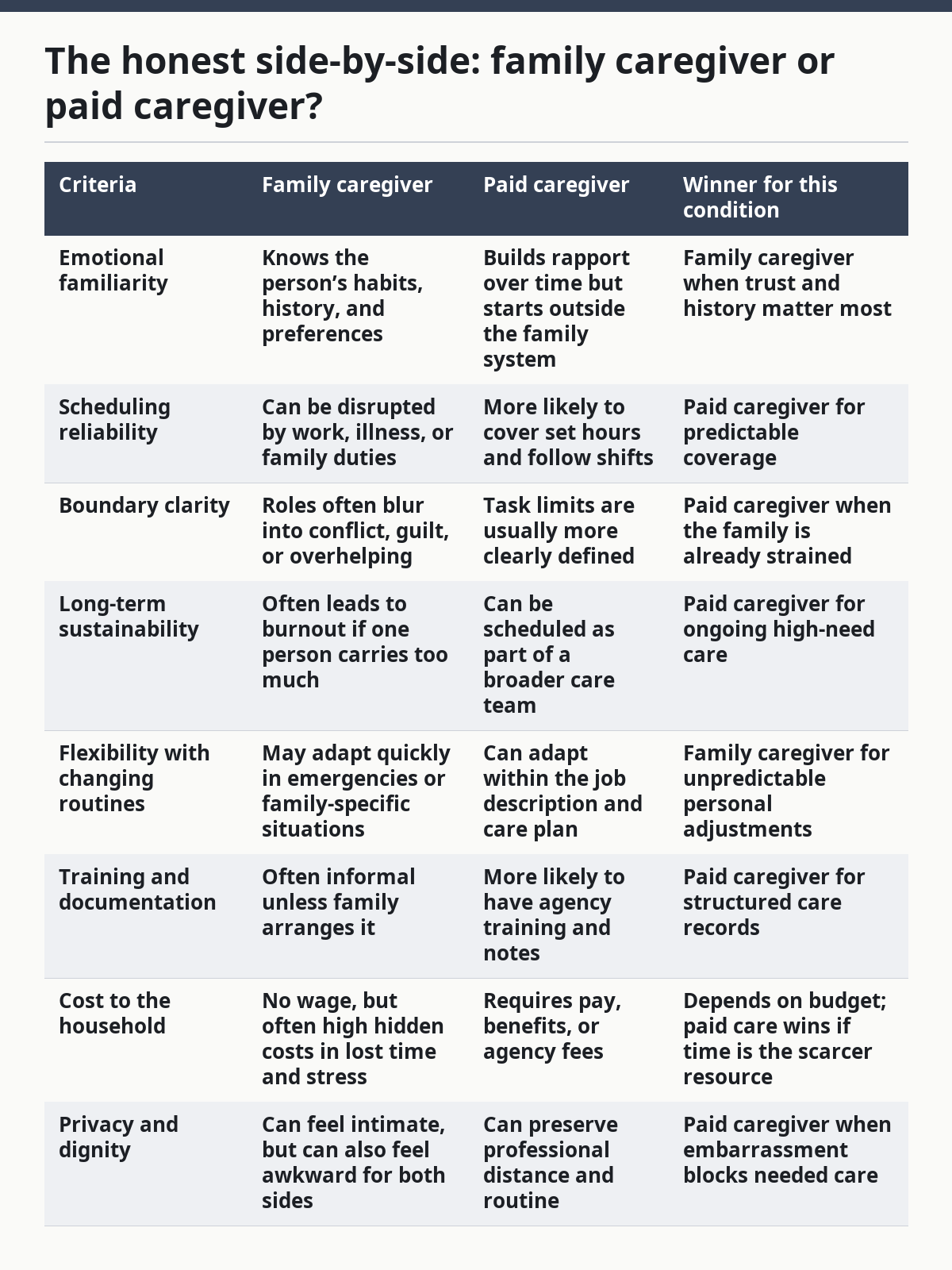
The family caregiver is the better fit when the person strongly prefers a familiar face, the care plan is moderate, and the family can share tasks. It fails when one person becomes the default for everything. The paid caregiver is the better fit when the schedule is heavy, the work needs documented handoff, or family relationships are too tense for practical care. It fails when the person rejects strangers and the house has no room for turnover.
A generic article may present these as equal options. They are not equal in practice. Family care is more personal; paid care is more sustainable. The most practical answer is often a blend, not a single hero.
When do the rules change because of the setting?
The rules change when the caregiver works in a home, a hospital, or a long-term care setting, because authority, supervision, and access to equipment are not the same in each place. A caregiver in a private home usually has the least backup and the most improvisation; a caregiver in a facility usually has the most oversight and the clearest procedures.
At home, the caregiver has to notice problems early because there may be no nurse down the hall. This is where a written medication list, emergency contacts, and a simple daily log matter. If the person uses oxygen, a walker, a hospital bed, or a commode, home setup becomes part of the care job. Small hazards like loose cords, poor lighting, or cluttered walkways can do real damage.
In a hospital, the caregiver role shifts toward support and communication. Family members may feed, comfort, interpret preferences, and ask questions, but the clinical team controls treatment. A family caregiver can be an essential advocate here, yet they should not assume they can override a physician, nurse, or discharge planner. The job is to listen carefully, clarify instructions, and prepare for the next step.
In assisted living or skilled nursing, the caregiver role is shaped by facility rules. Family members may help with personal care, but they do not control staffing, medications, or the care plan. If the facility’s process is slow or unclear, the right move is to document the issue, speak to the charge nurse or administrator, and keep records. Tone matters less than specificity.
This section is where many readers need the hard truth: the setting can limit what a caregiver can do, even if the family wants more. A house may not be safe for heavy lifting. A facility may not allow outside caregiving to replace staff duties. A hospital may discharge a person before the family feels ready. The setting shapes the role, not the other way around.
A good caregiver adapts to the environment rather than trying to force the same routine everywhere.
The special case: caring for someone with dementia or mobility loss
Dementia care and mobility-limited care demand more supervision, more repetition, and more patience than ordinary companionship. That is because the person may not remember instructions, may misjudge risk, or may resist help that they actually need.
With dementia, the caregiver’s job often includes reducing confusion before it turns into conflict. Simple language works better than long explanations. Sudden changes in routine can cause distress. If the person cannot remember why they need a bath or where they are going, the caregiver often has to redirect rather than argue. Wandering risk, nighttime waking, and medication refusal become central concerns.
With mobility loss, the caregiver’s job becomes a safety and mechanics problem. Transfers, turns, steps, ramps, and seating all matter. A bathroom without grab bars or a bed that is too low can create daily risk. If the person uses a wheelchair or walker, the caregiver must keep pathways clear and make sure equipment is within reach. This is where a physical therapist or occupational therapist can be worth far more than a long list of tips, because the right setup depends on the person’s body and the home layout.
The trade-off is plain: these conditions can make care deeply meaningful and deeply exhausting at the same time. The caregiver may see progress in comfort, but not in recovery. That can be emotionally hard. It can also create unrealistic family expectations, especially when the care recipient has good days and bad days. A bad day is not necessarily a setback; it may be part of the condition.
This is not the role for someone who needs immediate results, low complexity, or quiet routines. It is for a person who can handle repetition, has patience for slow movement, and is willing to ask for professional guidance on safety equipment and behavior management.
How do you know if the caregiver role is becoming too much?
The role is becoming too much when the caregiver starts missing meals, sleep, work, or medical appointments of their own because the care load never stops. That is a warning sign, not a badge of honor.
Other red flags are easier to miss. The caregiver may become irritable, numb, or resentful. They may forget instructions, stop returning calls, or feel unable to leave the house without panic. They may begin to take shortcuts with bathing, lifting, or medication reminders because the routine has become impossible to sustain. If the person being cared for is also getting worse, the caregiver can feel trapped between duty and capacity.
This is where respite is not a luxury. It is a safety measure. A few hours of covered time can prevent a fall, a medication error, or a blowup that harms the relationship. Family meetings, paid backup care, adult day programs, and home health support are all tools for spreading the load. If money is tight, the local Area Agency on Aging or equivalent community resource can sometimes point to low-cost options.
A generic guide often says “take care of yourself” and leaves it there. That advice is too thin to use. The real standard is this: if the caregiver cannot safely sustain the role for a month, the plan is already failing. Care should be redesigned before burnout becomes the reason care breaks down.
This is also the point where professional consultation may be needed, especially if the care recipient’s medical needs are changing. A nurse, social worker, physician, or occupational therapist can help reassess the plan before an emergency does it instead.
The verdict: which caregiver role fits which situation?
Choose a family caregiver if the person needs trust, familiarity, and flexible help with daily life, and the family can share the load without one person carrying everything. Choose a paid caregiver if the schedule is heavy, the tasks need documentation, or the family relationship is too strained for reliable care. Neither is the right answer if the person needs skilled medical care, 24-hour supervision, or safe transfers that the current caregiver cannot provide without training and backup.
The cleanest decision is not about affection. It is about capacity. A loving family member can still be the wrong sole caregiver if the tasks are too many or too technical. A paid caregiver can still be the wrong choice if the person will not accept outside help and the situation depends on intimate trust.
The most practical plan is often hybrid: family for advocacy and continuity, paid help for the recurring physical work. That balance protects the person receiving care and the caregiver who would otherwise burn out.
What should a new caregiver do first?
A new caregiver should start with the care plan, the medication list, the emergency contacts, and the daily routine. Those four items tell you what matters today and who to call when something changes.
Then set the limits in writing. Clarify who handles meals, bathing, transportation, refills, finances, and after-hours calls. If the person has a diagnosis that affects judgment, mobility, or swallowing, ask the clinician what warning signs require immediate help. A list on paper is better than vague family memory, especially when several people are involved.
The first week is not about perfection. It is about building a working system. A notebook, calendar, pill organizer, and phone list can prevent a surprising amount of chaos. If the role includes lifting, toileting, or dementia supervision, ask for instruction before the routine becomes unsafe. If the role feels bigger than one person can manage, that is not failure; that is information.
FAQ
What are the main duties of a caregiver?
The main duties are helping with daily living, keeping the person safe, watching for changes, and communicating with family or clinicians. In practice, that often includes meals, bathing, dressing, toileting, transportation, medication reminders, and emotional support.
Is a caregiver the same as a nurse?
No, a caregiver is not the same as a nurse. A nurse has clinical training and a license for medical assessment and treatment, while a caregiver usually provides daily support and observation. Some tasks overlap, but the legal and clinical responsibilities are different.
Can a family member be paid as a caregiver?
Sometimes, yes, depending on the program, insurer, state rules, and care arrangement. The details vary, so the family should check with the relevant agency, payer, or benefits office before assuming payment is allowed.
What is the hardest part of caregiving?
The hardest part is usually the constant demand, not one single task. Sleep loss, emotional strain, repeated decisions, and the pressure to stay available can wear a person down even when the hands-on work seems manageable.
When should a caregiver ask for help?
A caregiver should ask for help as soon as the role starts affecting safety, sleep, work, or health. If lifting is unsafe, symptoms are changing, or the caregiver is close to burnout, the plan needs backup from family, community services, or a professional.
Drafted with AI; not yet reviewed by a person.