Last updated: November 19, 2026
Quick answer: for most families, the choice between agency caregivers and independent caregivers comes down to whether you want backup coverage or direct control. Choosing between an agency caregiver and an independent caregiver comes down to coverage, control, and payroll. The best fit is the one that matches how much management you can handle and how much backup you need. This guide on how to decide between agency caregivers and independent caregivers settles the trade-offs so you can pick the right caregiver employment model with less guesswork.
Our Top 3 Picks at a Glance
-
1 Best Overall: Agency caregiver — best for families who want replacement coverage, a set screening process, and less day-to-day admin.
-
2 Best Budget Pick: Independent caregiver — best for families who want direct control and can manage payroll, taxes, and scheduling themselves.
-
3 Best Heavy-Duty / Upgrade Pick: Agency caregiver with backup coverage — best for households that cannot afford a missed shift or a last-minute gap.
The Honest Short Answer
Choose an agency caregiver if you need backup coverage and less paperwork; choose an independent caregiver if you want direct control and can handle payroll, taxes, and scheduling yourself. That is the split that matters most.
The rest is details. Those details decide whether a care contract feels manageable or turns into a second job.
Key Takeaways
- Agency care buys structure: screening, replacement help, and a clearer chain of supervision.
- Independent care buys flexibility: you set the terms, the schedule, and often the working style.
- Payroll and tax tasks land on you much faster with a privately hired caregiver.
- The biggest risk with private hiring is not cost alone — it is what happens when the caregiver calls out.
- If a missed shift would create a safety problem, agency coverage usually fits better.
What changes between an agency caregiver and an independent caregiver?
An agency caregiver is often the better fit when you want a company to handle the staffing machine around the care, not just the care itself. An independent caregiver is often better when you want the person, not the agency, to be your direct hire and point of contact.
Picture this: you are trying to keep care stable for a parent, and one no-show can ripple through the whole day. In that moment, replacement coverage matters more than personality, and that is where agencies often win. On the flip side, if you want to shape hours, duties, and daily routines more tightly, an independent caregiver gives you that room.
| Criteria | Agency caregiver | Independent caregiver | Winner for [condition] |
|---|---|---|---|
| Backup coverage | Agency arranges replacements more often | You usually have to find the backup yourself | Agency caregiver for no-gap coverage |
| Payroll | Agency may handle wages and paperwork | You usually handle payroll and tax forms | Agency caregiver for low admin |
| Screening | Agency pre-screens before assignment | You screen the person directly | Agency caregiver for process support |
| Control over hiring | Less direct control over who is sent | Direct choice of the person you hire | Independent caregiver for personal fit |
| Supervision responsibilities | Shared with the agency structure | Mostly yours | Agency caregiver for lighter oversight |
| Replacement process | Faster because the agency already staffs | Slower unless you have a backup plan | Agency caregiver for urgent gaps |
| Care contract | Often standardized | Usually negotiated directly | Independent caregiver for custom terms |
| Scheduling flexibility | Limited by agency rules and staffing | Often more flexible by agreement | Independent caregiver for custom hours |
| Paper trail | More built-in documentation | You create and keep the records | Agency caregiver for simpler documentation |
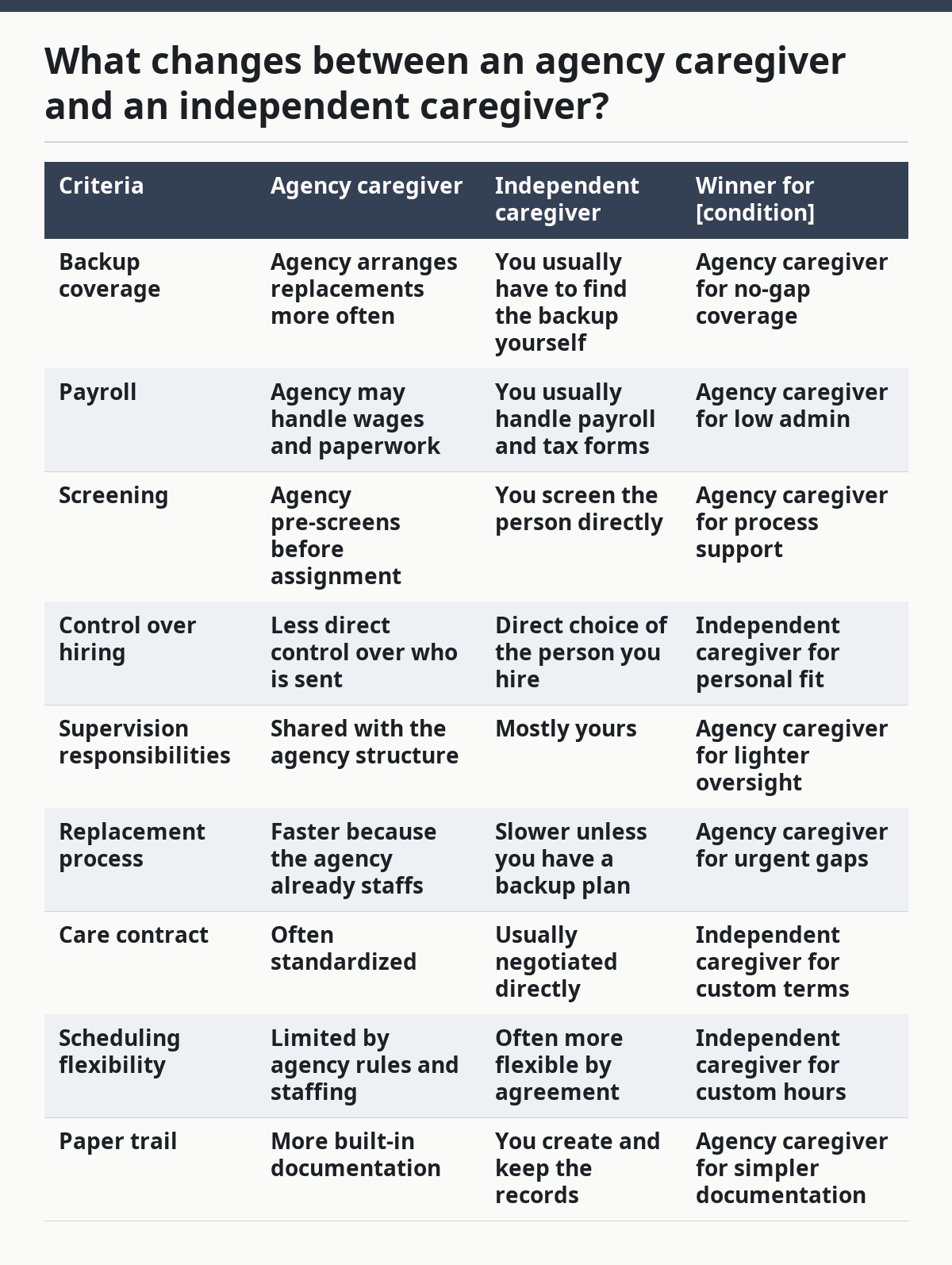
The key trade-off is plain: agency care reduces management burden, while independent care reduces the middle layer between you and the worker. That middle layer is either a comfort or a friction point, depending on your household.
What the table does not say out loud
Agency care can cost more in total because you are paying for staffing, office support, and replacement logistics, even when the invoice does not spell out each piece. Independent care can look simpler at first, but the work you take on does not disappear.
Here are the tasks that often move to you with an independent caregiver:
- wage setup
- tax paperwork
- backup planning
- schedule changes
- performance oversight
- contract changes
If those tasks sound manageable, private hiring can work well. If they sound like a burden you will keep putting off, the agency route is usually safer.
Why an agency caregiver wins for most families
An agency caregiver wins when your main problem is not finding care once — it is keeping care in place week after week. The agency model is built for replacement coverage, intake screening, and a clearer chain of responsibility.
Picture this: a caregiver gets sick at 7 a.m. and the day still has to happen. If the agency already has staff, the replacement process is often faster than your own scramble through phone calls and texts. That matters in homes where medication timing, transfers, or meal support cannot wait. That is the real advantage.
The other strength is supervision. With an agency, responsibility is shared in a more formal way. You still need to watch the quality of care, but you are not building every rule from zero.
A practical agency care contract usually helps with:
- who covers absences
- what tasks the caregiver may do
- how scheduling changes are handled
- how concerns are reported
- what the agency will replace or revise
The drawback is just as real. You may have less say over the specific person assigned, and agency rules can make the setup feel less flexible. If you want a caregiver who follows a very custom routine, the agency may feel too boxed in.
Here are the families who fit an agency better:
- households with unpredictable schedules
- people who need help every day, not just now and then
- families that cannot absorb a missed shift
- adult children who live far away
- anyone who wants less payroll and admin work
And here is who should skip it:
- a family that wants to hire one known person directly
- a household that can manage payroll and backup planning on its own
- a person who wants maximum control over duties and hours
Who Should Skip This: A family that wants a single, hand-picked caregiver and is willing to handle the paperwork itself may be better with an independent caregiver.
Buy this if: you are a caregiver manager who wants backup help and less admin.
Skip this if: you need one specific person and a fully custom routine.
Why an independent caregiver wins when control matters most
An independent caregiver wins when the person matters more than the system around them. If you already know who you want, and you can handle the employer side, private hiring gives you direct control over the care arrangement.
Picture this: you want the caregiver to follow a very specific morning routine, use a certain method for meals, and work only on certain days. With an independent caregiver, that kind of arrangement is easier to shape in the care contract. The line of communication is short. The decisions are yours.
That control has a cost. You become the person who has to think through payroll, tax rules, time off, and what happens when the caregiver cannot come in. If you do not build a replacement plan, the system is fragile. No agency safety net appears by itself.
The stronger case for private hiring usually looks like this:
- you already trust the person
- you want direct day-to-day communication
- you need a routine that an agency may not want to promise
- you are comfortable handling wages and records
- you can line up backup help in advance
The weak spots are just as specific:
- you may have to screen harder on your own
- you may miss warning signs without formal oversight
- a no-show can leave you stranded
- payroll and taxes can become a headache
- the care contract has to do more work because there is no agency policy behind it
If you want direct management and can handle the employer role, an independent caregiver can fit very well. If you want less risk around absences, this is the shakier choice.
How do payroll, taxes, and the care contract change the decision?
They change it a lot. If you do not want to deal with payroll and tax responsibilities, the agency model usually makes life simpler. If you do not mind being the employer, independent care opens more control.
Picture this: the caregiving schedule is working, but the money side is turning into your second headache. That is the moment many families realize that payroll is not a side issue — it is part of the job. With an agency, some of that burden may sit with the agency. With an independent caregiver, it usually sits with you.
A care contract also matters more than people expect. It is the document that sets duties, hours, pay terms, time-off rules, and what happens when the caregiver cannot work. In private hiring, the contract is not just paperwork; it is the thing that keeps the relationship from becoming vague and messy.
Use this quick filter:
- choose agency care if you want less payroll work
- choose independent care if you want more direct control
- choose agency care if you want a more formal replacement process
- choose independent care if you can write and enforce clear terms
- choose agency care if you need one place to call when something goes wrong
For tax questions, payroll rules, and employer duties, the safest move is to check current guidance from the IRS and, if needed, a payroll professional. The IRS explains household employment rules on its Household Employee guidance page, which is the kind of source that should shape the paperwork side of this choice. The U.S. Department of Labor also explains wage-and-hour basics for household employment, and the IRS guidance is updated as rules change.
The bottom line is simple: if the legal and payroll side sounds like a burden, agency care usually fits better. If it sounds manageable, private hiring stays on the table.
Which model handles supervision and screening better?
An agency caregiver handles screening and supervision better when you want structure and another set of eyes. An independent caregiver handles them better only when you are ready to do the screening and oversight yourself.
Picture this: you are not just hiring help, you are trying to lower the chance of a bad fit. Agencies often have a process before assignment, which can reduce the amount of direct vetting you must do. That does not make the agency perfect, but it does mean you are not starting from zero.
The trade-off is control. An agency may screen for general fit and credentials, yet still send a person who does not match your home’s exact rhythm. An independent caregiver lets you choose more directly, but then the quality of screening depends on the process you build.
A simple way to think about supervision:
- if you want shared oversight, agency care fits
- if you want sole control, private care fits
- if you do not have time to manage performance closely, agency care is safer
- if you want to set every rule yourself, independent care works better
The American Association of Retired Persons and similar caregiver resources often stress the importance of written duties and clear expectations. That advice matters more in private hiring, because the margin for confusion is smaller. AARP’s caregiver guidance and the CDC’s caregiver resources both point families toward clear expectations, especially when care changes hands.
This is where families get into trouble: they think “known person” means “low risk.” It does not. A known person can still miss shifts, misunderstand tasks, or become hard to manage without clear terms. Screening is only the first gate.
What are the exception cases where the answer flips?
The agency caregiver is not always the right answer, and there are a few specific cases where the independent caregiver wins even if the agency model looks safer on paper.
Because the care can be stable in some homes, the agency middle layer may add cost and friction without adding much value. A direct hire can make more sense.
The verdict flips in these situations:
- You already have a trusted caregiver and do not need a replacement pool.
- You need a highly custom schedule that an agency is unlikely to honor.
- You can manage payroll and taxes without stress.
- You want one-to-one communication and do not want an agency between you and the worker.
Now the other flip side. The independent caregiver is not the better choice if:
- the care cannot stop for a day
- the household has no backup plan
- the employer role will fall on someone already overloaded
- the care arrangement needs outside supervision
That is where the agency model takes back the lead. A missed shift is not a small inconvenience in every home. In some homes, it is the whole reason to hire.
The verdict: which one should you choose?
Choose an agency caregiver if you need backup coverage, less payroll work, and a more formal replacement process. Choose an independent caregiver if you want direct control, have a trusted person in mind, and can handle the employer tasks yourself. Neither is right if you cannot manage either the supervision or the paperwork at all.
Picture this: you are deciding before the first shift, not after the first problem. If you want the safer operations setup, the agency model wins. If you want the tighter personal fit and can run the admin side, the independent model wins. That is the clean call.
For families still sorting the wider care plan, the hub on choosing care services and paid help is the right next stop. This page only answers the hiring-model choice.
Is it cheaper to hire an independent caregiver?
It can be cheaper in direct hourly terms, but the full cost is not always lower. You may still need to handle payroll, tax paperwork, scheduling, and backup coverage yourself. If those tasks take time or force last-minute fixes, the cheaper rate can shrink fast.
Who handles backup coverage with an agency?
The agency usually takes the first pass at backup coverage. That is one of the main reasons families choose the agency model. The exact replacement process depends on the agency’s care contract, so it is worth asking how fast coverage can be arranged and what happens if no substitute is available.
What risks come with hiring privately?
The biggest risks are payroll mistakes, weak screening, and no-shift coverage when the caregiver is absent. Private hiring can work very well, but only if the care contract is clear and you already have a plan for supervision and backup. Without that, the arrangement can become unstable fast.
Drafted with AI; not yet reviewed by a person.