
Last updated: November 19, 2026
Caregiver routine and task management becomes hard fast when meds, meals, appointments, and paperwork all hit at once. Quick answer: use one master list, one daily order, and one backup plan for the day something slips. In this Caregiver routine and task management: Complete Guide, the sections below settle what to do first, what to batch, and what to drop.
Key Takeaways
- A caregiver routine only works if it starts with the next 24 hours, not a giant life plan.
- A practical task system is one you can repeat on a tired day with one hand free.
- Medication timing, sleep, and appointments set the shape of the day; everything else fits around them.
- A paper notebook, a phone calendar, or a shared app can all work if one place is the source of truth.
- When the load gets heavy, the fix is usually fewer moving parts, not more effort.
What actually determines the right routine?

The right routine is the one that matches the care needs, the number of people involved, and the amount of friction in the home. If the person you care for takes 3 or more timed meds, gets confused by changes, or needs transfers, the schedule has to be tighter than a simple meal-and-check-in day.
Picture this: you’re trying to keep track of pills, lunch, a wound check, and a 2:00 p.m. appointment while answering texts from three relatives. The routine fails when it asks your brain to hold too much at once. The fix is a written order of operations, not better memory.
If the day includes medical tasks, start with the tasks that cannot slide by 30 minutes without consequences. Then build everything else around them. If there are no timed medical tasks, the day can be organized around energy, naps, and the smallest number of transitions.
Here’s the catch: the same routine will not work for every home. A parent with dementia, a spouse after surgery, and a child with asthma need different rhythms.
- List every fixed-time task first.
- Mark which tasks happen every day, every week, or only on appointment days.
- Circle the tasks that cannot be skipped without a real problem.
- Put the hardest task in the part of the day with the most help.
- Remove anything that can be bought, automated, or done less often.
- Write the final order on paper where you can see it in 10 seconds.
A useful test is simple: if you missed one call, one dose, or one pickup, would the whole day wobble? If yes, that task belongs near the top of the list. That is the anchor.
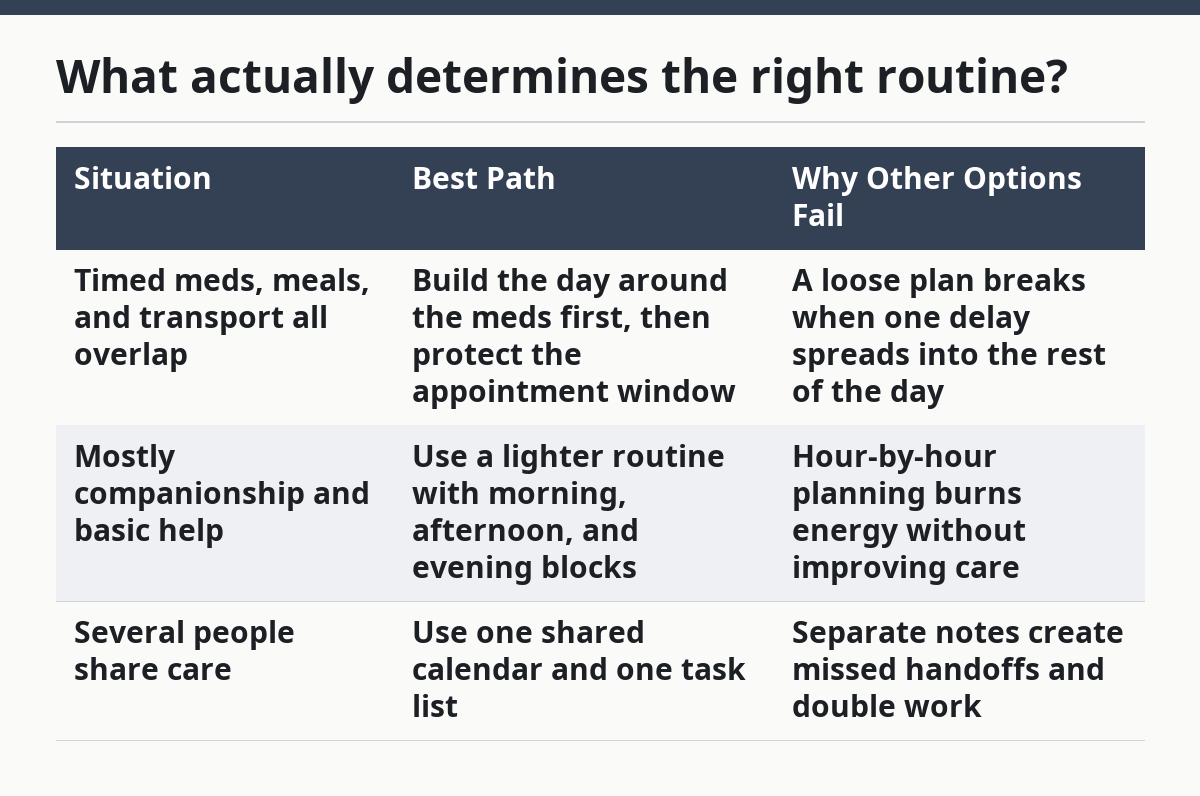
| Situation | Best Path | Why Other Options Fail |
|---|---|---|
| Timed meds, meals, and transport all overlap | Build the day around the meds first, then protect the appointment window | A loose plan breaks when one delay spreads into the rest of the day |
| Mostly companionship and basic help | Use a lighter routine with morning, afternoon, and evening blocks | Hour-by-hour planning burns energy without improving care |
| Several people share care | Use one shared calendar and one task list | Separate notes create missed handoffs and double work |
Quick check: if you can’t name the three non-negotiable tasks in under a minute, the routine is too vague.
How do I stop forgetting tasks every day?
You stop forgetting tasks by using one capture place, one daily review time, and one visible cue for the next action. If tasks live in sticky notes, texts, and memory, they will get lost the same day a nurse calls, a delivery runs late, or sleep gets short.
Picture this: you wake up to a calendar alert, a pill box, a grocery note, and a family text asking about an appointment. That is not a bad memory problem. It is a sorting problem.
Use a single system for all task types. A paper binder, a notes app, or a shared care app can work. The point is not the tool itself; the point is that every task lands in the same place before it gets scheduled.
- Set one inbox for every task, even tiny ones.
- Do a 10-minute review each morning.
- Sort tasks into today, this week, and later.
- Assign each task a time or a trigger, such as “after breakfast.”
- Keep one running list of phone calls, refill requests, and forms.
- End the day by moving unfinished items forward, not by rewriting everything.
For example, the review gets shorter once the system is stable. Most homes only need a few categories: meds, meals, hygiene, movement, paperwork, and calls. More categories usually mean more clutter.
A phone calendar works well for hard appointments, but it is weak for loose chores like “change sheets” or “call the pharmacy.” A notebook is better for those. If the care is shared, a whiteboard in the kitchen can cut down on duplicate work.
The truth is, a reliable system is not the fanciest one. It is the one the tired person can still use at 9 p.m.
- Use alarms for timed events.
- Use a notebook for open tasks.
- Use a shared place for family updates.
- Use the same labels every day.
- Keep emergency numbers on the first page.
Quick check: if you are re-reading the same text message three times to remember what was said, you need one task inbox.
What should go on the daily caregiver checklist?

The daily checklist should cover the tasks that repeat, not every possible thing that could happen. If your list is longer than 1 page, it usually means you’ve mixed routine work with rare problems, and that makes the list harder to use when you are tired.
Picture this: you are halfway through the morning and can’t tell whether you already gave breakfast meds, changed the bed, or called the clinic. A clear checklist ends that guessing game. It turns care into a sequence.
Start with the same order every day. Put the items that affect safety and comfort near the top. If the person you care for has blood sugar checks, oxygen, fall risk, or pressure sore risk, those checks belong before chores like folding laundry.
- Wake-up check: breathing, pain, sleep quality, temperature if needed.
- Meds and water: confirm dose, time, and any food rules.
- Personal care: bathroom help, washing, dressing, skin check.
- Food and fluids: breakfast, lunch prep, snack timing, hydration.
- Movement: walk, repositioning, stretch, or PT home exercises.
- Paperwork and calls: refill, appointment, insurance, transport.
- Evening wrap: meds, tomorrow’s clothes, supplies, and notes.
If the person you support has memory loss, use the same words on the checklist every day. “Morning meds” is better than “pharmacy stuff.” A repeated order lowers friction, and the best routine is boring on purpose.
A written checklist also shows what can be delegated. If a neighbor can sit for 45 minutes, they can cover snack time or a walk while you make calls. If a sibling can only help on Saturdays, assign laundry or supply pickup to that day.
One hard rule: don’t put “everything” on the daily sheet. Leave out rare tasks like annual forms, deep cleaning, or disaster prep. Those need their own list.
Quick check: if you keep forgetting the same two or three tasks, they belong on the daily checklist, not in your head.
What should go on the daily caregiver checklist?
The daily checklist should focus on the repeatable work that keeps the day steady, because a caregiver routine fails when every task gets treated like a surprise. If you need to cover meds, meals, toileting, and transport, the checklist must be built for real life, not wishful thinking.
Picture this: you’re starting at 6:30 a.m., and one missed step can throw off the entire morning. That’s why the checklist needs fixed order, not a random list. Order beats memory.
Use a format that shows what happens first and what can wait. A simple paper checklist can work better than an app if you need to mark things off with a pen. If several people share care, each task needs a clear owner and a time stamp.
- Morning: wake-up, pain check, meds, water, hygiene.
- Midday: meal, fluids, movement, wound or skin check if needed.
- Afternoon: calls, refills, forms, transport, rest.
- Evening: dinner, meds, prep for the next day, notes.
The catch is that not every task belongs on the same list. A dental appointment, a broken wheelchair, and a one-off insurance form are not daily tasks. Put those on a separate “later this week” list so the daily sheet stays short enough to use.
If the home uses home health visits, PT, or day programs, add their times to the same checklist. A visit at 2:00 p.m. changes the rest of the day, so the checklist has to show that shift.
Quick check: if your current list has more than a day’s worth of work on it, it’s too big for daily use.
How do I manage meds, appointments, and paperwork without losing control?
You manage meds, appointments, and paperwork by giving each one a different tool and a different review rhythm. If you try to keep all three in one place, the system gets messy fast, especially when refills, lab work, and visit notes pile up.
Picture this: a prescription is due, a specialist visit got moved, and the insurance form is still unsigned. That’s the moment when a caregiver needs a clear process, not just good intentions. Different tasks need different handling.
For meds, use a pill organizer, a med list, and refill alerts. For appointments, use a calendar with travel time built in. For paperwork, use one folder for “to do,” one for “done,” and one for “waiting on reply.” If you have access to a patient portal, keep login details in a secure place that more than one trusted person can reach in an emergency.
- Keep an up-to-date medication list with dose, time, and reason.
- Set refill reminders at least 7 days before you run out.
- Put appointment times and travel time on the calendar the day they’re made.
- File every form in one of three places: action, done, or waiting.
- Review the calendar every evening for the next 48 hours.
- Write down questions for the next visit as they come up, not at the last minute.
On the flip side, do not rely on memory for dose changes, even if the change seems small. A “half tablet” or “only on weekdays” note belongs in writing. The same goes for appointment prep like fasting, labs, ride pickup, and arrival time.
A lot of caregiver stress comes from being the only person who knows where things are. That is a systems problem. It gets better when the medication list, phone numbers, and appointment notes are visible and current.
Quick check: if you have ever found out about a visit after the appointment time passed, the system needs a calendar review every day.
How do I keep the routine working when the day falls apart?
You keep the routine working by planning for the day it breaks, because every care home gets a sick day, a bad night, or a missed delivery. If the routine only works when nothing goes wrong, it isn’t a routine yet.
Picture this: the delivery driver is late, someone slept badly, and the morning med was missed by an hour. That does not mean the whole day is lost. It means you switch to the backup plan.
Start by deciding what can slide and what cannot. A shower can wait. A seizure med, oxygen supply, or urgent symptom check cannot. If there is a home fall, sudden confusion, chest pain, breathing trouble, or a change you were told to watch for, the backup plan should already say who to call and what to bring.
- Write the top 5 emergency contacts.
- Keep the pharmacy, clinic, and after-hours numbers together.
- Note the signs that mean “call now” for the specific person you care for.
- Store copies of the med list, insurance card, and diagnosis summary in one folder.
- Keep a small go bag with charger, water, spare clothes, and any needed supplies.
- Decide in advance who takes over if you are down for 24 hours.
The best backup plans are short enough to use when you’re tired. A one-page emergency sheet is better than a three-ring binder nobody opens. If there are multiple caregivers, each person should know where the backup sheet lives.
The truth is, most routine failures come from too many moving parts. Simplify before you add more reminders. Fewer steps mean fewer misses.
Quick check: if a canceled appointment or a migraine would leave the whole day without a plan, your backup is too thin.
What changes when there are two or more caregivers?
The routine changes because handoff becomes the biggest risk when two or more people share the load. If one person knows the meds, another knows the appointments, and a third knows the grocery list, the gaps will show up at the worst time.
Picture this: one caregiver thinks the refill was picked up, another thinks the sister handled it, and nobody actually did. That’s how shared care breaks. The fix is one shared source of truth.
Use one calendar, one task list, and one place to log changes. If two people give care on different days, the handoff note must say what changed, what is due next, and what still needs a call. That note can be a notebook at the kitchen counter or a shared digital note, but it has to be easy to find.
- Pick one master calendar for all appointments.
- Write each task with one owner.
- Log med changes the same day they happen.
- Use a handoff note at every shift change.
- Agree on the same labels for urgent, routine, and done.
- Review the week together for 15 minutes.
Here’s the catch: shared care fails when people try to be polite instead of clear. If a task was not done, say so. If a supply is almost gone, say so. No one benefits from guessing.
This setup is especially useful when one caregiver lives nearby and another helps from a distance. The distant person can handle calls, forms, rides, or bill tracking. The local person can handle the hands-on work.
Quick check: if three people are helping and still nothing feels organized, the problem is probably handoff, not effort.
When the standard advice is wrong
The standard advice is wrong when the care needs are unstable, the person you care for has memory loss, or the day includes more than routine support. If you keep hearing “just make a schedule” but the schedule keeps failing, the advice is too simple for the job.
Picture this: the person you care for is not eating well, has new confusion, and the sleep pattern changed overnight. In that case, a normal routine won’t solve the problem on its own. The routine has to flex around the change.
If memory loss is part of the picture, keep instructions short and in the same order every day. If a condition changes day to day, plan the morning around the most likely bad point, not the ideal one. If the schedule is packed with transport, school, work, or multiple clinics, reduce the number of handoffs rather than trying to squeeze more in.
- Situation: sudden change in mood or behavior.
- What changes: the usual routine may hide a medical problem.
- What to do instead: contact the clinician and note the time, symptom, and trigger.
- Situation: repeated missed meds.
- What changes: the routine is too complex.
- What to do instead: simplify times, use a pill organizer, and add alarms.
- Situation: the person resists help.
- What changes: the routine needs fewer steps and less talking.
- What to do instead: use the same words, the same order, and a shorter checklist.
- Situation: travel or day program days.
- What changes: transport becomes the anchor.
- What to do instead: prep clothes, supplies, and paperwork the night before.
- Situation: caregiver burnout.
- What changes: speed matters less than sustainability.
- What to do instead: drop nonessential chores and ask for backup.
If the standard plan keeps breaking, don’t assume you failed. Sometimes the load is just too large for a normal checklist. The right move is to cut the number of tasks before you cut sleep.
Quick check: if the routine works on quiet days but collapses on hard days, it needs simplification, not more rules.
How do I know what to simplify first?
You simplify the task that causes the most delay, the most stress, or the most missed care. If the routine is too full, start by removing low-value chores, not the tasks tied to meds, safety, or food.
Picture this: your list includes laundry, meal prep, phone calls, bathroom help, paperwork, and a deep clean that never gets done. Something has to give. The right cut is the task that can wait.
Start with a 3-column sort: must do, should do, and can wait. Anything that does not protect health, safety, or basic comfort goes to the bottom. If a task takes more than 20 minutes and could be done by someone else, it is a strong candidate for delegation or a different schedule.
- Circle the tasks that keep the person safe.
- Mark the tasks that keep the day from falling apart.
- Cross out chores that are nice but not urgent.
- Move one-time admin work into a separate weekly block.
- Batch errands into one trip.
- Recheck the list after 7 days and cut again if needed.
For example, the most effective routines are not packed. They are clear. A shorter list is not a failure; it is often the reason the day works at all.
Tools can help here. Grocery delivery, autopay, refill reminders, and a shared calendar all reduce load. But no tool fixes a list that’s too long for one person to carry.
Quick check: if the list feels impossible before noon, you need to cut, batch, or delegate.
What’s the simplest caregiver routine that still works?
The simplest routine is one morning check, one midday check, one evening wrap-up, and one shared list for everything else. If the home does not have timed meds or special medical steps, that structure is usually enough to keep the day on track.
Use the same order every day so you do not waste energy deciding what comes next. The routine should fit on one page and be readable at a glance.
Should I use a paper planner or an app?
Use the one you will actually open at 7 a.m. and again at 9 p.m. If you are the only caregiver and you prefer paper, a notebook with tabs may work better than an app.
If several people share care, an app or shared calendar often works better because everyone sees the same updates. The best choice is the one that reduces missed handoffs.
How often should I review the care plan?
Review the plan every day for the next 48 hours and once a week for the bigger picture. Daily review catches meds, rides, and refill problems before they turn into missed care.
Weekly review helps you see patterns, like tasks that always spill over or appointments that need more travel time than expected. If the routine changes often, review it more often.
What if I’m the only caregiver?
If you are the only caregiver, the routine needs backup before you need it. Keep emergency contacts, refill information, and a short handoff note in one place so someone else can step in if you get sick.
You also need to remove avoidable work. Anything you can automate, batch, or outsource lowers the chance of burnout.
How do I know the routine is too much?
The routine is too much if you are skipping meals, missing sleep, forgetting meds, or dreading the day before it starts. Those are signs that the system is asking for more than one person can reasonably carry.
When that happens, cut low-value tasks first and simplify the day’s sequence. If the load still feels impossible, the care setup needs a deeper change, not a better checklist.
Drafted with AI; not yet reviewed by a person.