Last updated: November 19, 2026
Key Takeaways
- Choose based on the main problem, not the label.
- Home care covers daily support; home health care covers skilled medical tasks; palliative care covers symptoms and support.
- Home care may fit when the gap is everyday living, but ask a professional if medical needs are possible.
- Home health care is the better fit when a clinician-directed medical task can be done at home.
You’re trying to figure out how to tell if home care, home health care, or palliative care is the right next step after a decline, hospital stay, or new diagnosis. Quick Answer: the right option depends on the main problem, and home care, home health care, or palliative care may be the best fit for different needs. Home care helps with daily life, home health care helps with a medical need at home, and palliative care helps with symptom relief and support alongside treatment. This article sorts out who each one fits, how referrals work, and what to ask before you start.
The quick way to tell them apart

The right next step depends on what problem is driving the change. If the issue is meals, rides, bathing, or staying company, home care fits best. If the issue is wound care, therapy, medication management, or recovery after discharge, home health care is the match. If the issue is pain, shortness of breath, nausea, anxiety, or repeated hospital visits during a serious illness, palliative care belongs on the list. The National Institute on Aging and MedlinePlus both describe these as different kinds of help, and the distinction matters when choosing the next step.
Picture this: you’re standing at the kitchen counter with discharge papers, a medication list, and three family opinions. One person says to hire help at home, another says to ask for nursing, and a third says to call the oncology office. That confusion is normal. The fix is to sort the need by function, not by labels.
However, these options can overlap, but they do not do the same job. A hospital discharge planner may suggest one, two, or all three if the situation calls for it. If you want the broader map, the hub on getting the right help at home should sit beside this page.
What each one actually does
Home care handles daily support, home health care handles skilled care, and palliative care handles symptom relief and goals-of-care support. That is the cleanest way to separate them.
Picture this: you’re helping someone get back into a routine after a fall, a stroke, or a new diagnosis. The question is not “Which phrase sounds best?” It is “What task needs doing in the next 24 hours?” That answer points to the right lane fast.
- Home care usually covers nonmedical help such as bathing, dressing, meal prep, light housekeeping, companionship, and transportation.
- Home health care usually involves a clinician’s order and may include nursing visits, physical therapy, occupational therapy, speech therapy, medication teaching, or wound care.
- Palliative care is specialized support for people with a serious illness; it focuses on pain, symptoms, stress, and decision support at any stage of illness.
A primary care physician often helps sort the first two, while a hospital discharge planner often flags the next step after discharge. Palliative care may come from a specialist team in the hospital or community setting, and it can run at the same time as curative treatment. For more detail, MedlinePlus and the Center to Advance Palliative Care explain that palliative care can be provided alongside treatment and does not require the final stage of illness.
How do I know if home care is enough?
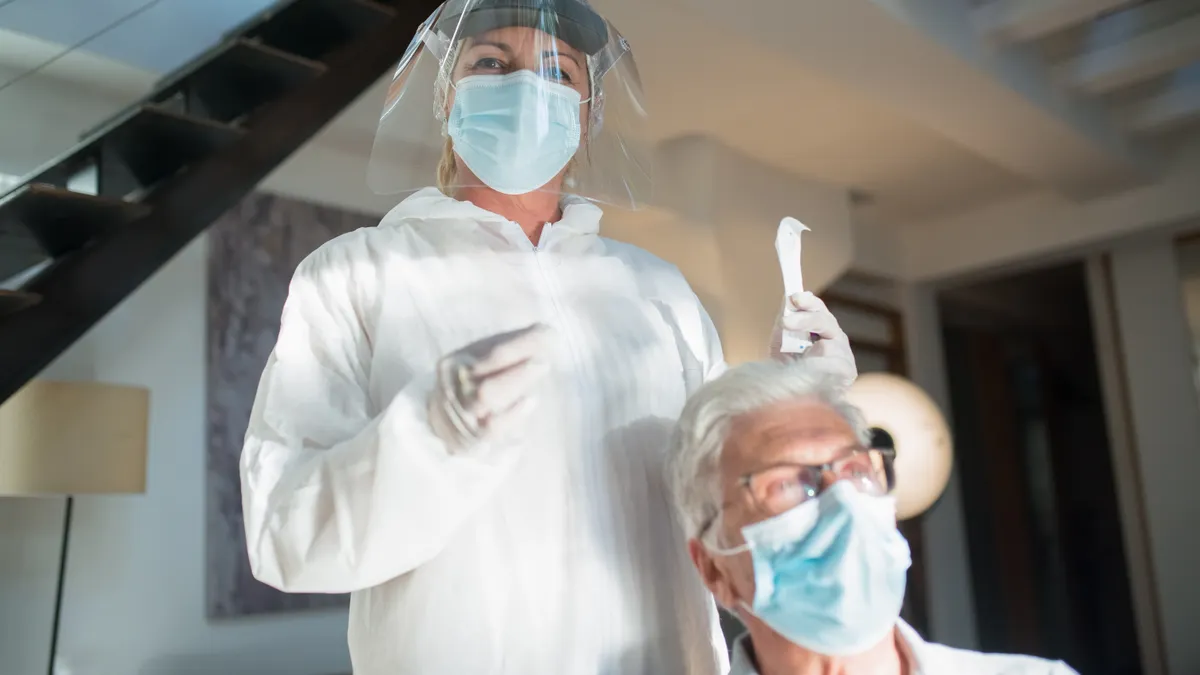
Home care is enough when the main gap is everyday living, not medical treatment. If the person can stay safe with help getting dressed, eating, moving around the house, or getting to appointments, home care may be the right start. If there is any doubt about medical needs, ask a clinician before assuming home care alone is enough.
Picture this: the person is back home after a hospitalization, but the bigger problem is exhaustion, clutter, and missed meals. A skilled nurse may not be necessary every day. What may be needed is steady hands, a safer routine, and another person in the room.
Home care wins when:
- The person needs help with 1-2 daily tasks, not clinical monitoring.
- Family caregivers are stretched thin by nights, work, or distance.
- The home is physically safe, but the routine has fallen apart.
- The goal is support at home, not treatment of a medical problem.
Its weakness is also its limit. Home care does not replace medical assessment, wound care, IV treatment, or rehab exercises prescribed after a hospital stay. If the person has new swelling, fever, confusion, drainage, or a sudden change in breathing, that is not a home care-only situation. A clinician should be involved, because those changes may need medical review rather than routine support.
Who should skip this: anyone who needs a nurse, therapist, or symptom management plan tied to a diagnosis. That person is usually a better fit for home health care or palliative care, depending on the main issue.
Why home health care wins after a discharge
Home health care is the better fit when there is a medical task that can be done at home under a clinician’s plan. It often starts after surgery, stroke, pneumonia, heart failure flare-ups, or another hospital event.
Picture this: a discharge planner hands you instructions for wound care, a walker, and follow-up therapy. The home feels familiar, but the recovery plan is not simple. That is home health territory. It is built for the transition from hospital to home. Medicare.gov notes that home health services are tied to a care plan and, in many cases, a physician order.
Home health care usually includes skilled services such as:
- Nursing assessment and monitoring
- Wound care
- Injection or medication teaching, when appropriate
- Physical, occupational, or speech therapy
- Lab draws or other ordered clinical tasks, depending on the agency and payer rules
The strength here is medical follow-through. The trade-off is that it is not open-ended help with chores, and it is not designed to cover every daily task. Visits are tied to a plan and eligibility, often after a physician order. A hospital discharge planner or primary care physician typically starts the process.
For someone who needs therapy after a stroke, home health care usually beats home care because it addresses function and recovery together. For someone who just needs help making lunch and remembering appointments, it is usually too clinical for the problem.
Who should skip this: someone whose main need is companionship, rides, or light household help without a skilled medical goal. That person is usually better served by home care, not home health care.
Where palliative care fits when the diagnosis is serious
Palliative care is the right next step when symptoms and stress are driving the crisis, even if treatment is still going on. It is not the same thing as hospice, and it can start early in a serious illness. If there is any uncertainty, ask a clinician whether palliative care is appropriate for the current stage and needs.
Picture this: the diagnosis is new, or the illness has become harder to control, and every appointment ends with a new medication list. Pain, nausea, fatigue, breathlessness, and family strain start taking over the week. Palliative care is designed for exactly that kind of mess.
Palliative care often helps with:
- Pain or symptom control
- Medication trade-offs
- Understanding treatment choices
- Coordinating among specialists
- Emotional and family support
This is the best choice when the question is not “Can the person function at home?” but “How do we keep symptoms from running the whole day?” A primary care physician, oncologist, cardiologist, nephrologist, or hospital team may refer. In many systems, the referral can happen during a hospital stay, after discharge, or at an outpatient visit.
Its weakness is that it is not a housekeeping plan and not a substitute for home health nursing when a wound, therapy plan, or post-op need is active. The better the symptom burden, the stronger the case for palliative care. The more the problem is chores and errands, the weaker the case.
The honest side-by-side
Home health care usually wins after hospitalization, while home care wins for daily support and palliative care wins for serious symptom burden. If you are trying to choose fast, this table does the sorting work.
| Criteria | Home Care | Home Health Care | Winner for [condition] |
|---|---|---|---|
| Main goal | Daily help and safety | Medical recovery at home | The one that matches the problem |
| Needs a clinician order | Usually no | Usually yes | Home health care for medical tasks |
| Includes bathing, meals, rides | Yes, often | Not the main focus | Home care for daily living |
| Includes nursing or therapy | No | Yes | Home health care after discharge |
| Focus on pain and symptoms | Not the core job | Sometimes, but not the main model | Palliative care for symptom relief |
| Works alongside treatment | Yes | Yes | Palliative care during active treatment |
| Best after surgery or stroke | Only if daily help is the issue | Yes | Home health care |
| Best when family is burned out | Yes | Sometimes | Home care |
| Best when diagnosis is serious and symptoms are heavy | Not enough by itself | Not enough by itself | Palliative care |
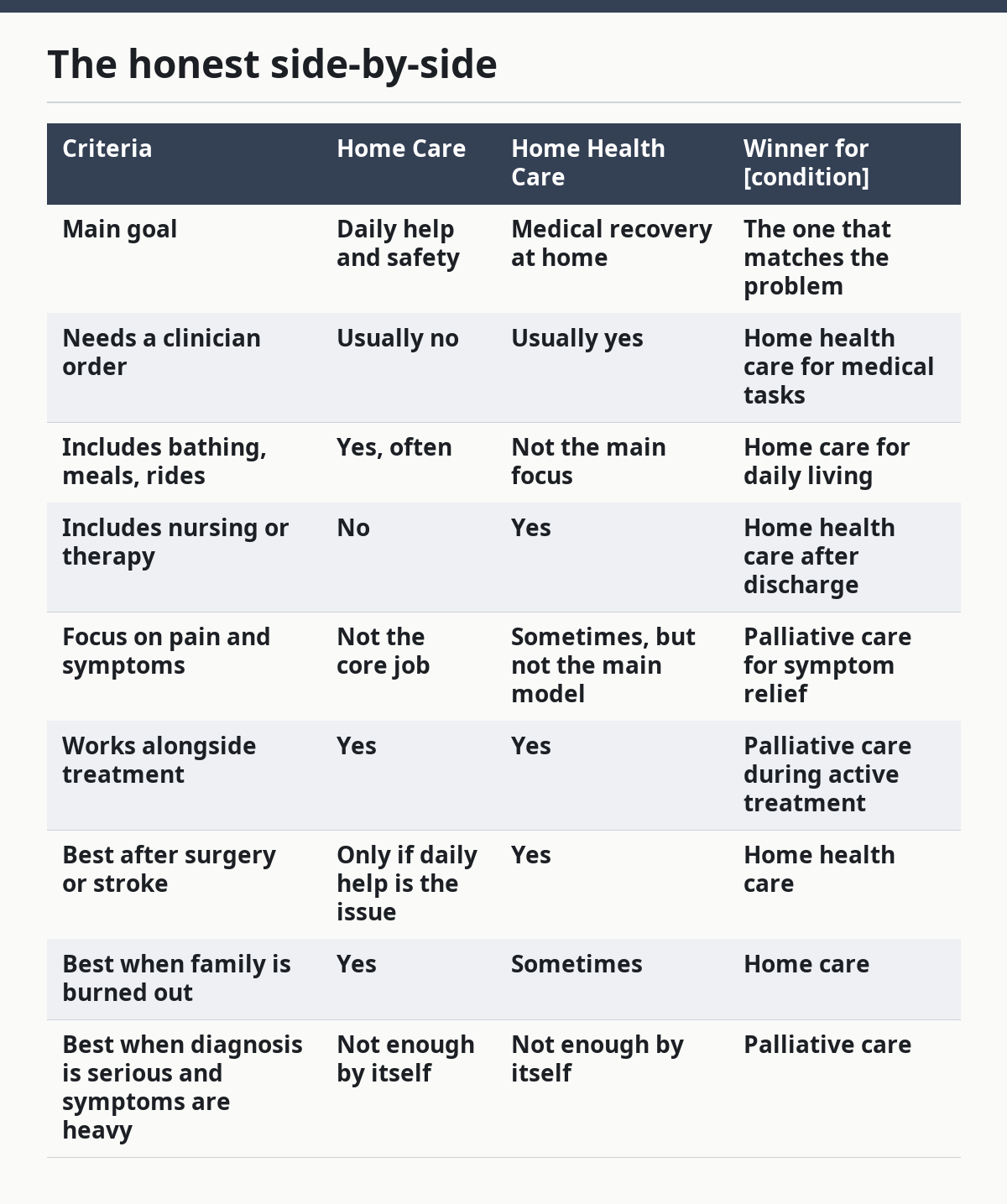
Now, you might be wondering why palliative care appears beside the other two when it sounds more medical. The answer is simple: it solves a different problem. Home care solves support. Home health care solves recovery. Palliative care solves suffering and complexity.
For source material on the model, the National Institute on Aging and the Center to Advance Palliative Care both explain these differences clearly; the NIH’s MedlinePlus pages on home care and palliative care are also useful starting points.
How referrals and eligibility usually work
Referrals usually start with the discharge planner, the primary care physician, or the specialist treating the illness. That person matches the need to the program, then checks what the plan of care and payer rules allow.
Picture this: you are home with a stack of paperwork and no one has explained who actually orders the next step. That is where delays happen. The order matters because home health care often needs documentation of a medical need, while palliative care may need a specialist referral or clinic intake, and home care may be arranged directly through an agency.
A useful rule:
- If the need is medical recovery, ask about home health care.
- If the need is daily support, ask about home care.
- If the need is symptom burden from a serious illness, ask about palliative care.
The truth is, the same person may qualify for more than one at once. Someone recovering from heart failure may need home health nursing, palliative symptom support, and home care help with meals and rides. That is not redundancy. It is a sign the situation is more than one problem in one room.
If you are unsure, ask the discharge planner, “What is the main problem this plan is solving?” That one question often clears up the whole picture.
Questions to ask before starting anything
The best next move is the one that answers these questions before the first visit. If the answers are vague, the wrong fit is close behind.
Picture this: you are ready to start, but the agency, clinic, and family all use different words. A few direct questions can stop a bad match before it starts.
Ask:
- What exact problem is this meant to fix?
- Who is ordering or overseeing the plan?
- Is this daily support, skilled care, or symptom care?
- What tasks are included, and what is excluded?
- How often will someone come, and for how long?
- What happens if symptoms get worse?
- Who do I call after hours?
A home health plan without clear visit goals can fizzle. Palliative care without a clear symptom list can drift. Home care without a realistic schedule can leave the family still doing the hardest parts. Specific questions protect the person at the center of the plan.
When the answer changes after a week or two
The right choice can change if the person gets weaker, improves, or develops new symptoms. A good plan for day 1 may be wrong by day 10.
Picture this: the person starts with home care after discharge, then a wound worsens, or breathing gets harder, or pain becomes the main issue. That shift is the signal to call the physician, discharge planner, or specialty team again. Don’t keep forcing the first answer to fit a new problem.
Reconsider the choice if:
- A daily living problem turns into a wound, infection, or mobility decline.
- Recovery stalls and therapy becomes the main need.
- Pain, nausea, breathlessness, or anxiety start driving the day.
- Family caregivers cannot safely cover the gap anymore.
That is the point where the plan should widen, not where everyone doubles down on the wrong label.
The verdict: which one should you choose?
Choose home care if the person mainly needs help staying safe and getting through the day. Choose home health care if the person needs a clinician-led recovery plan after an illness, injury, or hospital stay. Neither if the main issue is heavy symptom burden from a serious illness and no palliative care referral is being made.
That is the clean call. If the problem is chores and support, start with home care. If the problem is wounds, therapy, or medical follow-up at home, start with home health care. If the problem is pain, shortness of breath, fatigue, nausea, or repeated hospital use tied to a serious diagnosis, palliative care should be on the table right away.
What if more than one fits?
More than one can fit at the same time, and that is often the best answer. A person can have home care for meals and rides, home health care for wound checks, and palliative care for symptom relief.
Picture this: the hospital team says the discharge is safe, but the house is not ready, the recovery is shaky, and the illness is still causing trouble. One label is too small for that reality. The better plan is a layered one.
The exception scenarios where the usual answer flips are:
- A serious illness with major symptoms: palliative care may matter first, even before home support is added.
- A rehab-heavy discharge: home health care may come before any home care discussion.
- A stable person with no medical task: home care may be enough, and medical services would be too much.
- A sudden decline after discharge: the next step may be reassessment, not just choosing one of the three.
That’s the real picture. The title matters less than the job it has to do.
What is the difference between home care and home health care?
Home care helps with daily living tasks, while home health care handles skilled medical needs at home. Home care is for help with bathing, meals, rides, and companionship; home health care is for nursing, therapy, wound care, and other clinician-directed tasks. If the main issue is recovery after a hospital stay, home health care is usually the better fit.
When does palliative care start?
Palliative care can start as soon as a serious illness is affecting symptoms, decisions, or quality of life. It does not wait for the final stage of illness, and it can run at the same time as active treatment. If pain, breathlessness, nausea, fatigue, or stress are piling up, that is a reason to ask a clinician whether palliative care should be added now.
Drafted with AI; not yet reviewed by a person.