Last updated: November 19, 2026
Key Takeaways
- Hire help when daily care tasks outgrow what the family can reliably cover.
- Repeatedly missed tasks after sharing duties are a warning sign.
- If the family is exhausted, the care setup is already under strain.
You need a home health aide when family care is no longer covering the daily tasks, safety risks, and gaps in time. If you are asking how to know when it is time to hire a home health aide instead of relying on family care alone, this guide gives you a practical way to tell. The checklist below helps you see that line before someone burns out or gets hurt.
Use it to compare task load, safety, and family capacity before the situation turns into a crisis.
The point where family help stops being enough
Picture this: you’re juggling work, meals, pills, rides, and a parent who now needs help getting out of bed and into the bathroom. The answer is when the care plan has more moving parts than your family can cover every day.
That line is not about love. It’s about coverage. A family caregiver can do a lot, but one person cannot be on duty for 24 hours without a break, and a home health aide exists to cover the repeat work that keeps getting missed.
Here’s the catch: the need is often obvious before anyone says it out loud. The sink stays full, the pill box gets skipped, or one person starts missing work twice a week.
Look for these signals:
- Tasks are taking more than one person to finish.
- Basic routines are slipping for days at a time.
- Someone in the home is becoming unsafe.
- The same argument keeps happening over baths, meals, or medications.
- One family caregiver is close to quitting.
That last one matters. If the caregiver is exhausted, the whole setup is already unstable.
What a home health aide covers that family care often misses
A home health aide covers the repeat, hands-on jobs that eat up a day: bathing, dressing, toileting support, transfers, meal help, light household tasks, and watching for obvious changes during the visit. That makes the care plan hold together between doctor appointments.
The key difference is consistency. Family care usually comes in bursts—morning, evening, weekends. A paid aide can fill the middle hours when nobody else is available.
Common gaps this closes:
- No one can stay home for a 2-hour window during work.
- A parent needs help every day, not just “when someone can.”
- Bathing is being skipped because it takes too much lifting.
- Meals are late, cold, or forgotten.
- A person needs steady prompts, not just a quick check-in.
A home health aide is not a fix for every need. It is a better fit when the work is repetitive, physical, and time-sensitive. It is a worse fit when the main need is nursing-level treatment, complex wound care, or constant medical monitoring from a doctor’s plan; in those cases, consult a professional. The U.S. Department of Health and Human Services notes that home health services and aide support are different from skilled nursing care. HHS
The truth is, family care breaks down fastest when the job is invisible but constant. That is where paid help earns its place.
How do I know the care needs have crossed the line?
You know the care needs have crossed the line when the same task keeps failing even after the family has tried to split it up. If medication, bathing, meals, or transfers still depend on luck, the home setup has a coverage problem.
Use this 3-step check before the situation gets worse:
- List the daily tasks in one ordinary day—morning, afternoon, evening, and overnight. Write down what takes 15 minutes and what takes 45 minutes, because the long tasks are what break a family schedule.
- Mark the missed tasks from the past 7 days. If a job was skipped, rushed, or done by the wrong person, circle it. Missed showers, late pills, and untouched meals point to a real gap.
- Match the hours to people. If the care needs add up to more hours than the family can actually cover, the plan is short. That means the answer is not “try harder”; it is “add help.”
This check works because it turns a vague feeling into a concrete count of chores, hours, and hands. A family that can cover 10 hours a week may still be short if the person needs help every morning.
Use a simple note on paper or a phone app. After 7 days, the pattern is usually clear.
Safety problems that mean a home health aide should be on the table
Picture this: you’re watching someone grip the hallway wall to make it to the bathroom, and you know one slip could change everything. That is a safety problem, not a scheduling problem.
The strongest sign is repeated risk during transfers, bathing, stairs, or toileting. A family member who is small, injured, pregnant, or alone should not be the default lifter for someone who is unsteady.
Watch for these red flags:
- Near-falls or actual falls.
- Bruising from rough transfers.
- Refusal to bathe because the setup feels unsafe.
- Confusion that leads to wandering or leaving water on.
- A person who cannot stand safely for 1 minute without help.
Safety also includes the home itself. A cluttered hallway, loose rugs, poor lighting, and a bathroom with no grab bars can make a small task dangerous.
A home health aide can reduce that risk by providing trained hands for routine movement and body care. That does not replace changes to the home. It just lowers the chance that a tired family member makes one bad move at the wrong time.
On the flip side, if the danger is extreme—serious falls, fainting, or sudden confusion—home help may not be enough by itself. That is when a doctor needs to review the care plan.
When family limits are the real reason to hire
Picture this: you’re the one everyone calls, and you have not had a full night’s sleep in 3 weeks. The care might be manageable on paper, but the family is out of fuel.
This is the part many articles skip. The first sign is often not the person receiving care. It is the caregiver who is missing work, losing patience, or giving up sleep. That is a real limit, and it changes the math.
Common family limits:
- One caregiver is already doing the job alone.
- Adult children live too far away for daily help.
- A spouse is older and cannot lift safely.
- The family can cover weekends but not weekdays.
- Conflict is slowing down basic decisions.
The mechanism is simple: when one person is the backup for everything, every illness, late meeting, or school pickup becomes a care gap. A private duty aide or a home care agency can fill part of that gap so family members stop living on call.
This is also the right time to bring in the doctor and the care plan. If the person’s needs have changed, the plan should say what has to happen each day and what can wait. That makes it easier to decide which jobs belong to the family and which belong to a paid aide.
A family caregiver who is barely holding on is not a small problem. It is a warning sign.
How to compare paid help with the care you already have
Picture this: you have a relative doing mornings, a neighbor helping once a week, and still the evenings fall apart. That means the issue is not effort; it is the shape of the schedule.
The next step is to compare the current care map with the actual day. Start with the jobs that must happen at fixed times, then see where the gaps land. That shows whether a home health aide is the missing piece or whether the care plan needs a larger change.
Use this list:
- Morning tasks: getting up, toileting, washing, dressing, breakfast.
- Midday tasks: meals, medication prompts, mobility help, supervision.
- Evening tasks: dinner, bedtime routine, changing clothes, transfers.
- Overnight tasks: bathroom trips, turning, confusion, emergency response.
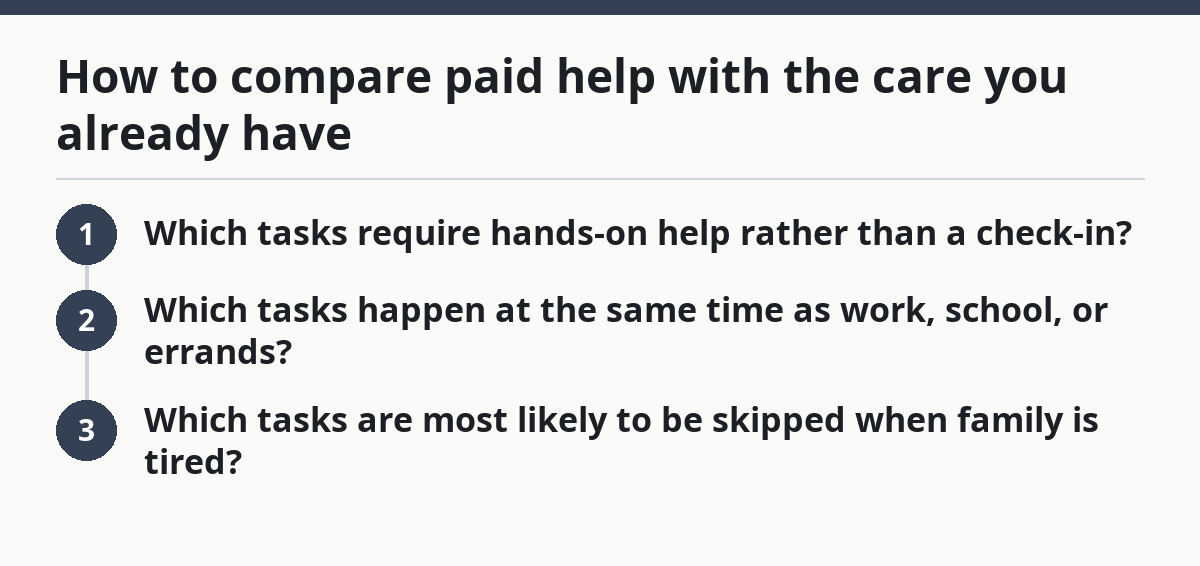
Now ask three questions:
- Which tasks require hands-on help rather than a check-in?
- Which tasks happen at the same time as work, school, or errands?
- Which tasks are most likely to be skipped when family is tired?
If the answer keeps pointing to the same uncovered block of time, paid help makes sense. If the gaps are tiny and rare, family care may still be enough for now.
For more on how these pieces fit with clinicians and service plans, the caregiver coordination with providers and services hub is the next stop. It helps connect the care plan to outside support without guessing.
What a home health aide is wrong for
Picture this: you’re hoping one extra helper will solve a problem that really needs a different level of care. That is where people waste time and money.
A home health aide is the wrong tool when the main problem is not daily personal care. It is not the best match for:
- Skilled wound care.
- Complex medication changes.
- A person who needs constant medical observation.
- A home that is unsafe in ways that still need repairs.
- A family looking for one person to replace every role.
It is also a poor fit if the care need is mostly emotional rather than physical. Aides can help with routine and presence, but they do not replace the plan, the doctor, or the family conversation.
The honest trade-off is this: paid help brings coverage, but it also means scheduling, supervision, and a new person in the home. That can feel awkward at first. Still, if the choice is between that and regular missed care, the trade is usually worth making.
A family that waits until it is already in crisis often ends up hiring under pressure, which is the worst time to make a rushed choice. Better to spot the gap when it first shows up.
The simplest rule for making the call
Picture this: you’re standing in the kitchen with a stack of unpaid tasks and one exhausted caregiver. The decision is usually clear once you ask one question: can the family cover the care safely, every day, without breaking down?
If the answer is no, the time to hire has arrived. If the answer is “almost,” that is still a warning sign, not a victory lap.
Use this rule:
- If tasks are being missed, add help.
- If safety is slipping, add help.
- If the caregiver is at the edge, add help.
- If the doctor’s care plan needs more hands than the family has, add help.
A home health aide is not about giving up family care. It is about making the care durable enough to last through a normal month, not just a good week.
What tasks can a home health aide do?
A home health aide can help with daily personal care and basic support tasks that are hard for family members to keep up with. That often includes bathing, dressing, toileting help, meal support, light housekeeping, and simple supervision during routine hours.
The exact list depends on the care plan and the agency. Some jobs need a doctor’s direction or a different level of professional care, so the written plan should spell out what is covered.
How do you tell if family care is no longer enough?
Family care is no longer enough when tasks keep getting missed, rushed, or done unsafely. If the same problems return over a week or two—late meals, skipped bathing, missed pills, or caregiver exhaustion—the setup needs more support.
The clearest sign is a pattern, not a single bad day. One bad day happens. A pattern means the schedule is too thin.
When should you ask for professional help at home?
You should ask for professional help at home when the care needs are more than the family can cover without stress, risk, or repeated gaps. That is especially true after falls, worsening mobility, confusion, or caregiver burnout.
If the home no longer matches the person’s needs, bring in the doctor and review the care plan. Then decide whether a home health aide, a home care agency, or another support fits the gap.
Drafted with AI; not yet reviewed by a person.