Last updated: November 19, 2026
Key Takeaways
- Note the exact change, the time, and how it differs from the person’s usual state.
- Write down changes that are new, worsening, or outside the usual pattern.
- Record repeated changes that show up 2 or more times, or at the same time of day.
- Make a note right away for sudden, severe, or out-of-range warning signs.
Caregivers have to catch small shifts early and get them into a change tracking log before a hectic day swallows them. Write down new, worse, or unusual changes the same day you see them. This guide on how to spot early changes in condition that caregivers should write down right away shows what to watch, what to record, and when a note needs a call.
What to write down first in a change tracking log
Picture breakfast. Something feels off, but not enough to say it cleanly in one breath. The first note in a change tracking log should include the exact change, the time, and what was different from the person’s usual state.
Start with the basics that can be checked fast: a symptom diary, a temperature log, a blood pressure cuff reading if one is used, and a weight scale if weight is part of the care plan. Then add plain care notes in the same entry. Keep it spare. Keep it usable.
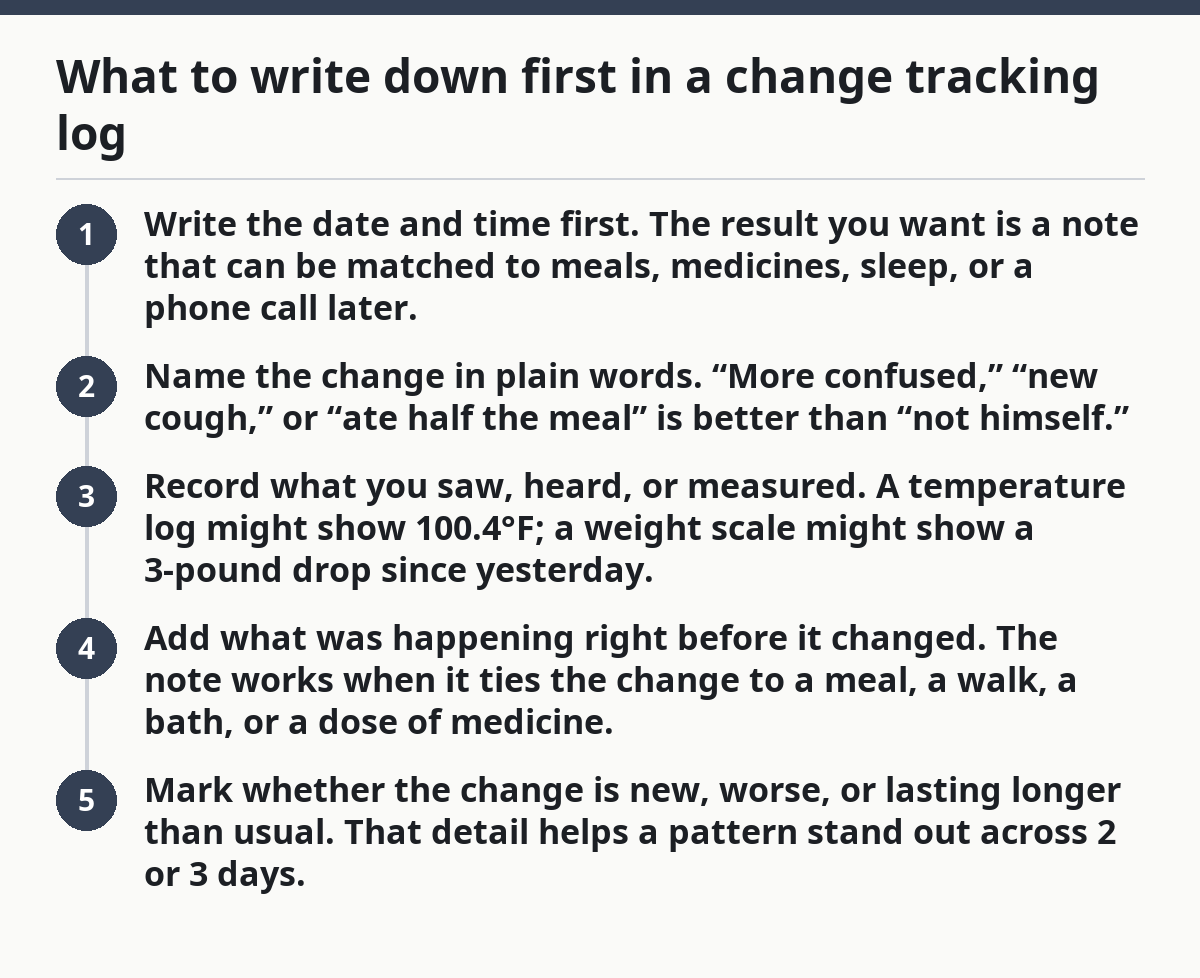
- Write the date and time first. The result you want is a note that can be matched to meals, medicines, sleep, or a phone call later.
- Name the change in plain words. “More confused,” “new cough,” or “ate half the meal” is better than “not himself.”
- Record what you saw, heard, or measured. A temperature log might show 100.4°F; a weight scale might show a 3-pound drop since yesterday.
- Add what was happening right before it changed. The note works when it ties the change to a meal, a walk, a bath, or a dose of medicine.
- Mark whether the change is new, worse, or lasting longer than usual. That detail helps a pattern stand out across 2 or 3 days.
The point is not a perfect chart. It is a note someone else can read and act on.
Which early changes matter enough to record right away?
Picture a small shift during a quick check between tasks. The changes worth writing down right away are the ones that are new, getting worse, or different from the person’s usual pattern.
A vague “fine” note misses the part that matters. Write down changes in alertness, walking, breathing, eating, urinating, pain, skin color, mood, and speech. Those are often the first signs that a condition is changing.
- Alertness: sleeping more, hard to wake, confused, restless, or unusually quiet
- Breathing: faster breathing, shortness of breath, wheezing, or new pauses
- Eating and drinking: less appetite, trouble swallowing, nausea, or skipped fluids
- Bathroom habits: fewer wet diapers, less urine, diarrhea, constipation, or pain with urination
- Pain: new pain, pain in a new place, or pain that lasts longer than usual
- Movement: unsteady steps, weakness, falls, shakiness, or trouble using one arm or leg
- Skin and color: pale, flushed, sweaty, blue lips, rash, swelling, or a wound that looks different
- Mood and speech: agitation, sadness, panic, slurred speech, or words that don’t fit the person’s usual way of speaking
If a change seems odd, record it. A careful note still helps before anyone knows the cause. That little line can be gold later.
How do I record pattern changes, not just one bad moment?
Picture one strange afternoon and ask: fluke, or the start of a trend? A pattern change is what appears 2 or more times, or what keeps happening at the same time of day, and that belongs in the log too.
One bad night matters. Three bad nights matter more. Write the same detail each time so you can compare it later: same symptom, same time, same trigger, same measurement.
Use a simple pattern line in the note:
- “Cough started after lunch for 3 days.”
- “Refused dinner 2 nights in a row.”
- “Blood pressure higher than usual at 8 a.m. on 2 days.”
- “More confused after taking evening medicine.”
This is where a change tracking log earns its keep. It turns separate moments into a pattern that jumps off the page. On the flip side, if the notes are too vague, the pattern disappears.
You can also compare against the person’s usual baseline. If someone normally walks 3 blocks and now struggles to cross a room, that change belongs in the note even if no one else saw it. If a person usually eats most of a meal and now only takes a few bites, that is a change, not “picky eating.”
A pattern note should answer 3 questions in 1 line: what changed, how often it happened, and what was different from usual. That is enough for the doctor, nurse, or family member to see the shape of the problem without guessing.
What counts as a warning sign that needs a note now?
Picture a busy day and the urge to wait and see. Warning signs need a note now when they are sudden, severe, or outside the person’s normal range.
Some changes are not “watch and wait” changes. Write them down immediately if they involve:
- trouble breathing
- new chest pain
- fainting or near-fainting
- a fall with a head hit
- sudden confusion
- slurred speech
- one-sided weakness
- seizure activity
- blue lips or gray skin
- repeated vomiting
- no urine for a long stretch
- a fever that is new for that person, especially if the care plan says to monitor it
- a wound that suddenly looks redder, hotter, more swollen, or draining
The note should say what happened, when it happened, and what you did next. If you took a blood pressure cuff reading, write the number. If you used a temperature log, write the exact temperature. If you called a nurse line or doctor, write the time of the call.
Here’s the catch: a warning sign may fade before anyone else sees it. That does not make it less real. A short, exact note beats a long guess later.
A simple line can be enough: “8:10 p.m., sudden shortness of breath after walking to bathroom, rested in chair, lips looked pale, oxygen not checked, daughter called doctor at 8:20 p.m.” That kind of note gives the next person something solid to work with.
What should go into daily observations so the log stays useful?
Picture an ordinary day. The little details still tell the story. Daily observations should cover the same basics each day so small shifts are easy to spot over 24 hours.
Record:
- sleep: slept through the night, woke often, napped most of the day
- meals and fluids: ate half, drank less, skipped lunch, needed help chewing
- mobility: walked with a cane, needed more help standing, slower than yesterday
- pain: where it hurts, what makes it worse, whether rest helped
- bathroom use: normal, less often, loose stool, straining, accidents
- skin: dry, sweaty, red spots, bruises, swelling, or a wound
- mood and thinking: calm, withdrawn, anxious, more forgetful, irritable
- medicines as they affect behavior: sleepy after a dose, shaky after taking it, nausea after pills
A daily note can be short if it is consistent. “Breakfast 50%, drank 1 cup, walked to chair with help, slept 2 hours after lunch” gives a usable snapshot of function.
Plain daily notes are often the most useful. They do not need medical language to be useful. They need the same categories each day, and enough detail that a change stands out when it happens twice in a row.
When should caregivers call the doctor with the note?
Picture 3 days of careful notes and the decision still hanging there. Call the doctor when the log shows a new problem that lasts, repeats, or is clearly worse than usual.
A change tracking log works best when it supports action, not just memory. Call after you record the note if the change is:
- lasting longer than a day or two
- happening more often
- getting worse instead of better
- tied to a medicine change
- affecting eating, drinking, walking, breathing, or thinking
- paired with a warning sign
Bring the note, not a story from memory. Say the date, the main change, the number if you have one, and how long it has been going on. If you use a symptom diary, bring the last few entries, not just today’s.
A useful call sounds like this: “For 2 days, he’s been more confused after supper, ate less, and his temperature was 100.4°F this morning.” That gives the clinic a clear picture in one pass.
For more on daily care routines, see what a caregiver does and how to keep a symptom diary. If you are tracking measurements, how to use a temperature log and how to read a blood pressure cuff can help make the note easier to use.
Common mistakes that hide early changes
Picture notes so thin that nobody can use them later. The biggest mistake is writing a feeling instead of a fact, and it costs you the chance to spot a trend early.
The most common errors are easy to miss:
- Writing “doing okay” instead of the exact change
- Waiting until the end of the week to fill in the log
- Mixing one-time events with true pattern changes
- Leaving out numbers from a temperature log, blood pressure cuff, or weight scale
- Writing only bad days and skipping normal days
- Not saying what happened before or after the change
What does that cost? A doctor or family member gets a blurry picture and may miss the difference between a one-off bad hour and a real decline. What to do instead is simple: make the note while the moment is fresh, even if it takes 2 minutes.
Use the same format each time:
- what changed
- when it started
- how long it lasted
- what number or sign you saw
- what happened next
That format keeps the log readable under stress. It also keeps you from talking yourself out of a real change because it seemed “too small” to matter. Small changes are often the first ones that count.
Which changes should a caregiver report immediately?
Report sudden breathing trouble, chest pain, fainting, seizure activity, one-sided weakness, blue lips, severe confusion, or a fall with a head hit right away. Those changes can point to a serious problem even if they improve in a few minutes.
Write the exact time, what you saw, and any number you measured with a blood pressure cuff or temperature log. Then contact the doctor or emergency service based on the care plan.
What signs mean a condition is getting worse?
A condition is getting worse when the same problem happens more often, lasts longer, or takes more effort to manage. Less eating, more confusion, weaker walking, worse pain, or a new fever are all signs to record closely.
Look for a shift from the person’s usual pattern over 1 to 3 days, not just one rough moment. If the change keeps repeating, it is not background noise.
How often should caregivers check for changes?
Check as often as the care plan calls for, and at least once a day for the basics you track in the log. Many caregivers notice changes during morning care, meals, medication times, and bedtime because those routines repeat every 24 hours.
If a person is already unwell, the checks may need to happen more often. The key is consistency, because the log only helps when today can be compared with yesterday.
Reliable sources for caregiver notes and symptom tracking
For symptom tracking and when to seek help, the National Institute on Aging and MedlinePlus both recommend watching for changes in daily function, thinking, and breathing. For practical note-taking and care planning, the Centers for Disease Control and Prevention also provides guidance on tracking symptoms and warning signs over time.
Drafted with AI; not yet reviewed by a person.