Last updated: November 19, 2026
Key Takeaways
- Use a calm dementia care routine, not a debate, and lower the noise around the person first.
- Match the person’s pace to settle the moment instead of proving a point.
- Turn care tasks into short, visible steps in the same order each time.
- Change the routine in small pieces, because even helpful changes can feel threatening on a hard day.
A hard day with dementia can turn a normal morning into repeated questions, agitation, or fear. How to help someone with dementia through a difficult day without escalating confusion starts with calm, simple redirection in a steady routine, not correction. The steps below show what to do first, what to say, and how to keep confusion from snowballing.
What to do first when the day starts to go wrong
When the day starts to go wrong, the first job in how to help someone with dementia through a difficult day without escalating confusion is to lower the noise around the person. Picture this: you’re standing in a kitchen at 9 a.m., the coffee is getting cold, and the same question has already come up three times. You need a calm dementia care routine, not a debate.
Start by checking the basics in the room. Look for glare, TV noise, too many people, an empty plate, a wet brief, or a missing familiar object. Then use the same clock calendar, the same chair, and the same short phrase you use on other hard days.
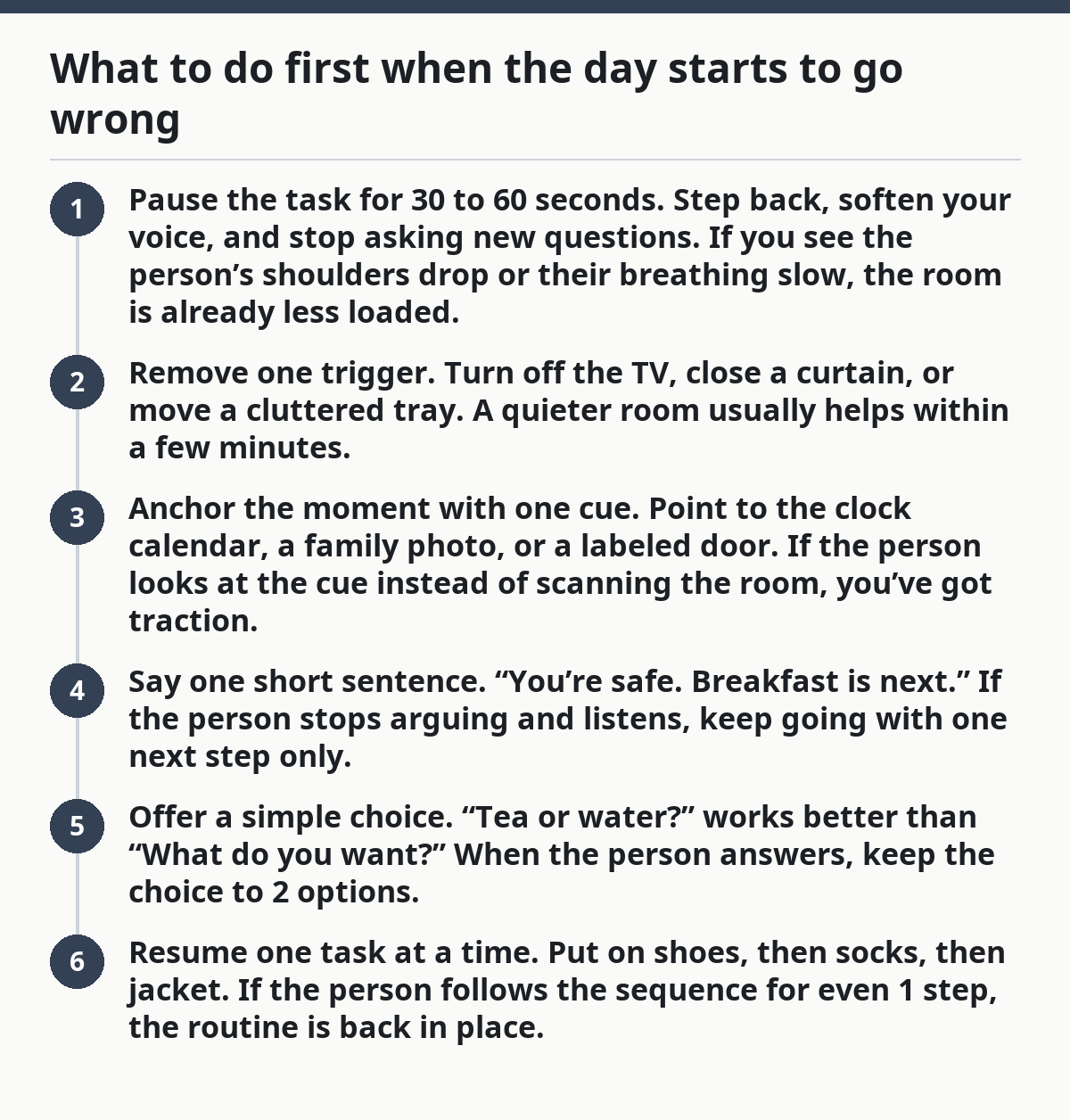
- Pause the task for 30 to 60 seconds. Step back, soften your voice, and stop asking new questions. If you see the person’s shoulders drop or their breathing slow, the room is already less loaded.
- Remove one trigger. Turn off the TV, close a curtain, or move a cluttered tray. A quieter room usually helps within a few minutes.
- Anchor the moment with one cue. Point to the clock calendar, a family photo, or a labeled door. If the person looks at the cue instead of scanning the room, you’ve got traction.
- Say one short sentence. “You’re safe. Breakfast is next.” If the person stops arguing and listens, keep going with one next step only.
- Offer a simple choice. “Tea or water?” works better than “What do you want?” When the person answers, keep the choice to 2 options.
- Resume one task at a time. Put on shoes, then socks, then jacket. If the person follows the sequence for even 1 step, the routine is back in place.
The truth is, a difficult day gets harder fast when the helper piles on explanations. A clock calendar, familiar objects, and the same order of care do more than a long speech ever will. For more on practical routines, see dementia care tips and how to communicate with someone with dementia.
How do I calm someone without arguing?
Calm the moment by matching the person’s pace, not by proving a point. Short sentences, a lower voice, and fewer words usually reduce fear in less than a minute.
Picture this: the person says they need to “go home” while standing in the home they’ve lived in for years. If you correct every detail, you may get a louder loop, not less confusion.
Use this pattern instead:
- Name the feeling first. “You seem upset.”
- Give one fact only. “Lunch is ready.”
- Offer one next action. “Let’s sit here.”
If the person repeats a false belief, do not keep correcting it. Try a response that protects the emotion behind the words. “That sounds worrying. I’m here with you.” Then move to something concrete, like folding towels or looking at a photo album.
A useful rule is the 10-second pause. After you answer once, wait before repeating yourself. Many helpers fill the silence too fast and restart the loop. If the person relaxes during the pause, your answer landed. If not, switch to redirection.
Here’s the catch: calm language works best when your face and hands are calm too. Leaning over the person, pointing, or rushing around the room can make the words useless.
Steps that reduce confusion during daily care tasks
Reduce confusion by turning every care task into a small, visible sequence with the same order each time. That works best during bathing, dressing, meals, and medicine prompts, where too many choices can stop the day cold. It also fits the advice from the NHS on dementia and Alzheimer’s Association communication guidance.
Picture this: you’re helping with a shirt, and the person has frozen halfway through putting one arm in the sleeve. The goal is not to finish fast. The goal is to get the person moving again without making them feel managed.
Follow this procedure:
- Set out only what is needed. Put one shirt, one pair of pants, or one plate on a clear surface. If the person looks at the setup and starts the task instead of scanning the room, the clutter is low enough.
- Say the first step, not the whole plan. “Here’s your left arm.” If the person begins that step, do not rush to the next one.
- Use a visual cue or hand cue. Hold up the sleeve, point to the chair, or place the toothbrush in view. If the person follows your cue, keep talking less.
- Wait 10 to 20 seconds. Give time for the brain to catch up. If the person completes the step, the pause was long enough.
- Offer help only where needed. Guide one wrist, not the whole body. If the person accepts help without pulling away, you’ve kept control with less friction.
- Finish with a clear close. “Done. Shoes next.” If the person shifts to the next task, the sequence held.
Familiar objects often do half the work for you. The same mug, the same towel, or the same sweater can cue the next action before you speak.
Don’t mix three tasks at once. A sponge bath, a change of clothes, and a medication reminder in the same 5 minutes is a fast path to refusal. Split them up. The person who can handle one step may fail at three.
What should I change when the routine itself is the problem?
Change the routine in small pieces, not all at once, because even a helpful change can feel like a threat on a rough day. The safest change is the one that looks almost the same as yesterday, and that is often the best way to keep the day steady.
Picture this: breakfast is late, the room is noisy, and the usual chair is blocked by laundry. That is enough to upset the day. A person with dementia often reads the whole scene as wrong, even if only one part changed.
Use these fixes first:
- Keep meals, washing, and outings in the same rough order.
- Put the clock calendar where it can be seen from the seat the person uses most.
- Leave familiar objects in the same place unless they are unsafe.
- Keep lighting even. Shadows can look like people or holes in the floor.
- Reduce choices to 2 items when the day is already shaky.
If you must change something, change one thing only. For example, move breakfast to the table but keep the same cup, spoon, and seat. If the person settles after the change, the rest of the routine can stay put.
A routine change that looks small to you may feel huge to the person. A new caregiver, a late shower, or a different route to the bathroom can all trigger distress. That is why the order of the day matters as much as the tasks themselves. See also how to handle dementia sundowning for evening routines that stay familiar.
Which triggers make a difficult day worse?
Triggers make confusion worse when they pile up: noise, hunger, pain, fatigue, and too many directions in a row. If you can spot the trigger early, you can often stop the day from sliding downhill.
Picture this: it’s midafternoon, the person has not eaten much, and the room is full of chatter. Now the repeated questions start. The person may not be “being difficult” at all. The body may be tired, hungry, or uncomfortable.
Watch for these common triggers:
- Noise: TV, a ringing phone, or several people talking.
- Pain or discomfort: tight clothes, constipation, hunger, thirst, or a full bladder.
- Fatigue: a long morning, poor sleep, or too much stimulation.
- Change: a different helper, new furniture placement, or a rushed schedule.
- Loss of bearings: no clock calendar in sight, dim light, or an unfamiliar room.
The question to ask yourself is simple: what changed in the last hour? If the answer is “almost everything,” start removing pieces until the person has fewer things to process.
On the flip side, don’t chase every behavior with a new intervention. If you keep changing your response every 2 minutes, the day becomes more confusing for both of you. Pick one calming move and give it time to work.
How do I use redirection without sounding fake?
Redirect by moving attention to something real and nearby, not by trying to distract with a lecture or a trick. The person should feel guided, not brushed off.
Picture this: the person is stuck on leaving, calling for a long-dead parent, or asking where a child is. If you say “Let’s not worry about that,” you may sound dismissive. If you try a long explanation, you may deepen the loop.
Use redirection in 3 parts:
- Agree with the feeling. “That sounds upsetting.”
- Shift to one familiar object or action. “Let’s look at your photo album,” or “Help me fold these towels.”
- Keep the action short. Aim for 5 to 10 minutes, then reassess.
A familiar object works better than a random distraction because it gives the person something known to hold onto. A soft blanket, a labeled drawer, or a favorite mug can be enough.
Choose redirection that matches the person’s energy. If they are restless, walking to the mailbox may help. If they are scared, a chair, a blanket, and a clock calendar may work better. If they are angry, keep your own voice flat and brief.
This is not the time for a performance. It’s the time for a simple bridge from distress to the next safe thing. The Alzheimer’s Association and the CDC both recommend simple, familiar supports when dementia symptoms flare.
When should I call the primary care provider?
Call the primary care provider when the difficult day comes with a sudden change from the person’s usual pattern, because sudden change can signal pain, infection, dehydration, or another problem that needs attention.
Picture this: the person is far more confused than usual, won’t eat, seems in pain, or is suddenly much sleepier than normal. That is not a routine “bad day” to simply ride out.
Use this short check before you call:
- Has there been a clear change in 1 day or less?
- Is there fever, new pain, a fall, trouble walking, or a big change in sleep?
- Is the person unable to settle with the usual routine?
- Has the person stopped drinking, eating, or using the toilet normally?
If the answer to any of these is yes, contact the provider the same day. If the person is at risk of falling, is suddenly unsafe, or you cannot keep them supervised, get urgent help.
Bring a note with the time the change started, what was different in the day, and which calming steps you already tried. That makes the call more useful and cuts down on back-and-forth.
FAQ
What should you do during sundowning?
You should reduce noise, lower the light changes, and keep the evening routine plain. Sundowning often gets worse when the room is busy or the person is tired, so slow the pace by 4 p.m. if you can. Use a clock calendar, simple food, and one familiar activity before bedtime starts.
How do you redirect repeated questions?
You should answer once, then switch to a visible cue and a short next task. Repeating the same full answer often feeds the loop, while a clock calendar, a snack, or folding a towel gives the brain something new to hold. Keep the wording the same each time.
How do you reduce confusion during daily care tasks?
You should break the task into one step at a time and keep the setup very plain. Lay out only the items needed for that moment, use the same order, and wait 10 to 20 seconds before helping more. The goal is progress without overload.
What if the person refuses help?
You should back up, lower the demand, and try again with a smaller step. Refusal often means the task feels too fast, too personal, or too confusing. Try a different time of day, a familiar object, or a one-step offer like “sit here first” instead of pushing the whole task.
Drafted with AI; not yet reviewed by a person.