
Last updated: November 19, 2026
Key Takeaways
- Keep the current medication list, pharmacy labels, and a missed-dose plan ready before filling.
- Match each bottle to its label and recheck every compartment before closing the box.
- Review labels, refill dates, and timing patterns before the first dose goes in.
- Use one steady routine for morning, noon, evening, and bedtime doses.
If the person you help takes several prescriptions, a medication organizer can keep daily doses lined up so you can spot mistakes before they happen. For how to use a medication organizer for a caregiver when the person you help takes multiple prescriptions, speak with the person’s pharmacist or prescriber about their own situation first. The steps below show how to sort pills, match labels, and handle missed doses without turning the organizer into a second problem.
Who this is for — and what you need first
This is for a caregiver who is filling a pill organizer for someone on multiple prescriptions, usually with morning, noon, evening, and bedtime doses. You should already have the current medication list, the pharmacy prescription labels, and a plan for what to do when a dose is late or missed. If the person uses inhalers, injections, patches, or “as needed” medicine, those may need a different setup.
This method fits people who can take oral solid medicines from a tray with compartments marked by day or time. It does not fit every regimen. A weekly box with 7 days works well for simple schedules; a 28-compartment organizer or two boxes may be better for split dosing.
The page on understanding caregiver roles and responsibilities can help frame who does what, but this page stays on the task itself.
Before you start, gather these items:
- All current prescription bottles
- The latest medication list from the pharmacy or clinic
- A reminder calendar or paper log
- Good light, a clean table, and dry hands
- A pen or label maker for notes
- A backup phone number for the pharmacy
A tidy setup only takes 1 pass when the list is current.
How do you fill a weekly pill organizer safely?
You fill it by matching each bottle to the current label, placing only the medicines that belong in each compartment, and checking every slot twice before the box is closed. A weekly organizer usually has 7 days and, in some models, 2 to 4 time slots per day.
Follow these steps in order:
- Lay out every bottle and the medication list. Put the list beside the bottles and sort them by time of day, such as morning, noon, evening, and bedtime. Verify that every bottle name matches the list exactly. If you find a bottle that is not on the list, stop and confirm it with the pharmacy.
- Check the prescription labels one by one. Read the patient name, drug name, strength, and directions on each label. Use the label wording, not memory. If the label is hard to read, torn, or different from the list, that is a problem and needs a pharmacy call before anything goes into the tray.
- Separate medicines by schedule, not by habit. Place each bottle in a small stack for the exact dose time it belongs to. A morning medicine should not land in a bedtime slot just because it is taken daily. Verify that each pill is going into the right time column. A wrong column is the earliest sign of a setup error.
- Fill one week at a time. Open the organizer and load only the next 7 days unless the product is designed for a longer cycle. Check that each compartment has the right count for that day. If a slot looks crowded, the problem may be that one medicine is meant to stay in its bottle or needs a separate organizer.
- Keep “as needed” medicines out of the box unless instructed. PRN medicine means taken only when needed. Those pills often stay in the original bottle so they are not confused with routine doses. Verify that routine doses are in the box and PRN items are stored separately with clear labels.
- Match the number of compartments to the dosing pattern. If the person takes medicines 2 times a day, a twice-daily box is easier to read than a 4-slot box with empty spaces. Empty compartments are not a problem by themselves; a mismatched pattern is. If you keep wondering where a pill goes, the organizer is not set up well enough.
- Close each compartment and review it against the label. After filling, check each day from left to right. Say the day and time out loud. Verify that every compartment closes fully and that no pill is stuck under the flap. If a lid will not close, the dose count is wrong or the pill is too large for that compartment.
- Place the organizer where the dose is actually given. Put it near the breakfast table, on the kitchen counter, or wherever the person reliably takes medicine, away from heat and moisture. Verify that the box is visible but not reachable by children or confused visitors. If it ends up hidden in a drawer, the system will fail on day 2.
A clean fill should look boring. Each compartment is closed, the day labels line up, and the schedule is easy to read at a glance. If you need to re-check a slot more than once, pause and compare it to the bottle label again.
What should you check before the first dose of the week?
You should check the labels, the refill dates, and the time pattern before anyone takes a pill from the organizer. This takes about 5 minutes and catches the errors that matter most: an outdated prescription, a bottle with a changed direction, or a missing medicine that should have been refilled.
Picture this: you are standing at the counter on a Sunday night, trying to sort five prescriptions that all look alike. The labels say the same patient name, but the directions are different. This is where a quick cross-check saves you from carrying an old instruction into the new week.
Use this short check:
- Compare the medication list with every bottle
- Confirm the pharmacy label still matches current directions
- Look for split tablets, capsules that cannot be opened, or pills that break easily
- Check whether any medicine has a specific timing rule, such as with food or at bedtime
- Look at refill counts so you know which bottle will run low first
A few medicines are poor fits for organizers because the dose can change often, the pill looks too similar to another one, or the instructions are too specific for a simple tray. That does not mean the medicine is “unsafe” on its own. It means the organizer may be the wrong container for it.
The organizer is a memory aid, not a decision maker. If a label changes, the box has to change too.
How do you handle multiple daily doses without mixing them up?
You handle multiple daily doses by giving each time of day its own pattern and by using the same routine every day. A 4-slot organizer works best when morning, noon, evening, and bedtime doses stay in the same place all week.
Use a fixed sequence:
- Morning first.
- Noon next.
- Evening after that.
- Bedtime last.
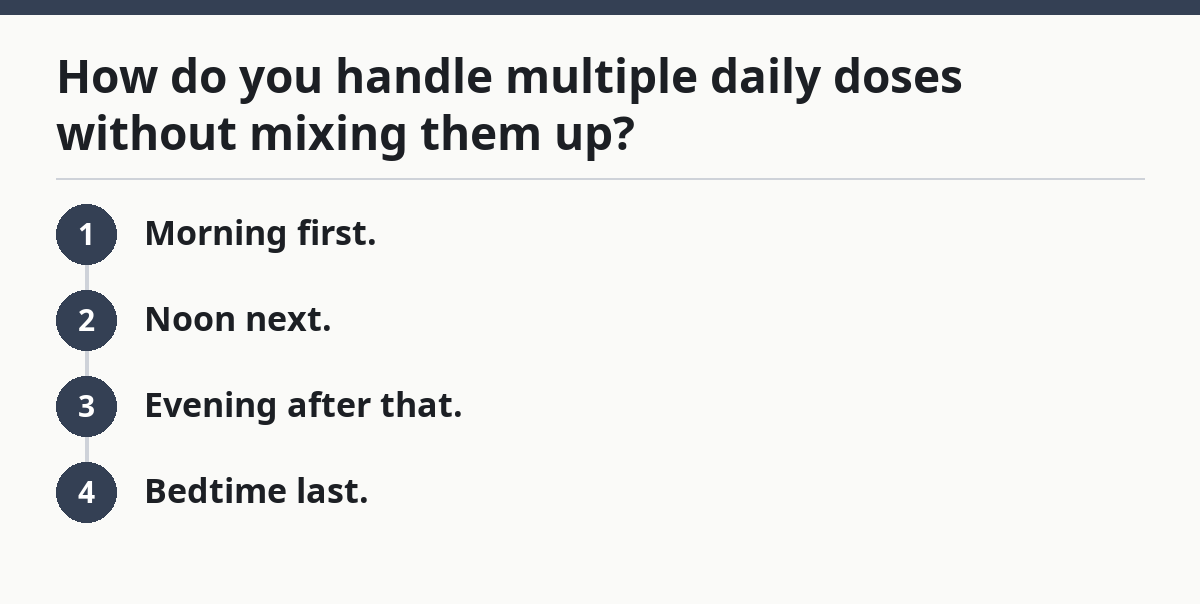
Keep each dosing time in the same physical spot every day. If the organizer has removable trays, label the top and side with tape so “morning” does not drift into “night.” On a 2-dose schedule, use only 2 marked compartments if possible; extra spaces invite mix-ups.
If the person takes more than one pill at the same time, place them together in the same compartment only when the labels and the pharmacy directions support that. If one medicine is taken with food and another is not, the timing note belongs on the tray or in the reminder calendar. A small note like “with breakfast” is better than trying to remember it from memory.
A simple paper reminder calendar still helps. Mark the refill date, the day the organizer is filled, and any dose that has been changed by the pharmacist. That paper trail matters when one medicine is stopped and another takes its place.
What to do if a dose is missed
You should follow the instructions on the prescription label or the pharmacist’s guidance for that specific medicine, because missed-dose advice varies by drug. Do not assume every missed pill should be taken right away.
Picture this: it’s 9 p.m., the evening compartment is still full, and someone asks whether to “double up” now so tomorrow stays on track. That is the moment to slow down, not speed up. The right answer depends on the medicine, the time missed, and the label instructions.
Use this general routine:
- Check the label first
- Look at the next scheduled dose on the organizer
- If the medicine has special timing instructions, call the pharmacy
- Do not move pills from the next compartment unless a qualified professional has said that is correct for that medicine
- Write the missed dose on the reminder calendar so the pattern stays clear
A missed dose is not just a forgotten pill. It can also mean the organizer is now out of sync with the bottle. If a pill was skipped and later taken from the wrong compartment, the whole week may need a reset.
If the person you help has a medicine that is often adjusted or has complicated directions, the organizer may need to be filled day by day instead of for the whole week. That is less convenient, but it can be safer.
When the standard organizer setup does not apply
A standard weekly box does not work well when the regimen changes often, the pills look too similar, or the medicine should stay in its original package. In those cases, the best move is to use a different method and ask the pharmacy how to separate the doses.
Do not use a routine pill organizer without extra review in these situations:
The label changed this week: The old directions may no longer match the current prescription — refill the organizer from the newest label only.
There are pills that look alike: Similar-looking tablets are easy to mix up — keep them in separate containers or leave them in the bottle until a pharmacist confirms the setup.
The medicine has special handling needs: Some pills should not be split, crushed, or placed in a tray that confuses the schedule — use the original package and follow the label.
The person takes “as needed” doses often: Routine organizers can make PRN medicine look scheduled — keep it separate and clearly marked.
The dose changes midweek: A half-filled tray can become wrong in a day — empty the affected compartments and rebuild the schedule from the updated instruction.
The organizer lid won’t close: The slot may be the wrong size or overloaded — switch to a larger box or a second organizer.
A 7-day tray is a tool, not a rule. If it creates more guessing than clarity, it is the wrong tool for that regimen.
The mistakes caregivers make, and what they cost
The most common mistakes are simple, and they are usually made in a hurry. The good news is that each one has a clear fix.
Picture this: you are trying to finish the week before dinner, and every bottle looks similar under the kitchen light. That is how small errors get into the box. One rushed fill can turn into 7 days of confusion.
Watch for these mistakes:
- Using an old label. The consequence is a schedule that no longer matches the current prescription. The fix is to fill from the newest bottle only.
- Mixing PRN medicine into daily slots. The consequence is that a needed medicine may be taken on autopilot. The fix is to keep it separate and clearly marked.
- Skipping the final check. The consequence is a pill in the wrong day or time. The fix is to review the box compartment by compartment before closing it.
- Ignoring refill timing. The consequence is running out midweek. The fix is to mark refill dates on a paper calendar and check bottle counts before filling.
- Overstuffing one compartment. The consequence is a lid that won’t close or pills that spill into the next slot. The fix is to use a larger organizer or keep some medicines in bottles.
- Relying on memory alone. The consequence is dose drift when the routine changes. The fix is to write the schedule down and keep it next to the organizer.
Most organizer mistakes are not about the box. They are about skipping the label check.
How to keep refill tracking from getting messy
You keep refill tracking manageable by pairing the organizer with a simple paper log and checking it on the same day each week. A reminder calendar on the fridge or near the medicine station works better than a note buried in a phone if several people help.
Use one page for this:
- Medicine name
- Pharmacy phone number
- Refill due date
- Last day the organizer was filled
- Any label changes
- Notes for medicines that stay outside the box
When a bottle gets low, mark it before the organizer is empty. That gives you time to call the pharmacy, ask about insurance delays if relevant, and avoid a last-minute scramble. If the refill is delayed, do not guess at the remaining dose plan; check the current label or ask the pharmacy.
A good refill system has one job: keep the organizer from becoming a surprise. If the weekly box is emptying and the bottle is empty too, the problem is no longer organization. It is supply.
When should a caregiver get help from the pharmacy?
A caregiver should get help from the pharmacy whenever the label, the bottle, and the organizer do not agree. That includes changed directions, unclear timing, a medicine that does not fit the tray, or any missed-dose question that is not spelled out on the label.
According to the FDA and NHS, label matching and clear timing instructions matter because medication errors often start with small setup mistakes. The pharmacy can help with label matching, refill timing, and whether a medicine belongs in a pill organizer at all. That is especially useful when there are multiple prescriptions with different schedules. A quick call can prevent a week of wrong placement.
Bring these details with you:
- The medication list
- The prescription bottles
- The organizer you plan to use
- The exact question about timing or missed doses
If you are helping someone with a complex regimen, that call is not overreacting. It is part of doing the job carefully.
Drafted with AI; not yet reviewed by a person.