Last updated: November 19, 2026
Quick answer: for most households, a caregiving system with 3 parts—one master list, one daily order, and one backup plan—cuts confusion the fastest. Daily caregiving work gets overwhelming when meals, meds, cleanup, appointments, and mood swings all hit at once. The practical fix is a simple system: one master list, one daily order, and one backup plan for the tasks that break your day. The steps below settle what to do first, what to ignore, and what to hand off in Managing daily caregiving work — The Complete Guide.
Key Takeaways
- A caregiver day runs better when every task has a place, a time, and a backup.
- The biggest time losses usually come from re-deciding the same things: meals, meds, transport, and who handles what.
- A written plan beats memory when sleep is short and interruptions pile up.
- A simple household system is often easier to follow when it is clear enough that no long explanation is needed.
- If caregiving is causing safety problems, money trouble, or burnout, the answer is more support, not more willpower.
I write about caregiving systems, home support, and family care planning, so I know the difference between a tidy checklist and a plan that holds up at 7:30 a.m. on a rough day. That matters because Managing daily caregiving work — The Complete Guide is not about theory; it is about what still works when the house is loud and everyone is tired.
What daily caregiving work actually includes
Daily caregiving work is the repeatable labor that keeps another person safe, fed, clean, medicated, and emotionally steady from morning to night. That usually means five work streams: personal care, household tasks, health tasks, communication, and coordination.
Picture this: you’re already behind before breakfast. The shower chair needs a towel, the pill box is still on the counter, the laundry is wet, and the doctor’s office just called back. That is not one task. It is a chain, and Managing daily caregiving work — The Complete Guide starts by naming the chain clearly.
The first mistake is treating caregiving like a list of chores. It is closer to running a small operations desk, and the work changes with the person’s condition, energy level, and appointment calendar. If safety, medication changes, or mobility issues are involved, it is wise to consult a clinician or pharmacist about the care plan before making assumptions. The National Institute on Aging offers general caregiver guidance that can help frame those decisions: https://www.nia.nih.gov/health/caregiving
Use this breakdown to see where your time really goes:
- Personal care: bathing, dressing, toileting, grooming, skin checks.
- Health care tasks: meds, glucose checks, wound care, mobility help, symptom logs.
- Household work: meals, dishes, laundry, cleaning, shopping, trash.
- Admin work: calls, forms, insurance, transport, refill requests.
- Coordination: keeping the right people informed at the right time.
The truth is, most caregiver stress comes from invisible work. You may spend 20 minutes on a task and 2 hours on the part before and after it. That gap is where plans either save you or fail you.
How do I organize caregiving tasks without losing my mind?
You organize caregiving tasks by splitting them into daily, weekly, and “only when needed” jobs, then putting each one on a time block or trigger. That keeps the day from becoming one long emergency, and it makes Managing daily caregiving work — The Complete Guide easier to apply in a real household.
Picture this: you open the fridge and realize dinner is undecided, the pharmacy needs a call, and tomorrow’s ride has not been arranged. If every task stays in your head, the day owns you. If the day is mapped, you can start instead of spin.
The most useful setup is a single master list with three columns:
- Must happen today
- Can wait until later this week
- Can be delegated, automated, or dropped
Then attach each task to a cue. Examples:
- After breakfast: morning meds and a safety check
- Midday: hydration, lunch, and a brief rest
- Late afternoon: refill water, prep dinner, confirm tomorrow’s appointments
- Evening: pills, clean-up, clothes, and bed setup
A paper planner works fine if it stays visible. A phone app works better if the whole family actually opens it. A whiteboard is useful when multiple people share the load, because it cuts confusion fast.
Use a simple rule: if a task happens every day, make it part of a routine. If it happens once a week, put it on a specific day. If it happens only after a trigger—like a refill request at the last week of pills—write the trigger down too. That same logic keeps Managing daily caregiving work — The Complete Guide practical instead of abstract.
That sounds basic. It is basic. Big mistake to skip it.
The daily caregiving routine that holds up under pressure
A good caregiving routine works because it removes decisions, not because it looks perfect on paper. The strongest routines usually have a fixed start, a mid-day check, and a clear end, even though real life may require some shifting.
Picture this: it’s 6:45 a.m., and the person you care for is awake, groggy, and asking the same question twice. You need breakfast, meds, and a clean shirt, but you also need to stay calm and avoid the rush that leads to mistakes. Routine is what keeps the morning from becoming a scramble, and it is a core part of Managing daily caregiving work — The Complete Guide.
Start with a morning block of 30 to 60 minutes that covers the essentials in the same order every day. For many households, that order is:
- Bathroom
- Wash and dress
- Meds
- Breakfast
- Calendar check
- Quick home safety scan
Then build a midday block for the work that gets forgotten:
- Hydration
- Lunch
- Pain or mood check
- Walking or repositioning
- Return calls
- One household task only
Close with an evening block:
- Dinner
- Pills
- Next-day setup
- Clothing and supplies
- Bedtime routine
- Notes for the next caregiver, if there is one
The reason this works is simple: caregiving drains attention. A steady order lowers the number of choices you make while tired. That matters even more if dementia, stroke recovery, Parkinson’s, or chronic pain is part of the picture.
The routine should still bend when it has to. If bathing wipes out the morning, move the shower to the afternoon. If a doctor visit runs late, shift dinner and drop a nonessential chore. A routine is a guide, not a trap.
What belongs in a caregiver’s daily checklist?
A caregiver’s daily checklist should cover safety, meds, meals, hygiene, mobility, and communication. If a task does not affect one of those six areas, it probably does not belong on the daily list.
A strong checklist is short enough to use on a bad day and specific enough to stop guesswork. “Help with hygiene” is too vague. “Wash face, brush teeth, change brief, apply lotion, check skin” works better.
Here’s a practical daily checklist to adapt:
- Morning meds
- Breakfast and fluids
- Bathroom support
- Wash, dress, grooming
- Mobility aid check
- Skin, swelling, pain, or confusion check
- Lunch and hydration
- Rest break
- One phone call or admin task
- Dinner and evening meds
- Bedtime prep
- Trash, dishes, laundry reset
Use checkboxes, not memory. Missed meds and missed meals are not the same problem, but both get worse when the day is crowded.
A checklist also helps another caregiver step in without a long briefing. That matters when you need relief for a few hours and somebody else is filling the gap.
How to coordinate meds, meals, and appointments without chaos
You coordinate meds, meals, and appointments by tying them to the same clock times and one shared calendar. That reduces missed doses, duplicate meals, and late arrivals, which is exactly why Managing daily caregiving work — The Complete Guide keeps coming back to coordination.
Picture this: the pill box says one thing, the meal plan says another, and the appointment reminder is buried in a text thread from last week. The result is a day that feels like three separate jobs. It shouldn’t.
Here’s the catch: these three parts of care must match each other. If meds need food, the meal has to land first or right after. If an appointment is at 10:00, breakfast and transport have to be built around it. If a medication can cause sleepiness, do not stack it right before a walk or a shower unless the care plan says it’s fine.
A simple coordination system often looks like this:
- One medication list with dose times and refill dates; if the list is changing often, check it with a pharmacist or clinician
- One meal map for breakfast, lunch, dinner, and snacks
- One calendar for appointments, ride times, and lab work
- One note spot for changes, side effects, and questions
Use the same place for all of them. Kitchen wall, binder, phone app, or all three if the household is split. What matters is that the system is visible.
The most common failure is assuming someone will remember. They won’t. Even a careful caregiver can lose track after two interruptions and one phone call. Write it down.
For medication safety and medication list support, the National Institute on Aging and the U.S. Administration for Community Living both publish caregiver guidance that is worth reading:
- National Institute on Aging: https://www.nia.nih.gov/health/caregiving
- Administration for Community Living: https://acl.gov/programs/support-caregivers
How do I keep the house running while caregiving?
You keep the house running by shrinking the number of standards for a while and focusing on safety, food, laundry, and sanitation. A clean house is nice; a workable house is better, and Managing daily caregiving work — The Complete Guide is really about workable.
Picture this: dishes stack up, clean clothes are in a basket, and the bathroom needs attention again. You can spend the whole day trying to restore the old order, or you can keep the place functional and stop there. Functional wins.
The fastest way to lower load is often to group household work into maintenance tasks and reset tasks. Maintenance keeps the place usable. Reset restores it after the day.
Maintenance tasks:
- Wipe counters
- Clear walking paths
- Keep laundry moving
- Take out trash before it overflows
- Restock wipes, briefs, paper goods, and snacks
Reset tasks:
- Run dishes
- Fold or sort clothes
- Clean the bathroom
- Refill meds and supplies
- Prep clothes and food for tomorrow
Do not chase perfect cleaning on a caregiving day. A spotless kitchen that leaves you too tired to manage meds is a bad trade. The house should support care, not compete with it.
One practical trick: keep “care zones.” Put meds, water, tissues, gloves, wipes, and spare clothing in the same places every day. That cuts the search time that eats into the rest of the schedule.
How do I stop caregiving burnout before it gets worse?
You stop caregiving burnout by noticing the signs early and lowering the load before your body does it for you. Burnout is not a mood problem. It is a workload problem, and that is why Managing daily caregiving work — The Complete Guide has to include rest.
Picture this: you feel irritated by small requests, forget basic steps, and dread the next task before the current one is done. That is not laziness. It’s a warning sign that the current setup is too heavy.
The earliest signs usually show up as:
- Short temper
- Brain fog
- Poor sleep
- Skipped meals
- Headaches or stomach trouble
- Feeling numb or trapped
- More mistakes than usual
The fix is not a pep talk. The fix is relief.
Use these pressure relievers:
- Drop one task that is not essential.
- Ask for one concrete help item — a ride, a meal, a grocery run, a 2-hour shift.
- Create one protected break each day, even if it’s short.
- Simplify the routine so fewer steps depend on memory.
- Get outside help earlier than feels comfortable.
Support can come from family, friends, adult day programs, respite care, home health, meal delivery, or a local aging services office. If the person you care for has Medicare, Medicaid, or a private plan, ask what caregiver support or home services may be covered. Coverage varies, so verify details with the plan before you count on it.
The truth is, no daily system can survive if the caregiver keeps running at zero. Burnout is often the point where care quality starts slipping. That is the moment to reduce, not grit harder.
When should I hand work off or bring in outside help?
You should hand work off when tasks start slipping, safety drops, or the schedule no longer fits one person’s body and attention. That can happen before a crisis, and it often should.
Picture this: the person you care for needs help lifting, but your back is already strained. Or the meals are slipping, bills are late, and you have not had a real day off in months. Waiting for a breaking point is a bad plan.
Hand off work when you see any of these:
- Falls, wandering, or missed meds
- Repeated missed appointments
- Unsafe lifting or transfers
- Caregiver exhaustion that affects judgment
- A home task that takes too much strength or time
- A need for round-the-clock supervision
Outside help does not mean failure. It means the care job is larger than one person can safely hold alone. In many homes, the right move is a mix: family for companionship and small tasks, paid help for bathing or lifting, and services for meals or transport.
Start small if needed. A once-a-week aide, a meal service, or one regular respite block can change the whole week. If money is tight, contact the local Area Agency on Aging or equivalent aging services office and ask what relief programs exist in your area.
The answer is not always more effort; sometimes it is more support. Small support often prevents a bigger collapse later.
The honest side-by-side: DIY caregiving system vs shared-care system
A shared-care system often wins for most households because it spreads the load and lowers the risk of one missed task taking down the day. A DIY system only wins when needs are light, predictable, and the caregiver has time, health, and backup.
Picture this: two households face the same care needs. In one, one person keeps everything in their head. In the other, a sibling checks the calendar, a neighbor drops off groceries, and the schedule sits on the fridge. The second home has fewer surprises because the work is visible.
Here’s the direct comparison:
| Criteria | DIY caregiving system | Shared-care system | Winner for [condition] |
|---|---|---|---|
| Mental load | One person holds the plan | Tasks are split across people | Shared-care, when memory gets overloaded |
| Missed-task risk | Higher when life gets busy | Lower because more than one person watches | Shared-care, when meds or rides matter |
| Setup time | Faster at first | Slower to organize | DIY, when needs are temporary |
| Flexibility | Easy to change alone | Needs communication | DIY, when the schedule changes daily |
| Backup for illness | Weak if caregiver gets sick | Stronger because someone else can step in | Shared-care, when no backup exists |
| Conflict risk | Lower coordination, but more resentment later | More talk, more chances to argue | DIY, when the family won’t coordinate |
| Burnout protection | Low unless tasks are light | Better if the load is real | Shared-care, when care is daily |
| Cost in money | Can be lower at first | Can rise if paid help is added | DIY, when needs are modest |
| Safety margin | Depends on one person’s attention | Better if check-ins are shared | Shared-care, when falls or confusion are present |
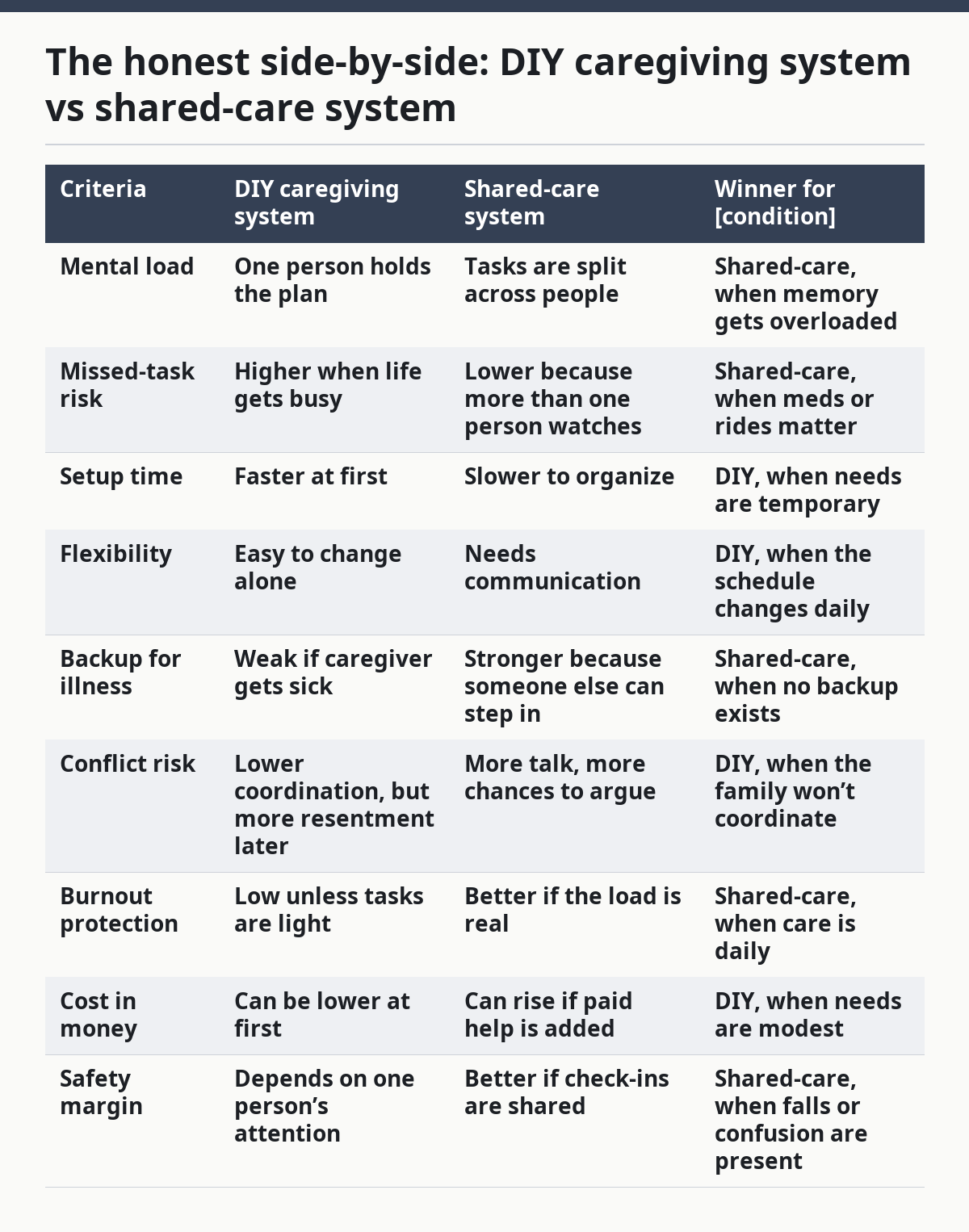
DIY wins only in a narrow lane: low-complexity care, a stable schedule, and a caregiver who still has spare capacity. The weakness is obvious. One sick day, one work crisis, or one bad night can knock the whole system loose.
Shared-care wins because it treats caregiving like a team task. That can include a sibling who manages appointments, a friend who handles one grocery run, a paid aide for bathing, or a neighbor who checks in. The cost is coordination, and that is real. But coordination is still cheaper than burnout.
The exceptions that change the answer
Shared care is not always the right answer, and a pure solo system is not always doomed. The verdict flips in a few specific cases.
Picture this: the care needs are light, the person is mostly independent, and the schedule hardly changes. Or the household is full of willing helpers who never follow through. Those two situations do not need the same plan.
Flip the overall verdict when:
-
Care is light and predictable.
If the person mainly needs reminders, rides, or occasional meal help, a simple solo system may be enough. A complex team plan would add more meetings than care. -
The family is high-conflict.
If every handoff turns into an argument, a clear solo lead with written backup can work better than a noisy group that never agrees. -
The caregiver has a temporary limit.
After surgery, during a work crunch, or while handling a short-term illness, paid help or short-term respite may matter more than building a long team. -
The care needs are unstable.
If the person’s condition changes often, the best setup may be a lead caregiver plus specialist support, not a full shared schedule that needs constant rewriting.
The real point is not “team or no team.” It is whether the structure matches the load. A small load needs a light system. A heavy load needs help on purpose.
The verdict: which caregiving setup should you choose?
Choose a shared-care system if the care is daily, meds or mobility matter, and one person is starting to slip. Choose a DIY system if the needs are light, the schedule is stable, and the caregiver still has room to absorb surprises. Neither works if safety is failing and nobody is available to add backup.
That is the clean answer.
What should I set up first if I start today?
Start with the master list, then the daily routine, then the shared calendar. Those three pieces solve most of the preventable chaos without waiting for a perfect system, which is a useful starting point for Managing daily caregiving work — The Complete Guide.
Picture this: you have one afternoon to get organized before the next week starts. Don’t begin with labels, apps, or color coding. Begin with the work that repeats and the tasks that can hurt someone if they’re missed.
Use this order:
- Write every repeat task on one page.
- Mark what happens every day.
- Add meds, meals, and appointments.
- Pick morning, midday, and evening blocks.
- Decide who does what if you cannot.
After that, add supply zones and backup contacts. That keeps the structure from falling apart when one person gets sick or the week gets ugly.
The setup should be boring on purpose. It should be easy to read, easy to repeat, and hard to break. If it takes a long explanation, it is too complicated for daily use.
How do I know if my caregiving system is working?
Your caregiving system is working if fewer tasks are missed, mornings feel less chaotic, and you are not constantly fixing the same problem twice. A system that only looks neat is not enough.
Picture this: the week still has hard moments, but you’re not hunting for pills, searching for clean clothes, or calling three people to confirm the same ride. That is progress. Quiet progress counts.
Check these signs once a week:
- Meds are on time more often
- Meals are not improvised at the last minute
- Appointments happen without last-minute panic
- Supplies are stocked before they run out
- The caregiver gets real rest, even if short
- The person receiving care feels less rushed
If those are getting worse, the system needs less complexity or more help. If they’re getting better, keep the setup and do not tinker with it just because someone suggests a fancier method.
The system is working when it protects energy and reduces errors. That is the whole job.
FAQ
What is the first thing to organize in daily caregiving?
The first thing to organize is the repeat work: meds, meals, hygiene, and appointments. Those are the tasks that shape the whole day, so getting them onto paper or a shared calendar gives the fastest relief.
How many caregiving tasks should I try to do myself?
You should do only the tasks you can handle safely and repeatably. If a task needs strength, constant attention, or more time than you have, it belongs on the handoff list.
What if the person I care for refuses help?
Start with the least intrusive help and keep the routine predictable. People often resist when the change feels sudden or takes away control, so small steps and the same order each day can lower the pushback.
How do I keep track of meds and appointments?
Use one visible place for both, such as a paper binder, wall calendar, or shared phone calendar. The key is not the format. The key is that every caregiver looks at the same place.
When is it time to ask for outside help?
It’s time when safety, sleep, or judgment starts to slip. If the current setup is causing missed meds, falls, or constant exhaustion, outside help is not a luxury — it is part of the care plan.
Drafted with AI; not yet reviewed by a person.