
How to Keep Care Instructions Together for Substitute Caregivers

Last updated: November 19, 2026
Key Takeaways
- A care instructions packet needs the first 10 minutes of facts, not a full backstory.
- Keep one master packet, one backup copy, and one regular update habit.
- A daily routine page works best on one sheet in day-of-use order.
Care instructions get scattered fast, and the substitute caregiver ends up hunting through texts, sticky notes, and half-finished reminders. How to keep care instructions together for substitute caregivers starts with one care instructions packet in one place, plus a second copy. The steps below show how to build a packet that covers the first day without turning into a pile of loose papers.
What a care instructions packet needs on day one

A care instructions packet needs the facts a substitute caregiver must use in the first 10 minutes, not the whole life story. Start with the household routine, food preferences, mobility notes, behavior triggers, and where items are kept.
Picture this: you are leaving for the afternoon and someone else walks in with a short list, a phone number, and a calm face. The packet should answer the same questions every time: what happens first, what gets fed, where supplies live, and what to do when a routine changes.
A useful packet usually fits in 3 to 6 pages. That size is enough for the essentials and small enough to read before the front door closes.
- Name and photo of the person being cared for
- One-page daily routine
- Food and drink notes
- Mobility or transfer notes
- Behavior triggers and calming steps
- Item locations and spare supplies
- Emergency contacts
Keep the language plain. “Breakfast at 8, meds with yogurt, walker by the chair” works better than long paragraphs. A substitute caregiver can act on short lines much faster than on a dense note dump.
Gather the written instructions in one folder
A care instructions packet stays together best when every note goes into one folder before you worry about format. Use a 1-inch binder, a clipboard folder, or a 9-by-12 envelope with tabs if that is easier to grab in a hurry.
Picture this: you are standing in the kitchen with a stack of handwritten notes, three text threads, and one grocery receipt that matters. The job now is not to rewrite everything. The job is to collect the real instructions in one container and strip out duplicates.
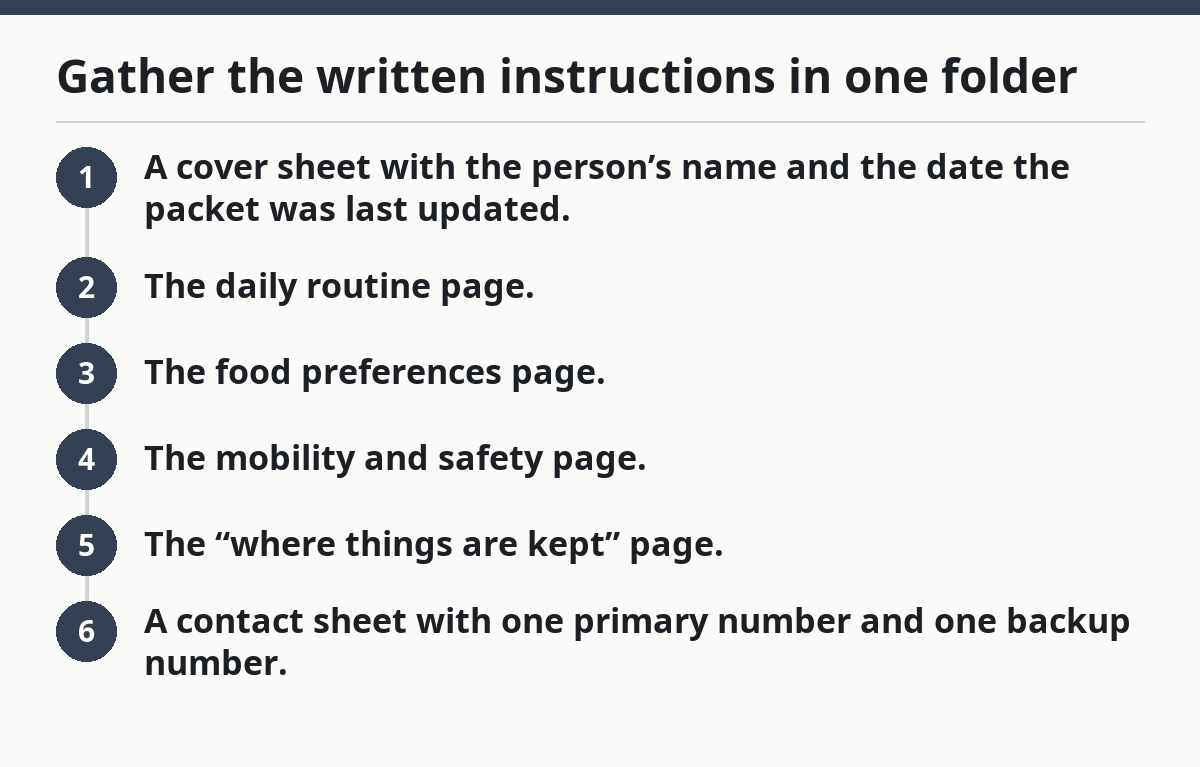
Put these items in the front:
- A cover sheet with the person’s name and the date the packet was last updated.
- The daily routine page.
- The food preferences page.
- The mobility and safety page.
- The “where things are kept” page.
- A contact sheet with one primary number and one backup number.
Then add anything special in the back, such as a note about a favorite cup, a bedtime song, or a dislike that causes conflict. Keep paper clips out of it. Paper clips fall off, and loose pages vanish into bags and car seats.
If the packet is for a child or an adult who needs help with transfers, place the most time-sensitive page on top. That is the page a substitute caregiver needs first when the door opens.
How do I keep care instructions together for substitute caregivers?

You keep care instructions together for substitute caregivers by using a single master packet, one backup copy, and one update habit. That gives the person arriving the same source every time instead of a scavenger hunt.
Picture this: the substitute caregiver is in the hallway, the timer is running, and you need them to find the walker strap, the lunch notes, and the right cup without asking five questions. One packet does that job better than scattered reminders on a fridge, a phone, and a drawer.
Use this exact order:
- Build a master binder and place it where the substitute caregiver will see it first, such as beside the keys or in a kitchen drawer labeled in large print.
- Copy the core pages and keep a second set in a different spot, such as a tote bag, locked filing box, or labeled envelope.
- Date every page so the caregiver knows which note is current when routines change.
- Use dividers for routine, food, mobility, behavior, and supplies.
- Mark urgent items with a bright tab or bold label, such as “Read before noon” or “Do not miss.”
- Keep one pen with the packet so small changes get written down before the page gets lost.
- Review the packet every 30 days or after any change in medication, diet, mobility, or schedule.
The trick is consistency, not decoration. A packet with the same layout every time beats a prettier version that changes shape each week.
Put daily routines where the caregiver can see them fast
A daily routine page works best when it fits on one sheet and follows the order of the day. That means wake-up, meals, rest, hygiene, movement, and bedtime, all in the sequence the caregiver will actually use.
Picture this: it is 7:30 a.m., and the substitute caregiver needs to know what happens before breakfast, what happens after lunch, and what cannot be skipped at bedtime. The routine page should answer that in under a minute.
Write the day in short blocks:
- Morning: wake-up time, bathroom help, breakfast, any meds with food
- Midday: snack, activity, nap, walk, therapy exercise, or quiet time
- Evening: dinner, bathing, skin care, pajamas, lights out
- Night: check-ins, water, pain relief, position changes, or alarm use
Include any timing that matters. If a snack comes before a walk, say so. If music helps with bathing, say that too. If the person gets upset when plans change, note the backup plan in one line.
The routine page is more specific when it names sequence, not “usual habits.” A substitute caregiver cannot follow “normal morning” unless “normal” is written down.
Record food, mobility, and behavior notes together
Food, mobility, and behavior notes belong on separate parts of the same packet because they change how the day runs. That keeps the substitute caregiver from missing one detail while reading another.
Picture this: the caregiver is plating lunch, helping someone stand, and trying to calm a frustrated reaction. Three kinds of notes matter at once. The packet should make those notes easy to scan, not buried in a paragraph.
Use this layout:
- Food preferences: what the person likes, refuses, chews slowly, or needs cut a certain way
- Mobility notes: walker use, wheelchair locks, hand support, stairs, or transfer cues
- Behavior triggers: loud noise, strangers, rushed speech, touch at the wrong moment, or changes in routine
If any note affects safety, put it in bold. “Needs walker within arm’s reach” is better than “uses assistive device sometimes.” “Gets anxious if approached from behind” is better than “can be sensitive.”
There’s a trade-off here. The more detail you add, the easier it is to miss the one line that matters. Keep each category to the facts that change care, and leave out the family history, the backstory, and the long explanation of why.
A food note should tell the caregiver what to serve and what to avoid. A behavior note should tell the caregiver what usually works to settle things down. A mobility note should tell the caregiver how to move safely and where the equipment sits.
Where should the packet live so it does not get lost?
The packet should live in one obvious spot and one backup spot, both chosen for speed. The main copy needs to be visible in less than 30 seconds after someone walks in, and the backup copy needs to stay dry and easy to find.
Picture this: you are not home, and the substitute caregiver is staring at three drawers that all look alike. If the packet has a home, they do not waste time searching. If it has two homes, they still have a plan when one copy gets moved.
Good places for the main copy:
- Inside a kitchen drawer labeled in large print
- On a shelf near the entryway
- In a binder clip on the refrigerator side panel
- In a tote bag that stays with the care supplies
Good places for the backup copy:
- A clearly labeled envelope in a filing box
- A second folder in another room
- A digital scan saved on the person’s phone and the caregiver’s phone
Avoid hiding the packet in a purse, under mail, or in a drawer that changes hands all the time. If the location is clever, it is too clever.
The fixed location also helps the caregiver return the packet to the same place after use, which keeps the next shift from starting blind.
Make updates without creating a mess
A care instructions packet stays useful only if updates are easy to make and hard to miss. Use one date line at the top of every page and a single place for handwritten changes so the caregiver can spot the newest note fast.
Picture this: the diet changes, the bedtime changes, and one page says Tuesday while another still says Monday. The fix is not a new binder every time. The fix is a clean update habit.
Use this simple method:
- Cross out old text once so the old instruction is still readable.
- Write the new note beside it or in the margin.
- Add the date next to the change.
- Replace the page if the edit is bigger than a few lines.
- Tell the substitute caregiver which page changed before the next visit.
If you scan the packet, save the file as a new version instead of overwriting the old one. “Care packet v3” is easier to trust than “final-final-updated.” The date matters more than the filename style.
This is also where a lot of people go wrong: they treat care notes like one-and-done paperwork. Real routines shift. Food needs change. Mobility changes. A packet that is never updated becomes a trap. If the care needs involve medication, diet, or transfer safety, consult the relevant professional before changing the instructions.
Common mistakes that split the instructions
The biggest mistake is spreading the same information across texts, phone photos, and random notes. That costs time, and in a care setting time is the thing that disappears first.
Picture this: the substitute caregiver knows there is a note somewhere, but the note is on a phone the battery cannot hold, or in a drawer nobody checked, or on a sticky note that fell off the fridge. The packet failed before the day started.
Watch for these problems:
- Too many locations: the caregiver has to search more than one place
- No date: nobody knows which note is current
- Too much writing: the key action gets buried
- Missing categories: food, mobility, and behavior are lumped together
- No backup copy: one spill or misplaced folder breaks the system
Use one packet, one layout, one update habit. That is the whole point. A neat system saves the substitute caregiver from guessing, and guessing is where mistakes grow.
If the care needs are complex enough that one page cannot hold them, split the packet by category, not by memory. Keep the sections labeled the same way every time so the substitute caregiver does not have to relearn the folder.
For a broader setup that sits above this packet, see the hub on caregiver paperwork and records organization. See also the related guide on emergency contact lists and the page on medication reminder systems.
What should a substitute caregiver know first?
The first thing a substitute caregiver should know is what happens in the next hour. That means the current routine, any food or medicine timing, mobility help, and where the needed items are kept.
A short first-page summary works better than a long biography. If one page can answer “what now?” the caregiver can start well and read the rest later.
How detailed should care instructions be?
Care instructions should be detailed enough to guide action, not so long that nobody reads them. A few clear lines for each task are usually better than full paragraphs.
If a note changes what the caregiver does, it belongs in the packet. If it does not change action, leave it out. That keeps the packet readable in 5 minutes or less.
Should I keep printed and digital instructions?
Yes, keeping both printed and digital instructions gives you a backup when one copy goes missing. A printed packet is faster in the moment, and a digital copy is easier to replace.
Keep the paper version in the main spot and the digital version as a scanned file with the same headings. That way a substitute caregiver can still work if the paper gets wet, moved, or left at home.
Drafted with AI; not yet reviewed by a person.