How to become the emergency contact hospitals use

Last updated: November 19, 2026
At 2 a.m., the hospital wants three things: a full name, a number that rings through, and the exact relationship the patient chose. That is the real test. Quick Answer: to become the emergency contact hospitals actually use, make sure the hospital emergency contact record shows your full name, a working mobile number, and the exact relationship the patient wants, then verify it at registration.
That only works when the front desk can reach you fast and sees you as the right person to call.
The steps below show how to make that happen at hospital registration, the admissions desk, and on the emergency contact form.
Key Takeaways
- The emergency contact field is not a wish list; it is a record staff use when they need a reachable person fast.
- The person named on the form may differ from the next of kin, and hospitals may follow their own contact order.
- A correct mobile number, clear relationship, and updated details matter more than being the closest relative.
- If the patient is awake and able, hospital staff often ask whom they want listed first.
- This page is general information, not legal advice; hospital rules vary by jurisdiction, and a qualified lawyer should be consulted for legal questions about authority or consent.
Who this applies to, and what the hospital is looking for
This applies to the person who wants to be called when a patient is admitted, checked in, or treated in an emergency department. It also applies if you are helping a parent, spouse, adult child, or friend fill out hospital registration forms and want your contact details to actually get used. For legal or consent questions, consult a qualified lawyer or local hospital policy, because rules vary by jurisdiction.
Hospitals usually want three things right away: a working phone number, the patient’s choice of contact, and enough detail to tell whether you are just a backup or the first call. So the emergency contact form is about reachability, not status. A receptionist or admissions clerk is often entering the data into the chart, and a tiny error can bury it.
A single typo can snowball.
When the patient cannot speak for themselves and there is confusion about who the hospital should call, the matter can shift from simple registration to a legal question. Local rules and hospital policy then matter, and a qualified lawyer may be needed. This article stays in general terms and does not tell you how to handle your own legal authority.
- Use this guide if you need your name entered correctly at hospital registration.
- Use it if you are replacing an old number, a landline, or a relative who no longer answers.
- Do not use it as a substitute for legal authority, consent, or a medical decision document.
How do hospitals decide who they call first?
Hospitals usually call the person listed in the chart, then move to the next listed contact if the first person does not answer. The exact order depends on the hospital’s registration software, the nurse’s workflow, and local policy.
Picture this: you are at the admissions desk, the lobby is noisy, and the clerk is typing fast. Saying only “my daughter” may leave staff with too little to work from later. But give the full name, mobile number, and the order you want used, and the record is far more likely to help.
Here’s the catch: the chart can only use what gets entered.
- Bring the right ID and spelling. Use the patient’s legal name exactly as it appears on the ID or insurance card, and bring your own full name for the emergency contact form. Verify spelling before the clerk saves it; a wrong middle initial or surname can split records and delay a call.
- State the contact order clearly. Say, “List me first, then list my sister as backup,” or the reverse. Check that the admissions desk enters the order in the same sequence you said it. If the system only shows one name, that is a problem because staff may not see the backup at all.
- Give one phone number that answers live. Provide the number most likely to be answered within a few rings, usually a mobile phone. Verify the area code, the last four digits, and whether voicemail works. If the number goes to an old landline or full inbox, the contact record is weak.
- Add a second number only if the desk accepts it. Some hospital registration systems allow a home, mobile, and work line; others do not. If there is room, ask for a second number to be entered as backup. If the clerk says the system only stores one, write down the exact number used so you can correct it later.
- Name the relationship in plain words. Use “spouse,” “adult son,” “sister,” or “friend,” not just a first name. Verify the relationship field matches what the hospital asks for, because some forms separate “next of kin” from “emergency contact.” A mismatch can make staff choose the wrong tab in the chart.
- Ask for the contact to be marked as current. Say you want the record updated today and ask the clerk to confirm the change is saved. Look for a printed registration sheet, after-visit summary, or portal screen that shows the update. If the paper and the chart do not match, the update may not have landed everywhere.
- Check whether the hospital wants an alternate contact. Some places list only one emergency contact on the main face sheet and keep an alternate in a separate field. Confirm both entries if the form allows it. If no alternate is visible, a missed call may leave staff with no backup.
The best part is that you do not need a special title to be useful to staff. You need a clean entry, a reachable number, and a clear place in the contact order.
What to say at the admissions desk
Say exactly what you want entered, in plain language, and then ask to see it before you leave the desk. That is often the quickest way to reduce errors in the hospital emergency contact record.
Picture this: the clerk is moving through five fields at once, and you are trying to fix a number that changed months ago. Wait until after discharge, and the record may already be wrong in the chart, the printout, and the portal. A 30-second correction now can save a long phone chase later.
Most mistakes happen because people assume the clerk knows the family tree.
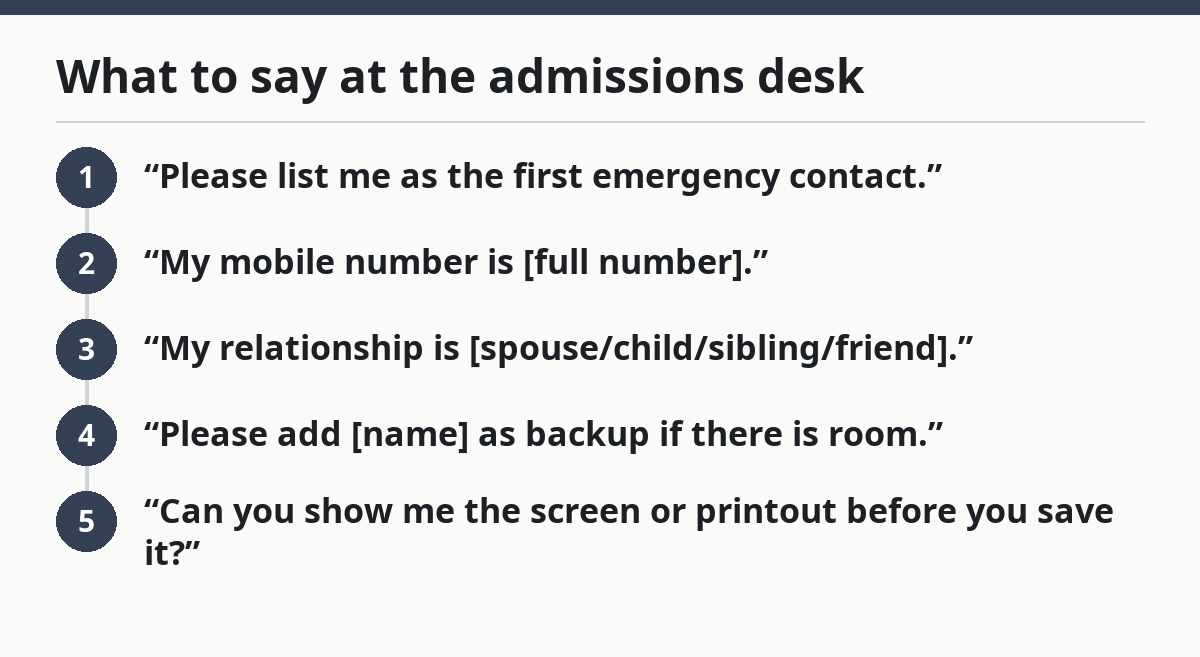
Use a short script:
- “Please list me as the first emergency contact.”
- “My mobile number is [full number].”
- “My relationship is [spouse/child/sibling/friend].”
- “Please add [name] as backup if there is room.”
- “Can you show me the screen or printout before you save it?”
- If the staff member asks for next of kin, answer that separately.
- If the form asks for guardianship or legal authority, stop and ask what the field means.
- If the patient is alert, let the patient say who they want first whenever possible.
A hospital may use a preferred contact order, which is just the sequence staff follow when the first person does not answer. That order matters more than family assumptions; one wrong guess can send staff to the wrong person at 2 a.m.
Next of kin is not the same thing as an emergency contact
An emergency contact is the person the hospital tries to reach; next of kin is the person the hospital identifies as the closest family member under its own rules. Those labels can overlap, but they are not identical in every hospital or jurisdiction.
Picture this: you are a niece who answers every call, but the intake form defaults to a parent or spouse because the chart uses a different field. Unless you ask which field the clerk is filling in, the hospital may record a name that does not match the person staff will actually try first.
That is the trap.
- Emergency contact: usually the first person staff call for updates, arrival questions, or pickup coordination.
- Next of kin: often a family category used for identification or hierarchy, not always the same as the call list.
- Decision-maker: a different legal role in many places; this page does not cover how to create that authority.
If the patient has no spouse, is estranged from family, or wants a friend called first, say that clearly. A good hospital registration team can usually enter the chosen contact even when the family tree is messy. The problem is not the label itself; it is when the wrong label gets used on the wrong field.
If your local hospital uses both terms, ask which one appears on the main face sheet and which one is buried in the chart. That single question can prevent a lot of confusion later.
What can go wrong with the phone number?
A phone number that is correct on paper can still fail if the hospital can’t reach a live person quickly. The most common failures are old numbers, voicemail that is full, blocked calls, and numbers that were never rechecked after a move or job change.
Picture this: the chart shows your number, but the call goes to an old prepaid phone sitting in a drawer. Staff marks “no answer,” moves on, and your chance to be the first contact is gone. That is why the number itself is only half the job.
The other half is making it usable.
- Old landline: the hospital may keep calling a dead line; update it to a current mobile number.
- Wrong country or area code: staff may misdial; say the full number slowly and ask for it to be read back.
- Busy voicemail box: the call may fail to leave a message; clear space before a planned surgery or admission.
- Work number with gatekeeper: the call may go through a receptionist; use a direct line if possible.
- Changed carrier or number port: the old number may still be in the chart; ask for a full re-entry, not just a note.
For someone who moves often, check the number every time they see a doctor, not just during an emergency. Hospitals do not have a standard 30-day refresh cycle you can rely on. The safe habit is to update the record whenever the number changes.
When should you stop and ask for more help?
Stop and ask for qualified help when the issue stops being a contact-list problem and becomes a legal or consent problem. That line matters because hospitals can only use the fields they are allowed to use under local law and policy.
Picture this: the front desk is asking who can receive updates, who can sign, and who can make choices if the patient cannot speak. That is no longer a simple emergency contact question. It is a different process with different rules.
Pause there.
The patient cannot speak or understand the questions: the registration staff may need a different workflow — ask the hospital what it does for an incapacitated patient in that jurisdiction.
The contact wants to make medical decisions: that is not the same as being listed — ask about the hospital’s legal process and get qualified legal guidance if needed.
The family disagrees about who should be first: the front desk cannot solve a family dispute — ask the hospital to follow its policy and document the conflict.
The patient wants someone excluded: that can involve privacy and access limits — ask the hospital how it records excluded contacts before assuming the chart will block them.
The form uses unfamiliar terms like guardian or surrogate: those may carry legal meaning — stop and ask what the field means in that hospital and jurisdiction.
A good rule is simple: if the question is “who should the chart call?” you are still in registration territory. If the question is “who has authority?” you are out of simple registration and into a legal issue. This article is general information, not legal advice, and a qualified lawyer should be consulted for rights, authority, or consent questions.
How to keep the record current after discharge
You should update the hospital emergency contact record any time the number, relationship, or preferred order changes, even after the visit is over. A 5-minute correction after discharge can prevent a bad record from following the patient into the next admission.
Picture this: the patient had a short stay, the chart looks fine on the discharge paper, and three months later the old number is still in the system. The next time someone calls, it goes to the wrong person or nowhere at all. That is how stale records survive.
Don’t let them.
Use this quick update routine:
- Call the hospital registration desk and ask how to correct contact details.
- Give the patient’s full legal name and date of birth if asked.
- State the old number and the new number so the clerk can find the right chart.
- Ask whether the change updates the emergency department, admissions, and portal records.
- Request confirmation by portal message, discharge summary, or printed sheet if the hospital offers one.
If you are updating for a parent or adult relative, keep a simple note with the date of the change and which hospital you updated. A notebook or phone note is enough. The goal is not paperwork for its own sake; it is making sure the next call lands with the right person.
Frequently asked questions
Is an emergency contact the same as a decision-maker?
No, an emergency contact is not automatically a decision-maker. The emergency contact is the person the hospital tries to reach, while a decision-maker usually refers to someone with legal authority to consent or speak for the patient under local rules. If the hospital uses those terms separately, do not assume one role covers the other.
Can a hospital call anyone I list as an emergency contact?
Yes, hospitals usually call the person listed, but they may follow their own contact order and privacy rules. If the patient is able to speak, the hospital may still ask who they want contacted first. If the listed person cannot be reached, staff may move to the backup contact or another number in the chart.
How do I update an emergency contact at a hospital?
You update it by contacting the hospital registration desk, admissions desk, or patient portal and asking for the record to be changed. Give the patient’s full name, the old contact details, and the new ones, then ask for confirmation that the update was saved. If the hospital has separate departments, ask whether each one was updated.
Drafted with AI; not yet reviewed by a person.