Last updated: November 19, 2026
Finding care services and paid help is really about matching the right person to the right task, on the right schedule, with the least risk and the least waste.
The right choice depends on whether you need personal care, house help, or skilled support — and the guide below settles that.
Key Takeaways
- Start with the job to be done, not the job title.
- Pick paid help for clear, repeatable tasks; pick a care service for personal, medical, or safety needs.
- Check training, backup coverage, insurance, and whether the person is a contractor or an employee.
- Ask who covers nights, sick days, and emergencies before money changes hands.
- A cheap rate can be a bad deal if the person cannot replace themselves, document care, or handle higher-risk tasks.
- The best fit is the one that can do the work consistently, not the one with the nicest brochure.
What problem are you really trying to solve?
Picture this: you need help at home, but the need is not one thing — it is bathing, meals, laundry, transport, medication reminders, and maybe a safety watch after a fall. The best choice is the service that matches the task, not the one with the broadest label.
That sounds simple until you price it out. A companion, a home aide, a housekeeping service, and a licensed care agency can all say “we help at home,” yet they do very different work and carry very different risks.
Here’s the catch: the wrong fit often looks fine for the first week. The trouble shows up when the helper is late, cannot do lifting, cannot document anything, or is not allowed to do the task at all.
A good first question is not “Who is available?” It is “What kind of help am I buying?”
That split decides almost everything.
- Companion help: conversation, errands, light supervision, simple routines.
- Homemaker help: cleaning, laundry, meals, shopping, basic household upkeep.
- Personal care: bathing, dressing, toileting, transfers, mobility support.
- Skilled care: wound care, injections, medication management, clinical judgment.
- Respite care: short-term relief for a family caregiver.
- Live-in help: coverage across long stretches, often with sleep time rules.
If the need includes personal care or health judgment, paid help from a housekeeper is the wrong tool. If the need is mostly floors, dishes, and grocery runs, paying a clinical agency may be overkill.
Not even close.
Care services and paid help: what each one actually does
Picture this: you are sorting through agency websites and private listings, and every option says it can “support independence.” That phrase hides the useful difference. The right provider is the one whose daily duties match your list, not your hope.
The best choice here is the one with a written service scope. A clear scope prevents confusion about what is included, what costs extra, and what the worker is allowed to do.
A generic article often skips this and lumps everyone together. That causes bad comparisons. A house cleaner who does not do hands-on care is not a substitute for a personal support worker. A companion who can sit, talk, and supervise is not a substitute for a nurse.
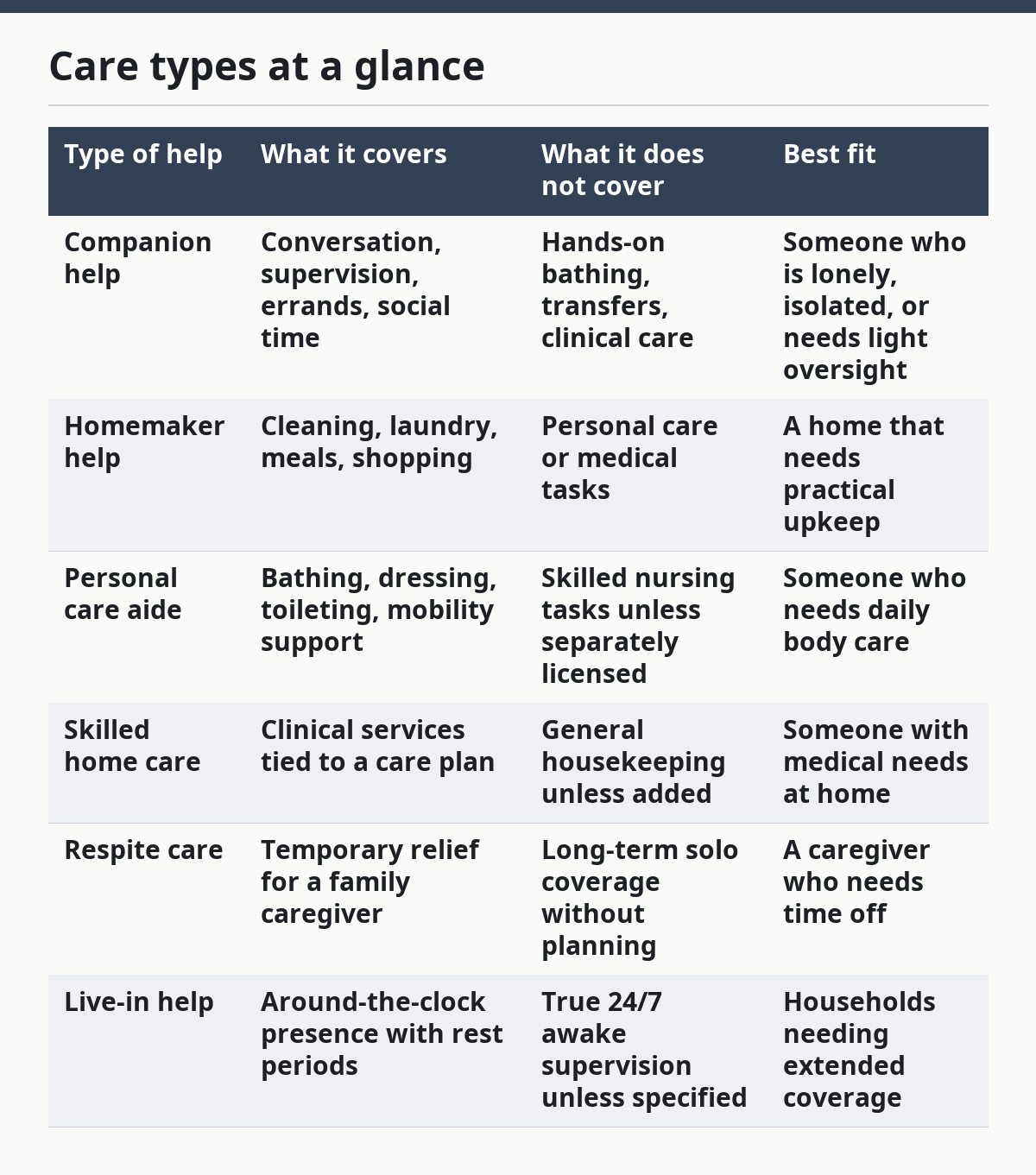
Care types at a glance
| Type of help | What it covers | What it does not cover | Best fit |
|---|---|---|---|
| Companion help | Conversation, supervision, errands, social time | Hands-on bathing, transfers, clinical care | Someone who is lonely, isolated, or needs light oversight |
| Homemaker help | Cleaning, laundry, meals, shopping | Personal care or medical tasks | A home that needs practical upkeep |
| Personal care aide | Bathing, dressing, toileting, mobility support | Skilled nursing tasks unless separately licensed | Someone who needs daily body care |
| Skilled home care | Clinical services tied to a care plan | General housekeeping unless added | Someone with medical needs at home |
| Respite care | Temporary relief for a family caregiver | Long-term solo coverage without planning | A caregiver who needs time off |
| Live-in help | Around-the-clock presence with rest periods | True 24/7 awake supervision unless specified | Households needing extended coverage |
A service agency usually offers screening, replacement coverage, and admin support. A private worker usually offers lower overhead and more direct communication. That is the trade-off.
The real difference between an agency and private paid help
Picture this: you have found two options that both sound good on paper. One is a care agency with office staff and backup workers. The other is an independent helper who speaks directly with you and may charge less. The real difference is accountability versus control.
An agency usually wins when the task is ongoing, the risk is higher, or you need backup if the worker is sick. Private help often wins when the job is stable, the duties are simple, and you want more say in who comes into the home.
The best part? You are not choosing between “good” and “bad.” You are choosing between two different ways to manage risk.
An agency brings structure. That can mean screening, insurance, payroll handling, and a replacement pool. It can also mean less flexibility, higher overhead, and less control over who actually shows up. Some agencies assign from a roster, so the face at the door can change. If your parent dislikes frequent turnover, that matters.
Private help can feel more personal. You may build a direct working relationship, set a tighter routine, and keep the process simple. The downside is plain: if the person cancels, you may have no backup. You may also need to handle taxes, worker classification, and safety checks yourself. If you skip those, the bargain can turn into a mess.
A generic article would say “both have pros and cons.” That is too soft. The practical question is this: do you need a managed service, or do you need a person you can hire directly?
Agency vs private help: the honest side-by-side
| Criteria | Agency | Private help | Winner for this condition |
|---|---|---|---|
| Backup when someone is sick | Office can often send a replacement | You may need to find coverage yourself | Agency, when the schedule cannot slip |
| Control over who comes | You may not choose every worker | You can often choose the person directly | Private help, when trust and consistency matter most |
| Admin burden | Payroll, scheduling, and screening are often handled | You may handle contracts, taxes, and vetting | Agency, for busy families |
| Cost structure | Often higher because overhead is built in | Often lower upfront | Private help, for simple, steady tasks |
| Scope of service | Can include personal or skilled care, depending on license | Often limited to agreed tasks | Agency, for higher-risk care |
| Flexibility | Less flexible on custom arrangements | More flexible if both sides agree | Private help, for unusual schedules |
| Documentation | May provide visit notes or care plans | Often informal unless you set it up | Agency, when records matter |
| Continuity of care | Staff may rotate | One person may stay with the case longer | Private help, if the same face is a priority |
What kind of help do you actually need?
Picture this: you are staring at a long list of tasks, and half of them feel too small to matter. They do matter. A helper who can do one part well but not the rest can leave you with gaps that create stress, missed meds, or a dirty kitchen nobody wants to use.
The right choice is task-based, not label-based. Start with the exact work, then match the service.
Here is a clean way to sort it:
- If the need is social or supervisory, look at companion help.
- If the need is household upkeep, look at homemaker help.
- If the need includes hands-on body care, look at personal care.
- If the need includes medical tasks, look at a licensed home care service.
- If the need is temporary relief, look at respite care.
- If the need is overnight presence, ask exactly what “overnight” means in writing.
This is where many families waste money. They pay for a higher level of help than they need, then complain about the rate. Or they buy the cheaper option, then discover it is not allowed to do the work they need.
A simple test helps: if the task is about safety, hygiene, mobility, or medicine, the bar is higher. If the task is about cleaning, shopping, cooking, or company, the bar is lower.
Different job. Different standard.
Questions to ask before you buy
- Can this person or service do all the tasks on my list?
- Is there a written service scope?
- What is off-limits?
- Who covers missed shifts?
- Are they insured and, if needed, licensed?
- Do they keep notes or a care log?
- What happens if the need changes in 30 days?
How to screen a provider without getting burned
Picture this: the interview sounded friendly, the website looked polished, and the first visit was fine. Then you learn the helper cannot lift, cannot drive clients, or cannot stay past 6 p.m. Screening is where you catch those misses early.
The best move is to verify before the first shift. A short call can save weeks of damage.
Here’s the catch: most families ask about personality first and process last. Process is what keeps the arrangement standing when things get hard. You want to know how they handle no-shows, documentation, boundaries, and emergencies.
Use these checks:
-
Ask for the exact duties.
If the answer is vague, the service is vague. -
Ask about training.
For personal care, ask what kind of care training they have and whether it matches the work. -
Ask about insurance and licensing.
A legitimate care provider should be able to explain this plainly. -
Ask for references or a work history.
You are checking stability, not perfection. -
Ask about replacement coverage.
If one person gets sick, what happens next? -
Ask how they handle medication-related tasks.
Never assume a reminder is the same as administration. -
Ask about boundaries.
Can they accept gifts? Can they use your car? Can they enter without you home?
A polished answer is not the goal. A specific answer is. If the reply sounds like a sales script, keep asking.
A generic guide might stop at “check credentials.” That is too thin. You also need to check whether the provider can do the job in your house, on your schedule, with your level of supervision.
That is the real test.
The hidden costs people miss
Picture this: the hourly rate fits the budget, so you say yes. Then the real bill starts growing through travel fees, holiday pay, minimum shift rules, extra tasks, and the cost of replacing no-shows. That is where many plans break.
The best choice is the one you can actually sustain. A help plan that looks affordable for two weeks but collapses in month two is not affordable.
The usual misses are plain:
- Minimum hours: you may need to pay for more time than you use.
- Travel or mileage: especially if the worker drives between clients.
- Weekend or holiday rates: these can change the plan fast.
- Laundry, meal prep, or lifting add-ons: some tasks are not bundled.
- Replacement time: a sick-day gap can force paid overtime elsewhere.
- Training time: if a family member must teach every task, the “cheap” option has a hidden labor cost.
You also need to think about risk cost. If a helper is not suited for transfers, a fall can cost far more than a higher hourly rate would have. If no one documents medication timing, the family may spend hours trying to reconstruct the day.
The smart budget question is not “What is the lowest rate?” It is “What does this arrangement cost after the extra fees, the gaps, and the trouble?”
That’s the number that matters.
When to choose an agency, and when private help wins
Picture this: you have narrowed the choice to an agency and one person you found directly. Both could work, but only one fits the way your home runs. The right answer depends on the level of risk, the need for continuity, and how much admin you want to carry.
The agency wins for higher-risk or unstable care. Private help wins for steady, low-complexity support.
An agency is the better fit if:
- the need may change quickly;
- you need backup coverage;
- the tasks include personal care;
- you want someone else to handle payroll, screening, and scheduling;
- the family is already stretched thin.
Private help is the better fit if:
- the work is routine;
- the person is reliable and well matched;
- you want one consistent helper;
- you can manage the admin side;
- the household values direct communication.
On the flip side, private help is a poor fit if the family already knows it cannot absorb cancellations, replacements, or admin work. An agency is a poor fit if the household wants full control over one carefully chosen person and does not want rotating staff.
A lot of families try to solve a staffing problem with a pricing problem. That rarely works. The issue is not just the hourly number. It is whether the help model can survive real life.
The specific situations where the verdict flips
Picture this: you think you have made the right call, then one detail changes everything. A fall, a new diagnosis, an overnight need, or a schedule change can flip the answer fast. That is why a rigid rule fails here.
The verdict changes when the care need changes. These are the cases that matter most:
-
A new medical task appears.
If wound care, injections, or close monitoring enter the picture, a licensed service becomes the safer fit. -
The schedule becomes unpredictable.
If coverage must be filled on short notice, an agency usually beats a lone worker. -
The care recipient resists strangers.
If trust and continuity are the main barrier, a private helper with a long run of stability may work better. -
The family can no longer supervise.
If no one can manage backup, notes, or payroll, the support model needs more structure.
The best choice can change in a month. That is not failure; it is normal. The mistake is pretending the first answer will always fit.
It won’t.
The Honest Verdict: which one to choose
Choose an agency if the work includes personal care, medical tasks, or backup coverage you cannot risk losing. Choose private paid help if the tasks are routine, the schedule is stable, and you want one consistent person with less overhead. Neither if you are still unclear on the task list, because a vague need leads to a bad hire.
That is the cleanest call. No hedging.
If you are unsure, use this final filter:
- If the task affects safety, lean agency.
- If the task is mostly household upkeep, lean private help.
- If the family needs records and backup, lean agency.
- If the family needs direct control and continuity, lean private help.
- If the need is still fuzzy, pause and write the duties down first.
What to put in writing before you start
Picture this: you have chosen a provider, and everyone is eager to begin. This is the point where a simple written agreement saves the relationship later. A half-page note can prevent a month of arguments.
The best move is to write down the deal before the first visit.
Put these points in the agreement or service plan:
- duties included;
- duties excluded;
- start date and schedule;
- pay rate and payment method;
- cancellation policy;
- who provides supplies;
- transportation rules;
- medication rules;
- emergency contact steps;
- backup plan if the worker cannot come.
A written plan is not about mistrust. It is about clarity. People forget details fast once the work begins. If the helper is part of a care plan, the home needs a shared reference point.
Do not skip the part about boundaries. A helper who is asked to “just do one more thing” every day will either burn out or quietly stop being clear about limits. Neither is good.
Clear now beats messy later.
Questions people ask before hiring paid help
Picture this: you are ready to move forward, but one last set of doubts keeps coming back. That is normal. These questions are the ones people ask after the first round of research, when the real decision starts to feel expensive and personal.
The short answer is that the best choice depends on the care task, the risk level, and the amount of admin you can handle.
Do I need an agency or can I hire someone directly?
You can hire directly if the work is simple, the schedule is stable, and you can handle the admin. An agency is the better fit if you need backup, more structure, or care that carries more risk. The more the job touches safety or clinical needs, the more an agency makes sense.
What is the biggest mistake families make?
They buy the wrong type of help for the task. A housekeeping arrangement will not cover hands-on personal care, and a companion arrangement will not cover medical tasks. The second mistake is ignoring backup coverage, which becomes obvious the first time someone cancels.
How do I know if the price is fair?
Compare what is included, not just the hourly number. Ask about minimum hours, travel time, holidays, and what happens when the helper is absent. A lower rate can still cost more if it comes with gaps, replacement stress, or extra admin.
What should I ask during the first call?
Ask what tasks they will do, what they will not do, whether they are licensed or insured if needed, and how they handle sick days. Ask for one concrete example of how they manage a schedule change. A clear answer is worth more than a polished pitch.
When is paid help not enough?
Paid help is not enough when the needs are complex, unstable, or medically risky without the right training. If the person needs frequent clinical oversight, repeated transfers, or round-the-clock supervision, the plan needs more than a general helper. In that case, start with the higher-support option and get professional guidance on the care level.
Drafted with AI; not yet reviewed by a person.