
Last updated: November 20, 2026
Quick Answer: A caregiver task list for morning, afternoon, and evening shifts works best when you split the day into 3 blocks and keep each block to 5 to 8 specific tasks. A caregiver task list for morning, afternoon, and evening shifts keeps urgent jobs at the right time, gives each caregiver a clear handoff note, and cuts down on missed meals, missed meds, and duplicate work.
Key takeaways
- Split the day by what the person needs, not by what is easiest to write down.
- Put fixed-time jobs first, like meals, medicines, hygiene, and transfers.
- Mark each task as must-do or nice-to-do so the list stays realistic when time runs short.
- Add a short handoff note to each shift so the next caregiver starts with the right facts.
- Keep a backup plan for missed shifts, late arrivals, and tasks that spill past the end of a block.
What goes on each shift?

Each shift gets the tasks that match the time of day and the person’s care needs. Morning, afternoon, and evening shift lists work best when they are short, specific, and tied to the same daily routine.
Start with the must-do care tasks: wake-up help, toileting, dressing, meals, medication timing, mobility help, and evening prep. Then add the jobs that depend on the clock, such as breakfast, lunch, dinner, bathing, or a bedtime routine. A list that names “help with breakfast at 8:00” is easier to use than “assist with meals.”
A plain home chart works fine for this. Use one page for the day and three boxes, one for each shift. If you need a digital tool, a notes app or shared spreadsheet can work, but only if everyone can open it in 10 seconds or less.
The National Institute on Aging has plain guidance on caregiving tasks and medicine routines, and the Family Caregiver Alliance also publishes practical caregiving resources. Those sources are useful when you want to compare your list with a standard approach: National Institute on Aging caregiving resources and Family Caregiver Alliance caregiving resources. For a fill-in format, see caregiver schedule template and caregiving checklist.
How do I divide tasks by time of day?
Divide tasks by time of day by asking one question: what must happen before this shift ends? That question keeps the list tied to real care, not to a vague wish list.
- Use a blank day sheet to map the 24-hour day. Draw three columns or three boxes for morning, afternoon, and evening, then leave room for 5 to 8 tasks in each one.
- List the fixed-time tasks first. Put meals, medications, and appointments in the shift where they actually happen, such as breakfast in the morning and dinner in the evening.
- Place hygiene and movement tasks next. Add bathing, tooth brushing, dressing, transfers, walks, and toileting help where they fit best.
- Mark the time-sensitive items with a clock time or time window. “7:30 a.m.” is clearer than “early,” and “after lunch” is clearer than “later.”
- Split long jobs into smaller steps. If a shower takes 20 minutes, write “prepare bathroom,” “assist shower,” and “dry and dress” instead of one long line.
- Leave the least time-sensitive tasks for the shift with the most room. Laundry, refilling wipes, or tidying supplies often fit better in the afternoon than in the morning rush.
- Review the full list once for overlap. If two shifts cover the same job, assign one owner so the task is not repeated or skipped.
A morning shift usually carries the most time-bound personal care. An afternoon shift often handles meals, rest, and cleanup. An evening shift usually closes the day with dinner, medicines, toileting, and bedtime prep.
What should the morning shift cover?

The morning shift should cover wake-up care, hygiene, breakfast, and any first medicines or mobility help. That is the part of the day when the person often needs the most hands-on support.
Put wake-up and toilet assistance near the top of the list. Add washing up, changing clothes, brushing teeth, and grooming if those are part of the routine. If the person uses a walker, wheelchair, or transfer aid, list that equipment in the morning box so the caregiver does not waste 5 minutes hunting for it.
Meal timing belongs here too. If breakfast and morning medicine happen together, write them in the same order the caregiver must follow. A note like “give medicine after breakfast” is more useful than a loose reminder to “handle meds.”
The morning list is wrong for tasks that can wait until midday. Deep cleaning, folding laundry, or long phone calls can clog the busiest shift and push out basics like bathing or breakfast. Morning should be for the tasks that set up the whole day.
What should the afternoon shift cover?
The afternoon shift should cover lunch, rest time, errands, cleanup, and any care tasks that were not finished in the morning. This shift often has room to move a task by 30 to 60 minutes, so it is usually the best place for work that can shift without affecting meals or medicine.
Use the afternoon box for lunch, hydration, snack checks, skin care, repositioning, and a short walk or chair exercise if that belongs in the care plan. If the person naps, write the nap window next to the check-ins so the caregiver knows when not to interrupt.
Since that shift can absorb more flexibility, it is also the place for replenishing supplies and short housekeeping jobs. Refill wipes, restock briefs, empty the trash, wash dishes, and set up clothes for the next day if those tasks help the evening run smoothly. The right supplies at the right time can prevent a late-night scramble.
Do not overload the afternoon with jobs that belong elsewhere. If lunch medicine has a strict timing rule, keep it on the lunch line, not buried in a “miscellaneous” section. The cleaner the list, the faster the handoff. For more organizing ideas, see caregiver notes and family care planner.
How do I write the evening shift list?
The evening shift list should cover dinner, bedtime prep, final medicine timing, and safety checks before sleep. This is the shift that lowers the chance of overnight problems, so the tasks need to be exact.
Start with dinner and any after-dinner medication instructions. Add toileting, changing clothes, washing up, and oral care if those happen before bed. If the person needs a shower at night instead of in the morning, this is where it belongs.
Then add the closing tasks that make the room ready for overnight care. That can include water by the bed, a phone charged in reach, a night light on, the call bell near the pillow, or a clear path to the bathroom. If the person tends to get up at night, note that in the handoff so the next caregiver is ready.
The evening list should not carry tasks that can wait until the next day. Long laundry, paperwork, and non-urgent organizing can steal time from bedtime and leave the person tired or unsettled. Evening works best when the end point is clear: the person is settled, the room is safe, and the next shift knows what happened.
How do I make the handoff note useful?
A useful handoff note gives the next caregiver the facts that matter in 3 to 5 lines. It should say what was done, what was missed, what changed, and what comes next.
Write the handoff note at the end of each shift, not hours later. Include medicine timing, food taken, bathroom or toileting issues, pain or mood changes, and any task that needs follow-up. If breakfast was skipped or dinner was only partly eaten, say that plainly.
Keep the format the same every time so the next person can scan it fast. A simple pattern works: “Done,” “Not done,” “Watch,” and “Next.” That keeps the note short and avoids a wall of text that nobody reads.
A bad handoff note says “everything fine” when it is not. That costs time on the next shift, because the caregiver has to guess what happened. A good note saves 10 minutes of catch-up and reduces the risk of repeating a missed task.
What mistakes make shift lists fail?
The biggest mistakes are too many tasks, vague wording, and no backup plan. Those three problems turn a list into clutter instead of a tool.
A list with 20 unchecked items looks complete and still fails in practice. If the shift is 4 hours, cut the list to the work that truly fits there. Put must-do items first and move the rest to a later shift or a separate “nice-to-do” column.
Vague words cost time. “Help with care” does not tell the caregiver what to do first, while “assist with breakfast and morning medicine” does. Clear verbs save decisions when the caregiver is tired or late.
No backup plan is the most dangerous miss. If one caregiver is late, the shift list should show which tasks can wait 30 minutes and which ones cannot. A short backup note, such as “call sibling if dinner is missed,” is better than hoping someone notices the gap.
A caregiver task list for morning, afternoon, and evening shifts is not the same thing as a calendar, a long checklist, or a handoff system for every family problem. It is the daily work list for one person’s care. If the day has more moving parts than one page can hold, the list is too crowded.
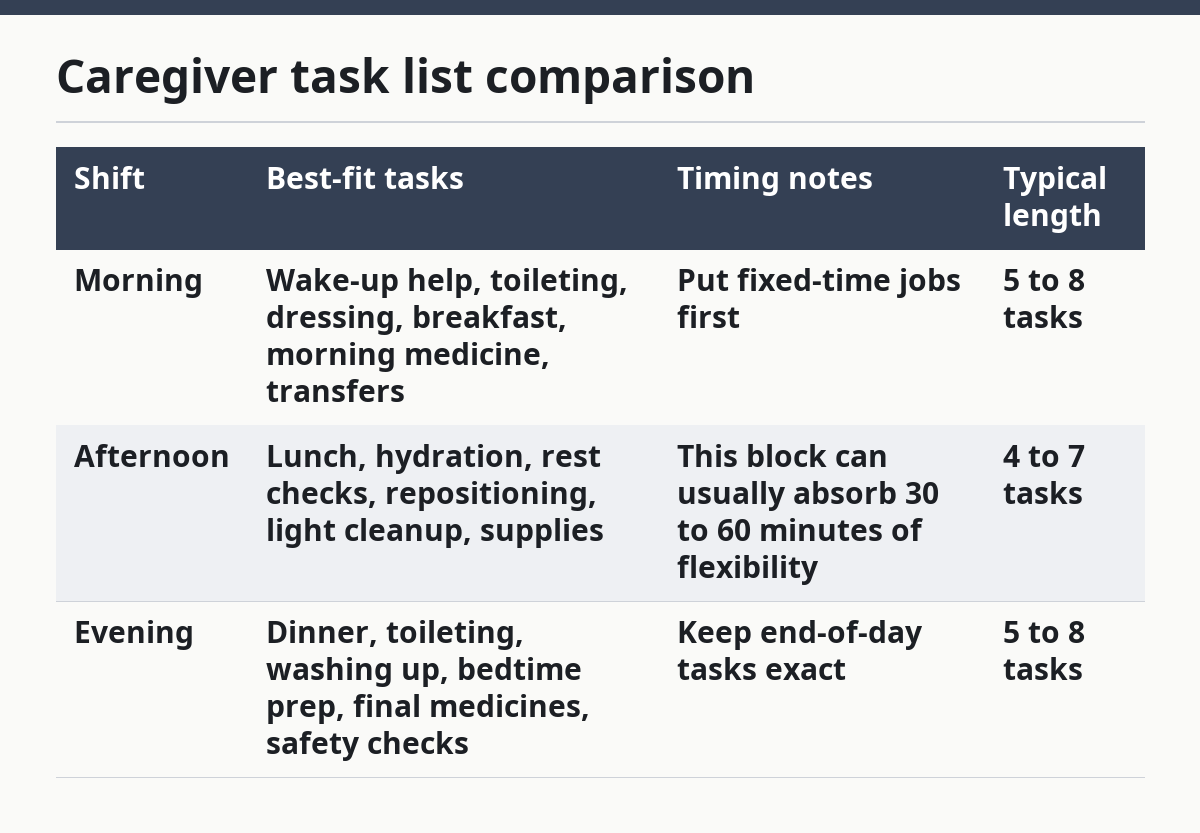
Caregiver task list comparison
| Shift | Best-fit tasks | Timing notes | Typical length |
|---|---|---|---|
| Morning | Wake-up help, toileting, dressing, breakfast, morning medicine, transfers | Put fixed-time jobs first | 5 to 8 tasks |
| Afternoon | Lunch, hydration, rest checks, repositioning, light cleanup, supplies | This block can usually absorb 30 to 60 minutes of flexibility | 4 to 7 tasks |
| Evening | Dinner, toileting, washing up, bedtime prep, final medicines, safety checks | Keep end-of-day tasks exact | 5 to 8 tasks |
What should happen on each caregiving shift?
Each caregiving shift should cover the tasks that fit that part of the day. Morning usually starts the body, afternoon keeps things stable, and evening closes the day and sets up sleep. The exact jobs depend on meals, medicines, hygiene, mobility, and the person’s normal routine.
How do I divide tasks by time of day?
Divide tasks by time of day by grouping them around fixed events like meals, medicine, bathing, and bedtime. Put the jobs that cannot move on the right shift first, then fill in the flexible jobs. If two tasks fight for the same time, the one tied to health or safety wins.
How do I make shift changes smoother?
Shift changes get smoother when the handoff note is short, standard, and written before the caregiver leaves. Use the same labels every time and include only the facts the next person needs in the next hour. A 3-line note is often easier to use than a long message.
Drafted with AI; not yet reviewed by a person.