
Last updated: November 19, 2026
Key Takeaways
- A caregiver medication list should include prescriptions, OTC drugs, supplements, and as-needed medicines, with label-matching details.
- Start with the label, put one medicine per line, and verify the newest information against the bottle.
- The most useful details are the ones that help a clinician compare the list with actual use, especially after a recent change.
- Check the list against the bottle, pharmacy record, and any discharge paperwork from the last 30 days.
A messy medication list makes doctor visits slower and riskier, especially when a caregiver is helping. How to organize a medication list for a caregiver and doctor visits starts with a clear list that shows every medicine, the dose schedule, who prescribed it, and what the person is actually taking right now. The steps below settle what belongs on it, how to format it, and how to keep it ready for appointments.
Who this medication list is for

This medication list is for a caregiver who needs one page that a doctor, pharmacist, or nurse can scan in under a minute. It is for how to organize a medication list for a caregiver and doctor visits when you already have pill bottles, prescription labels, and at least one pharmacy record or discharge sheet to work from. If the person takes complex high-risk medicines, has recently left the hospital, or has more than one prescriber, ask a qualified health professional or pharmacist to review the list with you.
Picture this: you’re standing at a clinic desk with three bottles, a loose printout, and a phone photo of a label from last month. A clean medication list turns that pile into one reference, which is why it matters before the visit starts.
- Use the list for appointments, handoffs, and refill calls.
- Keep it separate from the pill box itself.
- Update it after any medication change, even if the change seems small.
- Bring the original prescription labels when you can.
The truth is, a caregiver list is not a memory aid. It is a working record. If the list only has names and no timing, no prescriber, and no “as needed” notes, it will fail the moment someone asks a follow-up question.
What goes on a caregiver medication list?
A useful caregiver medication list includes prescription drugs, over-the-counter medicine, supplements, and as-needed medicines, each with enough detail to match the label. It also includes who prescribed each item, because a doctor visit often turns on who started what and why.
Picture this: you’re sorting a kitchen drawer full of bottles with different labels and refill dates. The goal is not to copy every word on the label; the goal is to capture the right fields so the next clinician can reconcile the list, which means compare the record against what the person is actually taking. The FDA and NIA both recommend keeping an up-to-date medication list for this kind of review. FDA NIA
Use these fields for each medicine:
- Name: brand name and generic name if both are known.
- Dose form: tablet, capsule, liquid, inhaler, patch, cream.
- Strength: the number on the prescription label, such as 10 mg or 5 mL.
- Dose timing: morning, bedtime, with meals, or another schedule listed on the label.
- Prescriber name: the clinician or clinic that ordered it.
- Pharmacy: name and phone number from the label.
- Reason, if known: blood pressure, pain, sleep, allergy, or other label instructions.
- As-needed rule: when it is taken and what counts as the trigger.
- Start date or note: if you know when it was added.
- Stop note: if a clinician said to stop it, mark that clearly.
A medicine list that leaves out timing or prescriber names often causes confusion at reconciliation, the standard check where staff compare what is listed with what is used. That kind of gap is how duplicate therapy and missed refills get missed.
For a related paperwork system, the caregiver records hub can help you keep the rest of the folder in one place.
How do you organize the medication list before a doctor visit?

You organize it by using the labels as your source and putting each medicine on one line, with the newest information checked against the bottle. The cleanest format is a single page, printed or digital, with one medicine per row and one person responsible for updates.
Picture this: you have 15 minutes before the appointment and need something that won’t fall apart under questions. Start with the bottles, not memory, because prescription labels and pharmacy printouts usually give the clearest dose timing and the exact spelling of the name.
- Gather every bottle, box, inhaler, patch, and tube in one place and separate prescription items from over-the-counter medicine and supplements.
- Copy the name from the prescription label exactly as written, then add the generic name in parentheses if the label shows both.
- Record the strength and form from the label, such as “tablet,” “capsule,” or “oral solution,” and check that it matches the bottle.
- Write the dose timing exactly as the label or current discharge sheet states, such as “twice daily” or “at bedtime,” and mark if it is taken with food.
- List the prescriber name and pharmacy phone number, and verify that both match the most recent label or refill record.
- Flag medicines taken only when needed, and note the reason for use, the usual trigger, and any limit written on the label.
- Add supplements, vitamins, and nonprescription products on separate lines so they do not get lost in the main list.
- Review the finished page against the physical bottles, and fix any mismatch before the visit; a mismatch means the list is no longer trustworthy.
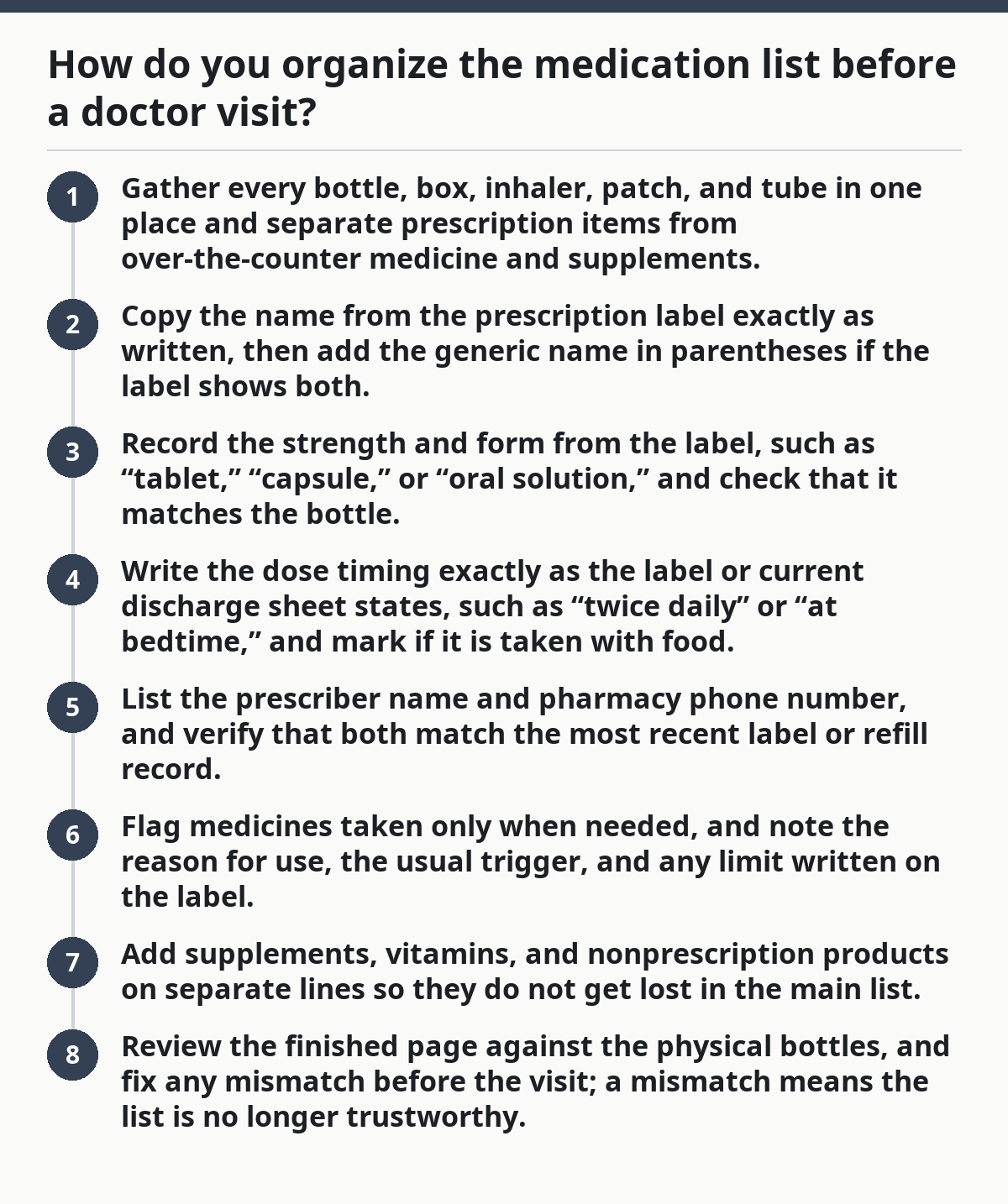
This format works whether you keep it on paper, in a notes app, or in a printed wallet card. The format matters more than the software. A neat spreadsheet is better than a perfect-looking page with missing dose timing.
Which details matter most at the appointment?
The most useful details are the ones that help the clinician compare the list to the person’s actual use, especially when the medication was changed recently. Dose timing, prescriber name, and as-needed use are the fields that usually stop confusion fastest.
Picture this: a nurse asks, “Is this still twice a day or only at night?” If the medication list says only “take as directed,” the answer is hidden. If it says the timing and the prescribing clinic, the appointment moves faster and the chart is easier to update.
Use this order when you edit the list for a visit:
- Dose timing first — write the schedule exactly as it appears on the latest label.
- Changes second — cross out stopped medicines with a single line and write “stopped” with the date if you know it.
- As-needed items third — include pain relievers, allergy pills, sleep aids, and rescue medicines separately.
- Supplements fourth — list vitamins, herbals, protein powders, and any product the person swallows, inhales, or applies regularly.
- Pharmacy details last — add the pharmacy name, location, and phone number so refill questions have a place to go.
A doctor visit usually exposes one problem quickly: the list says one thing, but the bottle says another. That gap is not a small paperwork issue. It can mean the chart is carrying an outdated medicine, a stopped medicine, or a duplicate from another prescriber.
What should be checked before the visit?
The medication list should be checked against the bottle, the pharmacy record, and any discharge paperwork from the last 30 days. That three-way check catches label changes, dose changes, and medicines that were started or stopped after a hospital stay.
Picture this: you’re sitting at the table with a pen, a printout, and a phone from the pharmacy. Before you leave, look for the things that most often trip up reconciliation: two names for the same drug, a changed strength, or a medicine that has no prescriber listed.
- Same drug, different name: brand and generic can both appear.
- Outdated dose: the label changed after the last refill.
- Duplicate medicine: two bottles with the same active ingredient.
- Missing as-needed note: the list says the medicine exists, but not when it is used.
- Old stop order: a medicine is still on the list even though it was discontinued.
If any of those show up, the list needs correction before the appointment. A clean list should match what the person is actually taking today, not what was true six months ago.
Here’s the catch: a medication list can be neat and still be wrong. Clean formatting does not fix old information. That is why reconciliation before the visit matters more than making the page pretty.
When should you stop and ask for help?
You should stop and get a qualified professional involved when the list no longer matches what the person is actually taking, or when the medication history is too uncertain to trust. In health care, uncertainty is the problem, not the paperwork style.
Picture this: a caregiver is sure a pill was changed, but no one knows by whom, and two bottles have similar names. That is not the moment to guess. It is the moment to bring in a pharmacist, prescriber, or clinic staff member who can verify the record.
Two prescribers list the same drug differently: the record may contain a duplicate or conflicting instructions — ask the clinic or pharmacist to reconcile it before the next dose.
A medicine was started after an emergency visit: the discharge record may supersede the old list — use the most recent discharge sheet as the lead source.
The person uses several pharmacies: the refill history may be split across records — request a full printout from each pharmacy.
The label is missing or unreadable: you cannot safely verify dose timing or strength — bring the bottle to the pharmacy or clinic for identification.
The person cannot describe what they take: memory alone is not enough for a reliable list — use pill bottles, pharmacy records, and clinician review.
There are recent side effects or confusion about use: the list may be hiding a use problem — flag it at the appointment and consult a professional rather than trying to solve it alone.
A caregiver should not keep updating a list by guesswork after any of these situations. The cost of a wrong entry is not cosmetic; it can send a clinician down the wrong path during reconciliation.
Common mistakes that make the list less useful
The most common mistake is writing only medicine names and skipping the details that matter at the visit. A list with names alone looks organized but can still fail when someone asks how often, from which pharmacy, or from which prescriber.
Picture this: you have the right stack of papers, but no one can tell which bottle goes with which instruction. That usually happens when the caregiver copies the top line of the label and stops there.
- Leaving out over-the-counter medicine: allergy tablets, pain relievers, and sleep aids get missed; the alternative is to list every nonprescription product on its own line.
- Combining supplements into one line: fish oil, vitamin D, and magnesium may matter separately; the alternative is one entry per product.
- Using vague timing: “as directed” helps nobody at a visit; the alternative is the actual schedule from the label.
- Forgetting a stopped medicine: old entries stay on the page and confuse staff; the alternative is to mark the stop date or remove the item after the clinician confirms it.
- Not naming the pharmacy: refill questions take longer and errors are harder to track; the alternative is to include the pharmacy name and phone number.
- Relying on memory after a refill: the list drifts away from the bottle; the alternative is to update the page whenever the bottle changes.
The truth is, a strong medication list is boring. It reads like a clean inventory, not a family history or a care story. That plain format is what makes it useful in a 10-minute visit.
How do you keep it up to date?
You keep it up to date by treating the list like a living document and checking it after every refill, visit, or med change. A 5-minute update beats a full rebuild the night before the appointment.
Picture this: the doctor changes one medicine, the pharmacy fills another, and the old list is still in the glove compartment. That is how lists drift. The fix is simple: update the master copy the same day the change happens, then replace every old version.
Use one of these systems:
- Keep one paper master copy in a folder and discard older printouts.
- Keep one digital file on the caregiver’s phone and label it with the date.
- Put the list on the fridge only if it is updated often enough to stay current.
- Bring the current copy to each appointment and ask staff to note changes directly on it.
If the list is shared among more than one caregiver, choose one person to make changes and one place to store the master version. Multiple versions cause contradictions fast, especially after a hospital discharge or pharmacy switch.
The safest way to keep the list useful is to make it easy to update within 24 hours of a change. Longer than that, and the page starts becoming history instead of a reference.
Why this matters during reconciliation
Medication reconciliation is the formal check where the care team compares the current list with what the person uses, then resolves the differences. A good caregiver list makes that process shorter and safer because it gives the team a starting point they can trust.
Picture this: the clinician has 2 sources in front of them, and one is clear while the other is messy. The clear one usually wins the conversation. That is why a caregiver’s list can shape the appointment even before the exam starts.
A strong list helps with:
- catching duplicate prescriptions,
- spotting medicines that were stopped but never removed,
- clarifying which provider manages which drug,
- and making refill requests easier to explain.
A weak list does the opposite. It turns a routine visit into a guessing session.
What belongs on a caregiver medication list?
A caregiver medication list should include every prescription medicine, over-the-counter product, vitamin, supplement, and as-needed medicine the person uses. It should also show dose timing, prescriber name, pharmacy details, and any stop notes. If a product is used only once in a while, it still belongs on the list.
Should vitamins be on the medication list?
Yes, vitamins should be on the medication list if the person takes them regularly.
Drafted with AI; not yet reviewed by a person.