Last updated: November 20, 2026
Quick answer: choose a live-in caregiver for overnight help at home when the need is steady, the home can support sleep time, and the plan can hold up for 2 or 3 nights in a row. A good fit is someone who can follow a clear care schedule, handle the night routine, and stay calm when plans change.
Key takeaways
- A live-in caregiver is a fit when overnight support is regular, not random.
- Sleep time matters. If the caregiver cannot get real rest, the arrangement will break down fast.
- Write the night duties down before anyone starts, down to the 2 a.m. tasks.
- Live-in care and hourly care solve different problems; mixing them up leads to bad staffing.
- The wrong setup often fails because the home plan is vague, not because the person is unkind or unskilled.
What should a live-in caregiver do overnight?
A live-in caregiver should do the overnight tasks you agree on, and those tasks should be specific enough that there is no guesswork at 1 a.m. The right list might include helping someone to the bathroom, checking on comfort, answering a call bell or monitor, or staying alert for falls and confusion during the night. For general caregiving guidance, see the National Institute on Aging.
Start by writing the night duties in plain words. Put the items in a care schedule with time ranges, such as bedtime, overnight, and morning handoff. If the person wakes often, note what counts as a normal wake-up and what counts as a problem. That matters because “overnight help” can mean very different things in different homes.
A live-in caregiver is not the same thing as a nurse on a hospital unit. The role usually centers on support, supervision, and routine care rather than medical treatment, so consult a professional or home care agency if the night tasks include medication decisions, wound care, or repeated lifting. If the night tasks include those kinds of medical needs, the arrangement may need a different level of home care agency support or a different staffing plan. See also home care services and 24-hour care for comparison.
Use a short checklist before you hire:
- List the night tasks on one page, with the exact times and triggers.
- Mark the urgent tasks that cannot wait 30 minutes.
- Name the morning tasks so the caregiver knows where the overnight shift ends.
- Separate care from housekeeping so the job does not drift.
- Review the list with the caregiver and ask which tasks fit a live-in schedule.
That last step matters because a person can agree to a plan that looks fine on paper and still be a poor match for the actual night workload. A schedule that needs four or five wake-ups every night may be better handled another way.
How do I know live-in care fits?
Live-in care fits when the overnight need is predictable, the home has a workable sleep arrangement, and the person needs a steady presence more than constant hands-on care. It usually makes sense when the nights are the hard part of the day and the daytime routine is manageable with less help.
It is often the wrong choice when the person needs active care every hour, repeated transfers, or constant medical observation. In those cases, the caregiver may not get enough rest for the job to stay safe or sustainable. That is where people sometimes confuse live-in care with 24-hour care, even though the two models work very differently. For the difference in staffing, see hourly care and overnight care.
Think in terms of the real night pattern, not the label. If the person wakes once or twice, needs bathroom help, and can sleep most of the night, live-in care may be enough. If the person wanders, calls out many times, or needs frequent repositioning, the home may need a different staffing plan.
A home care agency can often help you sort out the basic fit, but the decision starts with the home routine itself. Ask three simple questions: Can the caregiver sleep? How often will the caregiver be awakened? Can the care continue for several nights in a row without burning someone out?
That last question is the one people skip. A plan that works for one night can still fail after 3 or 4 nights if the sleep loss is too heavy. Overnight help has to be judged by the whole week, not by a single good shift.
How do I screen for the right fit?
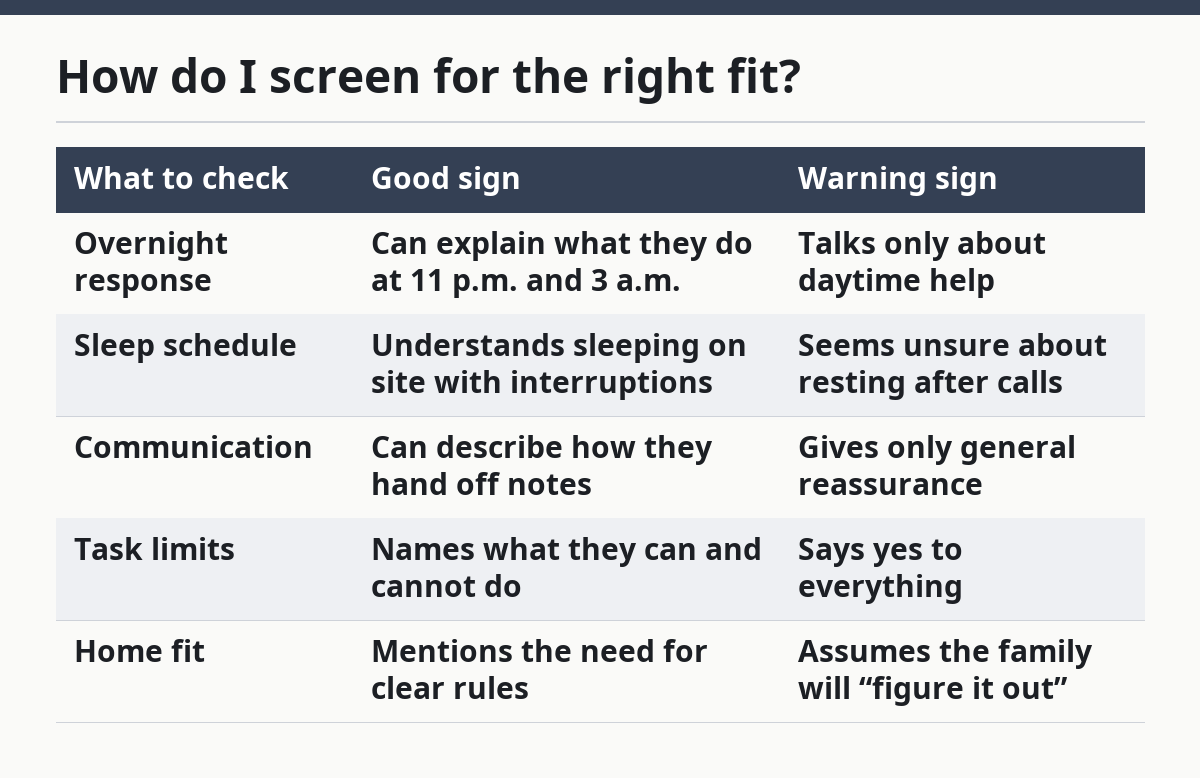
You screen for the right fit by checking night skills, sleep tolerance, and communication before you agree to a care schedule. A warm personality helps, but it is not enough if the person cannot handle a 10 p.m. bedtime routine, a 2 a.m. bathroom trip, and a calm morning handoff.
Ask about real overnight situations, not vague strengths. You want to know how the caregiver handles interrupted sleep, what they do after a fall scare, and how they record night events. If the person says they “do it all,” ask for the details. That answer is too broad to be useful.
Use a simple comparison to sort candidates.
| What to check | Good sign | Warning sign |
|---|---|---|
| Overnight response | Can explain what they do at 11 p.m. and 3 a.m. | Talks only about daytime help |
| Sleep schedule | Understands sleeping on site with interruptions | Seems unsure about resting after calls |
| Communication | Can describe how they hand off notes | Gives only general reassurance |
| Task limits | Names what they can and cannot do | Says yes to everything |
| Home fit | Mentions the need for clear rules | Assumes the family will “figure it out” |
This is also where you compare live-in care with hourly care in practical terms. Hourly care may fit a home that needs a short evening block or an early morning block. Live-in care fits better when the person wants an overnight presence without paying for every hour as if someone were awake the whole time. The wrong choice here costs time, money, and sleep. See live-in care and respite care for related options.
If you use a home care agency, ask how they handle the care schedule when the night routine changes. A good answer will sound specific, not vague. You should hear about shift length, backups, and how the agency handles an off week, not just a promise that someone will “take care of it.”
What sleep setup and night rules matter?
A workable sleep setup and clear night rules matter because a live-in caregiver needs rest to stay alert. If the caregiver is expected to answer every sound all night, the arrangement acts like 24-hour care, not live-in care, and the job will wear out quickly.
Set the sleeping arrangement before the first night. The caregiver needs a private room or at least a defined sleep area, plus a clear sense of when they are off duty and when they must respond. Without that, the night becomes a blur of half-sleep and half-work. That is bad for the caregiver and risky for the person receiving help.
Night rules should cover the common interruptions. Spell out whether the caregiver should wake for every call, only for bathroom help, or only for urgent changes. Put the routine in writing along with any 10 p.m. or 6 a.m. tasks, so no one has to guess in the dark. For practical home setup guidance, see home safety and the CDC falls prevention guidance.
A few details matter more than people expect:
- Where the caregiver sleeps
- How they are alerted at night
- What counts as urgent
- What can wait until morning
- Who is responsible for the first call, if there is one
That last point matters because families often assume “someone will hear it.” In practice, sleep, walls, and home layout can change everything. A clear plan keeps the night from turning into a series of small arguments.
This section also answers a common mistake: treating live-in care like a guest staying over. It is work, not a sleepover, so consult a professional or home care agency if the setup is unclear. If the setup does not respect that, the arrangement will fail even if the caregiver is skilled.
How does live-in care differ from hourly care?
Live-in care differs from hourly care because one person stays in the home for a longer stretch, while hourly care is built around set blocks of time. That difference changes the sleep setup, the cost structure, the handoff process, and the amount of continuity the person gets overnight.
Hourly care works well when the need is narrow, such as a 2-hour evening routine or a morning wash-up. Live-in care works better when the person needs a steady overnight presence across the whole night, with help available if needed. The distinction is not just semantic; it shapes the entire care schedule. For related models, see 24-hour care and overnight care.
Use this quick comparison to decide which model fits the home.
| Feature | Live-in caregiver | Hourly care |
|---|---|---|
| Overnight presence | Stays in the home | Comes for set hours |
| Sleep time | Built into the arrangement | Usually not part of the plan |
| Best for | Ongoing overnight help | Short, specific tasks |
| Handoffs | Fewer handoffs | More handoffs |
| Schedule | One long care block | Several separate visits |
The downside of live-in care is that it depends on a home that can support rest and on a night routine that is not too intense. The downside of hourly care is that it can leave gaps between visits. The right answer depends on the actual night pattern, not the label that sounds nicer.
If you are comparing both, keep the focus on the overnight workload. A person who needs help once or twice a night may do well with live-in care. A person who needs active attention most of the night may need something else entirely.
What mistakes cause the most trouble?
The biggest mistakes are vague night duties, no real sleep plan, and choosing a caregiver who is kind but not ready for interrupted nights. Those mistakes cost sleep, trust, and sometimes safety, and they usually show up in the first week, not months later.
The first mistake is leaving the overnight job undefined. If the caregiver does not know whether to wake for a sound, a bathroom trip, or a routine check, the family and caregiver will make different guesses. That can lead to missed help or repeated interruptions that wear everyone down.
The second mistake is treating the room setup as a minor detail. If the caregiver has no private room or no clear sleeping space, the arrangement can become stressful fast, so consult a professional or home care agency before you assume it will work. A live-in caregiver who cannot rest may still try to help, but the quality of night support drops when fatigue builds.
The third mistake is hiring for personality alone. A pleasant first meeting does not tell you how someone handles a 3 a.m. wake-up, a confused client, or a poor night of sleep. Ask about the exact care schedule, the overnight routine, and the person’s limits.
The fourth mistake is using live-in care when the need is really closer to 24-hour care. That can create unsafe expectations. If someone needs frequent attention through the night, do not assume a live-in model will stretch far enough. See 24-hour care for a better fit when the workload is heavier.
A final mistake is skipping the review after the first few nights. The early shift tells you whether the plan works. If the caregiver is awake too often, the duties need to change or the model needs to change. A good fit still needs checking after 2 or 3 nights, because the home will show its real pattern once the routine starts.
What should I check before I say yes?
You should check the night duties, the sleep setup, the care schedule, and the fit with the home care agency or caregiver before you say yes. That is the shortest path to a choice that can actually last.
Look for four things in the final plan. First, the overnight tasks should be written in a way both sides understand. Second, the caregiver should have a place to sleep and a clear boundary for when they are on duty. Third, the schedule should match the real number of wake-ups, not an ideal version of the night. Fourth, the arrangement should make sense for more than one evening in a row.
If those pieces do not line up, the choice is probably wrong for live-in care, even if the person seems pleasant and capable. The point is not to fill the room with help. The point is to create a night routine that can hold up for the whole week. For more on matching needs to services, see home care services and caregiver jobs.
For a broader view of paid help at home, the guide to Home care services and paid help can help place live-in care in context without turning every problem into the same answer.
What is included in live-in caregiver duties?
Live-in caregiver duties usually include the agreed day and night tasks that support the person at home, such as help with bedtime, overnight checks, bathroom support, and morning routines. The exact list depends on the care schedule and the home setting, so the duties should be written down before the first night.
How is live-in care different from 24-hour care?
Live-in care is different from 24-hour care because one caregiver stays in the home and still needs sleep time, while 24-hour care assumes active staffing across the full day and night. If the person needs help many times overnight, live-in care may not be enough for the workload.
Do live-in caregivers need a private room?
A live-in caregiver needs a defined place to sleep, and a private room is the clearest setup when the home can provide one. Without a proper sleep space, rest suffers and the overnight arrangement becomes harder to sustain. The exact setup should be agreed on before the first shift.
Drafted with AI; not yet reviewed by a person.