Last updated: November 20, 2026
Quick Answer: In 3 steps, you can usually narrow how to find short-term respite care after a hospital discharge: ask the discharge planner, match the care level to the next 24 hours to 7 days, and confirm whether home help or a short-term stay can start on time. If the person needs help with transfers, bathing, medications, or round-the-clock supervision, a home care agency or a short-term stay may fit better than an informal helper.
Key takeaways
- Start with the discharge team, because they already know the care plan, the equipment list, and the timing.
- Match the setting to the need. A short-term stay, home help, or a blend of both can solve different discharge gaps.
- The right choice depends on mobility, wound care, medicine timing, and whether someone must be present overnight.
- Respite after discharge is usually a bridge, not a long-term fix. Use it to cover the first days or weeks while you line up next steps.
- The wrong match can lead to missed meds, falls, or a second hospital visit, so the details matter.
What should I ask the discharge team?
Therefore, the discharge team should tell you what the person needs for the next 24 hours, 72 hours, and 7 days. Ask the care coordinator or discharge planner for the written discharge instructions, the medication list, and the names of any services already suggested before the person leaves the hospital.
Start with one direct question: “What kind of help is needed at home or in a short-term stay after discharge?” That question forces a useful answer. If the plan includes wound care, oxygen, a walker, help with stairs, or a 2-person transfer, the respite care search gets narrower right away.
Use the hospital setting to collect names, not just advice. Ask for at least three options: a home care agency, a short-term stay provider, and any local respite care placement contact the hospital already uses. If the person is leaving the hospital in 1 day, do this before discharge papers are signed, not after everyone is home and tired.
A good discharge note should give you the timing, too. You want to know whether help is needed for 3 days, 2 weeks, or longer. That number changes the search, because some services are built for a quick bridge and others are better when recovery will stretch past the first week.
For background, the Medicare discharge planning page and the National Institute on Aging’s respite care page are useful starting points:
https://www.medicare.gov/basics/get-started-with-medicare/discharge-planning
https://www.nia.nih.gov/health/caregiving/respite-care
How do I match respite care to discharge needs?
Next, you match respite care to discharge needs by sorting the person’s care into three buckets: hands-on help, supervision, and medical tasks. A short-term stay works best when the person cannot safely manage stairs, toileting, or overnight needs alone. Home help works best when the person is stable but still needs a few hours of support.
The right fit depends on the discharge instructions, not on the label “respite.” If the person needs help taking pills on time, getting to the bathroom at night, or following a 10-step wound care routine, a casual helper may fall short. If they only need meals, a ride, and help setting up the first day at home, the placement can be lighter.
Compare the main options this way:
| Option | Best for | Limits |
|---|---|---|
| Home care agency | Help in the home for a few hours or a few days | Usually not enough for 24-hour needs |
| Short-term stay | Recovery when the home is not safe or no one can stay overnight | Less control over routines and location |
| Family or friend coverage | Simple needs and a short gap | Quality varies, and tasks may be hard to cover consistently |
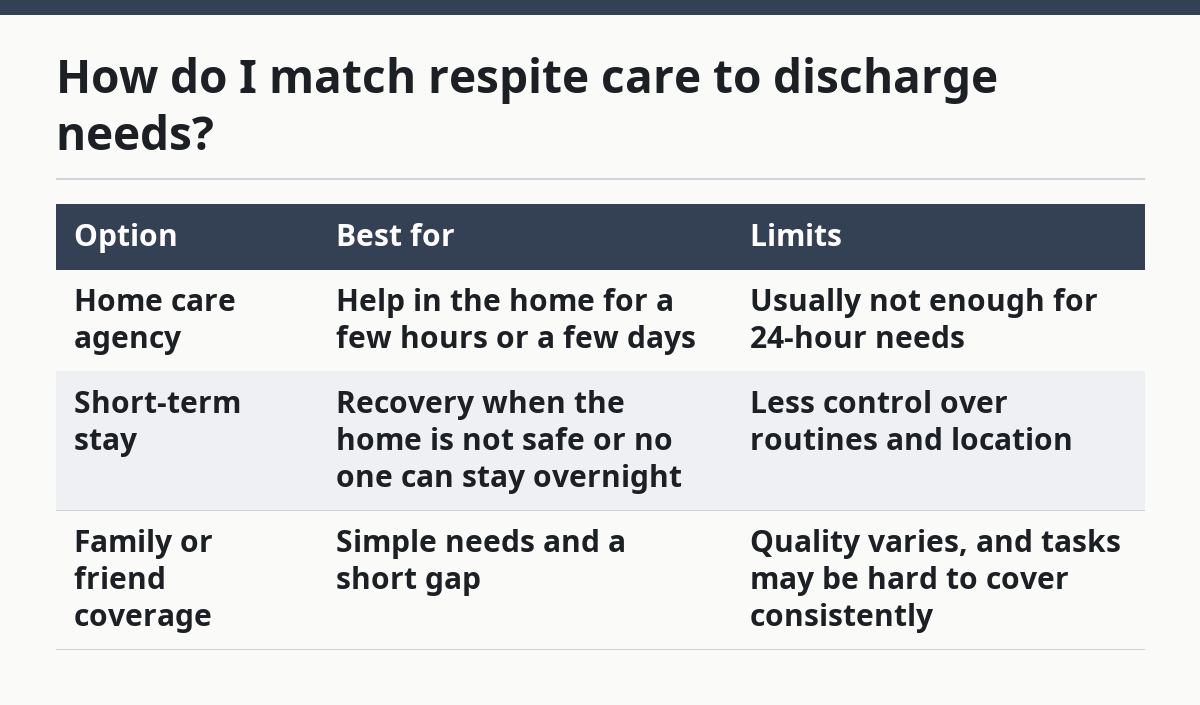
A short-term stay is often the safer choice when mobility is poor or the house has barriers like stairs and narrow bathrooms. Home care is often the better choice when the person wants to stay in their own bed and only needs help during meals, bathing, or the first 2 or 3 days.
Do not pick by convenience alone. A placement that sounds easier can fail fast if the person needs more than light help. The cost of a mismatch is not just stress; it can mean skipped meds, a fall, or a return to the hospital.
What are the steps to find a short-term stay?
Overall, a short-term stay can be found fastest by using the hospital discharge coordinator, one home care agency list, and a direct check of the provider’s intake rules. Work the search in order, because the first call often determines whether placement can happen in hours or takes several days.
- Ask the care coordinator for the discharge level of care, the expected start date, and whether a short-term stay is medically appropriate. This gives you the placement standard to work from, not a guess.
- List the care tasks from the discharge sheet: medication help, bathing, transfers, dressing, meals, oxygen, or wound care. This tells you whether you need light support or more supervised coverage.
- Call one home care agency and ask whether it accepts the needed tasks and the start date. A single phone call can rule in or rule out a whole category of help.
- Call one short-term stay provider and ask about length of stay, admission timing, and what documents they need. Some placements can move quickly once the paperwork is ready.
- Compare the first 2 options against the discharge instructions and pick the one that covers the highest-risk tasks. If one option cannot handle the night shift or medication schedule, it is not the right fit.
- Confirm the handoff with the hospital team so the discharge papers, medication list, and care instructions go to the right place. A clean handoff reduces confusion on day 1.
The point is not to make a perfect long-term plan in one afternoon. The point is to get the next 3 to 14 days covered without a gap. That short window is where many families get stuck, because the discharge date arrives before the caregiving plan does.
If the first provider says no, ask what requirement blocked the match. Sometimes the issue is timing, sometimes it is the level of care, and sometimes it is the person’s medical complexity. That answer helps you move to the next option instead of starting over.
Home or facility: which should I choose?
Conversely, home care fits when the person is safe in the house and mainly needs help for a limited part of the day; a facility short-term stay fits when the house is not safe enough for the first recovery days. The choice is usually about safety, not preference.
Home care keeps the person in familiar rooms, but it depends on the home being usable. If the bathroom is hard to reach, stairs are steep, or the person cannot get from bed to chair without help, the home option may be too thin for the first week. A facility setting can absorb more of that risk because help is closer and more constant.
A short-term stay can also help when family lives far away or works full time. In that case, even 8 hours of daytime help may leave a dangerous gap overnight. A placement that looks expensive on paper may still be the safer bridge if it prevents a 2 a.m. crisis; if you are unsure, consult a hospital discharge planner or care coordinator, and review Medicare’s discharge planning guidance before deciding.
Here is the honest trade-off: home care gives more comfort and control, while a facility gives more coverage. Home care is wrong for someone who needs near-constant supervision. A facility may not be necessary if the person only needs a few check-ins and a ride to follow-up care.
What mistakes cost families the most?
Meanwhile, the biggest mistakes are waiting until discharge day, undercounting the help needed, and assuming a friend can fill every gap. Those errors cost time, and time matters when the person is leaving the hospital with new medicines, new limits, or a new walker.
A common mistake is asking only, “Can someone help at home?” That question is too vague. A better question is, “Can this placement handle bathing, toileting, stairs, and medication reminders for 5 days?” That level of detail is what separates a real match from a polite yes.
Another mistake is ignoring the nighttime hours. Many discharge plans look manageable from 8 a.m. to 6 p.m. and fall apart after dinner. If the person wakes often, needs help to the bathroom, or cannot safely get up alone, overnight coverage becomes the deciding factor.
A third mistake is skipping the written discharge instructions. Verbal notes get missed, especially when the family is tired. The written sheet is usually the main guide the respite provider should follow, and it is the fastest way to keep everyone on the same page.
How long can short-term respite last?
Then, short-term respite can last just long enough to cover the post-discharge gap, but the right length depends on the recovery plan. For some people, that means a few days. For others, it means longer while the home setup, mobility, or medication routine gets easier.
The key is to tie the length to the discharge instructions, not to a guess about “quick recovery.” If the person has a 2-week medication change, a 7-day wound check schedule, or a follow-up appointment that changes the care plan, the respite window may need to last through that period.
Do not assume short-term stay means the same thing everywhere. Some placements are built for a brief bridge, while others can stretch longer if the person still needs support. Ask the provider what length of stay it can accept before you sign anything.
A useful rule is simple: use respite long enough to cover the hardest part of the transition, then reassess. That may be after the first bath, the first shower, the first follow-up visit, or the first week of sleeping through the night. The point is to buy stability, not just time.
Can respite care start right after discharge?
Yes, respite care can start right after discharge if the paperwork, the provider, and the discharge instructions are ready. The main barrier is usually timing, not the idea itself.
In particular, same-day start is more likely when the care coordinator, the medication list, and the receiving provider are lined up before the hospital release. If those pieces are missing, the start date slips. That delay is risky for a person who needs help with transfers, wound care, or medicine on the first night home.
A quick start is most realistic when the need is clear and the placement is simple. If the person needs a short-term stay, the admission often hinges on bed availability and the provider’s intake process. If the person needs home help, the agency still has to confirm the schedule and the tasks.
What kind of help does short-term respite provide?
Specifically, short-term respite can cover the day-to-day tasks that are hardest right after discharge, such as meals, bathing, dressing, transfers, toileting help, medication reminders, and supervision. The exact help depends on the provider and the discharge instructions.
The practical test is this: if the task is written in the discharge plan, ask whether the respite placement can do it for the next 24 hours, 3 days, or 1 week. If the answer is no for any essential task, the placement is incomplete.
How do I match respite care to discharge needs?
Likewise, match respite care to discharge needs by starting with the highest-risk task and working downward. If the biggest risk is falls, pick the option that handles mobility and overnight support. If the biggest risk is missed meds, pick the option that can follow the schedule exactly.
A good match covers the discharge plan without forcing the family to improvise. If a provider cannot handle the bathroom routine, stairs, or a 2-person transfer, keep looking. The best fit is the one that makes the first days after discharge safer, not the one that sounds easiest to arrange.
For more context, see fall prevention and medication management.
Drafted with AI; not yet reviewed by a person.