Last updated: November 20, 2026
Quick Answer: if 1 or more daily activities—bathing, dressing, toileting, transfers, or safe walking—need hands-on help, personal care is usually the better fit. If the person can still do those tasks safely and only needs reminders, company, meals, or light help, companion care may be enough. This article on how to tell if a companion care plan is enough or if you need personal care shows the difference between companion care and personal care in plain terms. For a quick reality check on aging at home, the National Institute on Aging and the CDC explain why falls, weakness, and trouble with daily tasks change the level of help a person needs.
A care plan should match what the person can do safely on a normal day, not on a good day. The National Institute on Aging and the CDC both explain why falls, weakness, and trouble with daily tasks change the level of help a person needs. For more context, see the National Institute on Aging fall prevention guidance and the CDC’s older adult falls page.
Key takeaways
- Companion care helps with company, meals, light household tasks, reminders, and safety check-ins.
- Personal care adds hands-on help with bathing, dressing, grooming, toileting, transfers, and some walking support.
- If the person needs physical help to get out of bed, use the bathroom, or bathe, companion care is usually not enough.
- A home care aide is often the right next step when the problem is not loneliness but daily safety and body care.
- The better choice depends on what happens on a bad day, not just on the day the family sees.
What does companion care actually cover?
Companion care covers non-medical support, not hands-on body care. It usually fits when the person needs company, routine help, and a second set of eyes, but can still manage personal hygiene and movement without physical assistance.
This level of care often includes conversation, meal support, light tidying, transportation, reminders, and supervision during the day. It can also help reduce isolation, which matters for people who live alone or spend long stretches without visitors. The limit is clear: a companion care plan should not be carrying the person, bathing the person, or doing the physical work of toileting.
That limit matters because the difference between “helpful” and “needed” changes fast when a person starts missing basic daily activities. If the main issue is loneliness, poor appetite, or forgetting appointments, companion care can be enough. If the issue is standing, bathing, or getting to the toilet in time, it is no longer enough.
For related planning, see home care services, paid help at home, and fall prevention at home.
What does personal care add?
Personal care adds hands-on help with daily activities that involve the body. That includes bathing, showering, dressing, grooming, toileting, continence support, transfers, and some mobility support.
This is the level that fits when the person cannot safely complete those tasks alone, even if they can still talk clearly and make choices. A home care aide who provides personal care may help steady someone from bed to chair, assist with a shower, or help after an incontinence accident. The key difference is physical assistance, not just supervision.
The drawback is that personal care is more intimate and can feel harder to accept. It also means the care plan must be specific about privacy, timing, and boundaries. If the person still only needs reminders and light help, personal care may be more than they need. If they are skipping bathing because it is hard, or rushing to the toilet because they fear falling, the added hands-on support is usually the safer choice.
See also help with bathing and dressing, in-home support, and home care aide basics.
Companion care vs personal care: what changes?
Companion care wins for lighter needs; personal care wins the moment the job becomes physical. The table below shows the difference that actually changes the choice.
| Criteria | Companion care | Personal care | Winner for [condition] |
|---|---|---|---|
| Meal support | Can prep simple meals, cue eating, and offer reminders | Can also help if eating is tied to body care needs | Companion care for light meal help |
| Bathing | Not a fit for hands-on bathing | Can assist with bathing and shower routines | Personal care if bathing needs help |
| Dressing | Can lay out clothes and remind | Can help put clothes on | Personal care if dressing is hard |
| Toileting | May remind and watch for safety | Can help with toileting and continence support | Personal care if bathroom trips are unsafe |
| Transfers | Can stand nearby but should not physically move the person | Can help with bed, chair, and similar transfers | Personal care when transfers need a hand |
| Walking support | Can supervise and encourage safe movement | Can provide more direct mobility support | Personal care when balance is unreliable |
| Home tasks | Good for light tasks and companionship | Can still help, but the body-care role is the point | Companion care for household support |
| Supervision | Useful when the person is alone but safe | Useful when the person needs closer day-to-day monitoring | Personal care if safety issues are daily |
| Dignity and privacy | Less intrusive | More intimate and hands-on | Companion care if hands-on help is not needed |
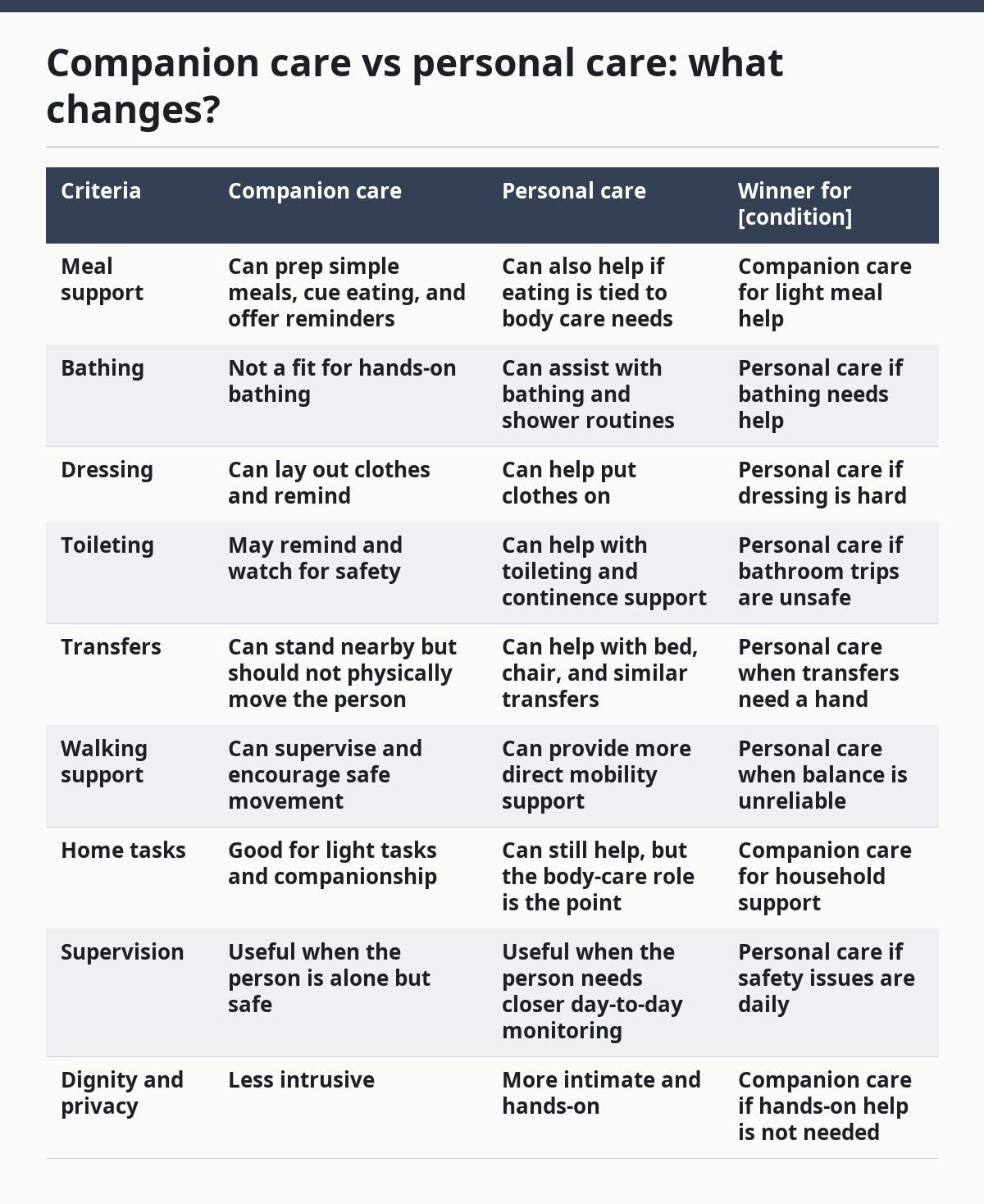
The table gives the basic rule: if the task is social, logistical, or supervisory, companion care often works. If the task touches bathing, dressing, toileting, or safe movement, personal care is the better match. The biggest mistake families make is trying to stretch companion care over a physical problem.
When companion care is enough
Companion care is enough when the person can do personal hygiene and mobility on their own, even if they need help staying organized. That means they can bathe, dress, toilet, and move around without another person physically helping.
This level often fits someone who is lonely, forgetful with meals, tired after errands, or uneasy being alone. It also fits someone who wants a calmer day with fewer chores and more routine. A companion can help with meal preparation, a walk, conversation, medication reminders if allowed by the care plan, and light supervision around the home.
The strength of companion care is that it preserves independence while filling in the gaps around it. The weakness is that it only works while the gaps stay non-physical. If the family starts spotting wet clothes, skipped showers, bruises from near falls, or a need to hold on during every transfer, the plan has already outgrown companion care.
When personal care is the better fit
Personal care is the better fit when the person needs hands-on help with daily activities or is at risk of injury without it. That includes trouble getting into the shower, using the toilet safely, standing from a chair, or walking across a room without steady support.
This level also fits when hygiene starts slipping because the task is too hard, not because the person forgot. A person who avoids bathing for days, wears the same clothes because dressing is exhausting, or rushes to the bathroom and nearly falls is not just lonely. That person needs physical support from a home care aide.
The trade-off is privacy. Personal care means another person is close during some of the most private parts of the day. That is a real burden for many people, but the cost of not making the change can be higher: falls, skin problems, missed toileting, and family stress. If the person’s needs are already on the edge, personal care usually protects dignity better than a plan that leaves them struggling alone.
For more on safety and planning, review CDC falls prevention and NIA aging at home guidance.
How do I decide the right level of help?
The right level of help is the one that matches the hardest part of the day, not the easiest. Use a simple check of daily activities, mobility support, and safety.
- List the daily activities that happen without help and the ones that do not.
- Check the bathroom routine, since bathing and toileting are often the clearest dividing line.
- Review mobility around the home, including standing, transfers, and walking between rooms.
- Compare the current care plan against the person’s weakest day, not the best one.
- Ask whether the help needed is supervision or hands-on physical care.
If the answer is mostly reminders, meals, light chores, and company, companion care is likely enough. If the answer includes a shower, a toilet transfer, a fall scare, or repeated help getting up, personal care should be on the table right away. For readers building a fuller plan inside the home care services and paid help hub, this is the point where the category changes from support to physical assistance.
When should the plan change?
The plan should change as soon as regular daily tasks stop being safe, not after a crisis. A move from companion care to personal care is usually the right call when the person needs help with hygiene, toileting, or transfers more than once in a while.
Three signs matter most. First, a pattern of near falls or unsteady walking. Second, skipped bathing, missed toileting, or clothing changes that are no longer manageable. Third, a caregiver having to do more physical lifting than the current plan allows. A plan that still says “companion” while the family is already doing personal care work is a mismatch.
For a practical next step, see how to choose home care and what a home care aide does.
Exception scenarios that change the answer
The overall answer can flip if the person has sudden weakness, a new diagnosis, or severe fatigue. In those cases, a companion care plan that seemed fine last month may no longer be enough.
A second flip happens when the person is safe during the day but not at night. Nighttime toileting, confusion, or bathroom falls can push the need toward personal care even if daytime support is light. A third flip happens when family members are filling the gap with hands-on help they cannot keep doing.
The final exception is refusal. If the person refuses bathing, dressing help, or a safer transfer method, the plan may need to change before the family expected. A plan is only useful if it matches what actually happens in the home.
The verdict
Choose companion care if the person needs company, meal help, reminders, light chores, and supervision, but can still bathe, dress, toilet, and move safely without hands-on help. Choose personal care if the person needs physical assistance with any of those daily activities, has regular fall risk, or cannot keep up with hygiene alone. Neither if the needs are suddenly severe, medically unstable, or beyond what a non-medical home care aide can safely cover; that is the point to get a professional assessment.
What can companion care do that personal care cannot?
Companion care can focus on social support, routines, and light day-to-day help without entering hands-on body care. It is the better fit for conversation, meal prep, reminders, rides, and a safer, less intrusive presence at home. It should not replace bathing, toileting help, or physical transfers.
When does someone need personal care instead of companion care?
Someone needs personal care instead of companion care when daily activities require physical assistance. Bathing, dressing, toileting, standing, and walking are the clearest signs. If the person is starting to need a steadying hand or a lift more than a rare one-off, the care plan has likely crossed the line.
How do I decide the right level of help?
Decide by asking what kind of help is actually needed on the hardest day of the week. If the need is mostly reminders, meals, and company, companion care may be enough. If the need involves hands-on help with hygiene, toileting, or movement, personal care is the better fit and usually the safer one.
Drafted with AI; not yet reviewed by a person.