Last updated: November 19, 2026
Key Takeaways
- Ask how caregivers are screened, matched, and supervised, and who to call if there is a problem.
- A good screening process is clear, repeatable, and easy to explain in plain words.
- The caregiver should fit the job, the home, and the person receiving care.
- Ask how flexible the schedule is and what happens if a caregiver cancels.
A home care agency can sound fine on the phone and still be a bad fit once visits start. What to ask a home care agency before you sign up for services is the key question, and the answer should cover screening, care matching, schedules, supervision, and billing before you sign anything. The questions below will help you spot weak spots fast and avoid a messy first week.
What should I ask a home care agency first?
Ask how they screen caregivers, how they match them to your needs, and who you call when something goes wrong. Those three answers tell you more than a glossy brochure ever will.
Picture this: you’re comparing two agencies after a long day, and both promise “reliable help.” One gives clear answers about background checks, scheduling, and backup coverage; the other stays vague. That difference usually shows up later at the door.
Start with the basics below:
- Who does the screening? Ask whether the agency checks references, confirms work history, and does background checks on every caregiver.
- How is the match made? Ask what details the agency uses: mobility limits, memory issues, language, shower help, lifting limits, and personality fit.
- Who supervises the caregiver? Ask whether an agency coordinator checks in, how often that happens, and what gets reviewed.
- What happens if the match is wrong? Ask how fast they can send someone else.
- What is the minimum visit length? Many agencies set a 2-hour, 3-hour, or 4-hour minimum. That affects cost and fit.
- What is the after-hours contact? If the office closes at 5 p.m., you still need a number for late changes.
Some agencies answer in plain English, while others lean on broad promises.
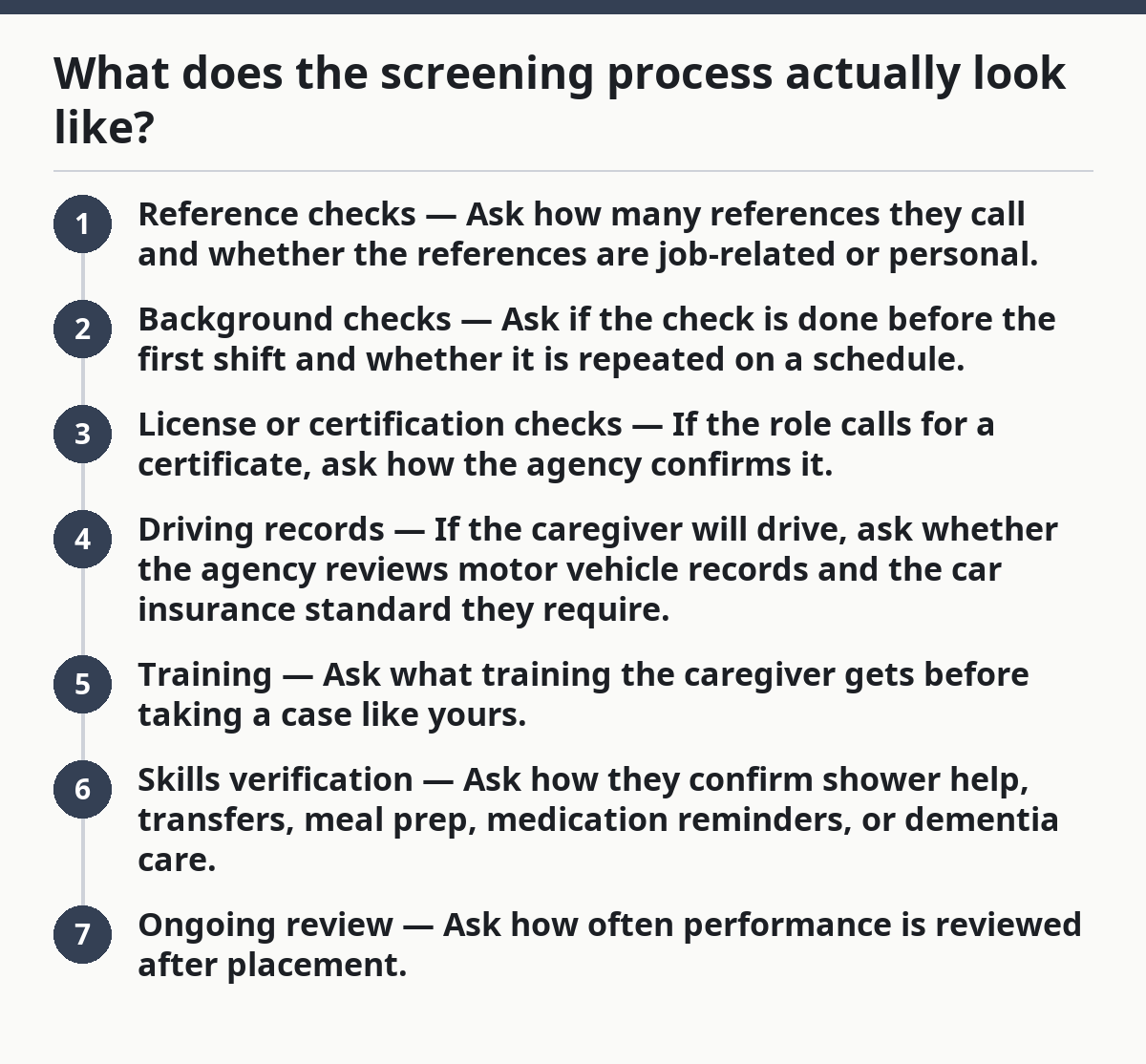
What does the screening process actually look like?
The screening process should be specific, repeatable, and easy to describe in plain words. If the answer sounds fuzzy, the agency may be hiring fast and sorting it out later.
Picture this: you ask about checks, and the person says, “We look for good people.” That is not a process. You want to hear what they verify before anyone enters your home, because that tells you how much risk the agency takes on your behalf.
A solid screening conversation should cover:
- Reference checks — Ask how many references they call and whether the references are job-related or personal.
- Background checks — Ask if the check is done before the first shift and whether it is repeated on a schedule.
- License or certification checks — If the role calls for a certificate, ask how the agency confirms it.
- Driving records — If the caregiver will drive, ask whether the agency reviews motor vehicle records and the car insurance standard they require.
- Training — Ask what training the caregiver gets before taking a case like yours.
- Skills verification — Ask how they confirm shower help, transfers, meal prep, medication reminders, or dementia care.
- Ongoing review — Ask how often performance is reviewed after placement.
A better agency will name the steps and the order. A weak one will say “we do all that” and stop there.
One useful outside source is the Consumer Financial Protection Bureau for general guidance on checking service contracts and billing language. For care standards and workforce practices, the Home Care Association of America is also worth reading.
How do I know the caregiver will be a good match?
The caregiver should fit the task list, the home, and the person receiving care, not just the calendar. A warm personality helps, but skill and reliability matter more once the work starts.
Picture this: you need help with bathing, meal prep, and light transfers, but the agency sends someone who is kind and completely unprepared for lifting or a strict routine.
That mismatch can create stress in a single morning.
Ask the agency coordinator these questions:
- What details do you use to match caregivers? Ask about memory loss, fall risk, pets, stairs, smoking, language, and gender preference if that matters to the person receiving care.
- Can the agency match for pace and personality? A quiet person may need a calm caregiver, while someone social may want more conversation.
- How do you handle special routines? Ask about wake-up times, meals, prayer, television habits, and bedtime.
- Who decides if the match is working? Ask whether the coordinator checks in after the first visit, the first week, or the first month.
- How do you handle skill gaps? Ask what happens if the caregiver cannot safely do a task on day one.
- Can one caregiver follow the case long-term? Consistency matters when the schedule is 3 days a week or more.
A good match is not luck. It is the result of questions, notes, and honest limits. If the agency says yes to everything without asking about the home, that is a bad sign.
What should I ask about the schedule and backup plan?
Ask how flexible the schedule really is and what happens when a caregiver cancels. That is where many families get burned, especially when the care plan depends on mornings, rides, or medication reminders at fixed times.
Picture this: you’ve built your week around a 7 a.m. visit, then you get a cancellation text at 6:30 a.m. The agency’s backup plan matters more than the original promise. Here’s the catch: a nice coordinator is not the same thing as a workable system.
Use this checklist:
- What are your arrival windows? Ask whether the caregiver arrives at an exact time or within a range.
- How much notice do you give for changes? Ask about notice for schedule swaps, holidays, and illness.
- What happens if my caregiver is sick? Ask whether a substitute is guaranteed or only offered if available.
- Can I change days or hours without restarting the process? Life changes, and the plan should bend with it.
- What is the minimum weekly schedule? Some agencies only take cases above a certain number of hours.
- How are missed visits handled? Ask whether you get a same-day call, a substitute, or a refund policy in writing.
A practical agency will spell out coverage rules before you sign the service agreement. The weak spot is often not the first month. It is month three, when the agency is juggling too many homes and too few people.
What billing questions stop surprise charges?
Billing should be plain enough that you can follow it without a phone call. If the agency cannot explain the invoice, it is harder to trust the rest of the agreement.
Picture this: the first bill arrives and includes travel time, holiday rates, a cancellation fee, and a minimum charge you never heard about. That sort of surprise usually starts with one missing question before enrollment. It’s a costly one.
Ask these billing questions before you sign:
- What is the hourly rate? Ask whether evenings, weekends, or holidays cost more.
- What is the minimum charge per visit? A 2-hour minimum can change the math if you only need brief help.
- Do you bill for drive time or mileage? Some agencies do.
- When is payment due? Ask whether they bill weekly, every 2 weeks, or monthly.
- What happens if a caregiver arrives late? Ask how the agency handles partial visits.
- What fees can appear later? Ask about cancellation fees, holiday premiums, holiday pay rules, and last-minute changes.
- Who do I call about a mistake? Ask for the name or role of the person who handles billing disputes.
This is also the point to ask for a sample invoice. A sample bill shows the line items that matter. If the agency won’t show one, assume the contract needs a second reading.
What belongs in the service agreement?
The service agreement should spell out the work, the schedule, the billing terms, and the exit rules in writing. If it stays vague, the agency has room to interpret things later.
Picture this: the coordinator remembers one version, you remember another, and the caregiver follows a third. Written terms prevent that mess. They also make it easier to compare agencies side by side, especially when one sounds friendlier but hands you a thinner contract.
Make sure the agreement covers:
- The exact duties — bathing, meal prep, light housekeeping, companionship, errands, or transportation.
- The schedule — days, hours, arrival windows, and minimum visit length.
- The rate sheet — base rate, overtime, holiday pay, and any extra charges.
- The cancellation policy — how much notice you need and what it costs if plans change.
- The substitution policy — what happens when the assigned caregiver is out.
- The complaint process — who you call, how fast they respond, and what happens next.
- The end date or notice rule — how either side can end the arrangement.
Ask for the agreement before the first visit, not after. If the agency says the paperwork can wait, that is a red flag. The better path is simple: read it, ask about anything unclear, and keep a copy in a folder you can find later.
What questions reveal how an agency handles problems?
Ask who owns the problem, how fast the agency responds, and what changes after a complaint. The best agencies do not pretend problems will never happen; they explain the process for fixing them.
Picture this: a caregiver no-shows, or a task gets skipped, or the match is wrong after the first week. You want a clean path to a human being, not a voicemail maze. That path matters at least as much as the original promise.
Use these questions:
- Who is my main contact? Ask for the agency coordinator’s name or role.
- How fast do you respond to complaints? Ask for a clear time frame, not “as soon as possible.”
- What happens after a problem is reported? Ask whether they document it, coach the caregiver, or send a new person.
- Can I request a different caregiver without penalty? That question matters if the fit is poor.
- How do you track repeat issues? Ask whether the agency keeps notes on missed tasks, lateness, or poor communication.
- What if the same problem happens twice? A strong agency has a step-up process.
A good answer sounds organized. A weak one sounds defensive or vague.
What should I compare before I choose one agency?
Compare the facts you can verify, not the pitch you liked best. A friendly phone call is nice, but screening, backup coverage, billing, and contract terms matter more once the home care starts.
Picture this: two agencies both say they can help, but one gives a clear written service agreement, names the coordinator, and explains backup coverage in a few minutes. The other keeps circling back to “we take good care of people.” Choose the one that answers like a business, not a slogan.
Use this comparison list:
- Screening — references, background checks, and any extra checks for driving or skills
- Matching — how they choose the caregiver for the home and the task list
- Schedule flexibility — whether they can handle changes without chaos
- Supervision — how often the agency checks in
- Billing — how the invoice is built
- Agreement terms — what is written down before the first visit
The strongest agency is not always the cheapest. It is the one that leaves fewer blanks. That matters more when the schedule is tight, the needs are specific, or the family cannot absorb a missed shift.
Frequently Asked Questions
How do you compare agencies?
Compare the answers, not the sales pitch. Put screening, matching, schedule flexibility, supervision, billing, and contract terms side by side in writing. If one agency is clear about background checks and backup coverage while another stays vague, that difference usually tells you more than price alone.
What questions reveal how an agency handles problems?
Ask who takes the complaint, how fast someone responds, and what changes after the report. The answer should describe the process in plain language, including whether they document the issue, coach the caregiver, or send a new person. Vague answers usually mean weak follow-through.
What should be in the service agreement?
The service agreement should list duties, hours, rates, cancellation rules, substitute coverage, and the complaint process. It should also spell out any holiday or overtime charges. If those terms are missing or fuzzy, ask for a revised copy before anyone starts.
Why does background check detail matter?
Background check detail matters because “we check everyone” is too vague to trust. Ask when the check is done, what it includes, and whether it is repeated. A real process should be easy to describe without hand-waving.
Drafted with AI; not yet reviewed by a person.