Last updated: November 19, 2026
Quick Answer: the right help at home is usually one of 4 buckets — household help, companion help, personal care, or skilled care — and the best match depends on the hardest task, the risk, and the level of support you actually need. In this guide to Getting the Right Help at Home — The Complete Guide, the goal is to sort that out so you can choose without guessing. If the need includes falls, wounds, confusion, or missed medicines, the answer can change fast.
Key Takeaways
- Start with the task, not the title. Cleaning, bathing, meals, rides, and medical needs call for different kinds of help.
- Match the job to the person’s limits. A housekeeper, companion, home health aide, and skilled nurse do not do the same work.
- Check for clear duties, backup coverage, and who supervises the worker.
- Ask about training, insurance, references, and whether the help is insured, bonded, or licensed where needed.
- If the home situation includes falls, wounds, confusion, or missed medicines, the choice shifts fast toward more structured care.
I have spent years writing about home support, elder care, and the gap between “a little help” and “too much help.” That gap is where families waste time and money.
What kind of help do you actually need?
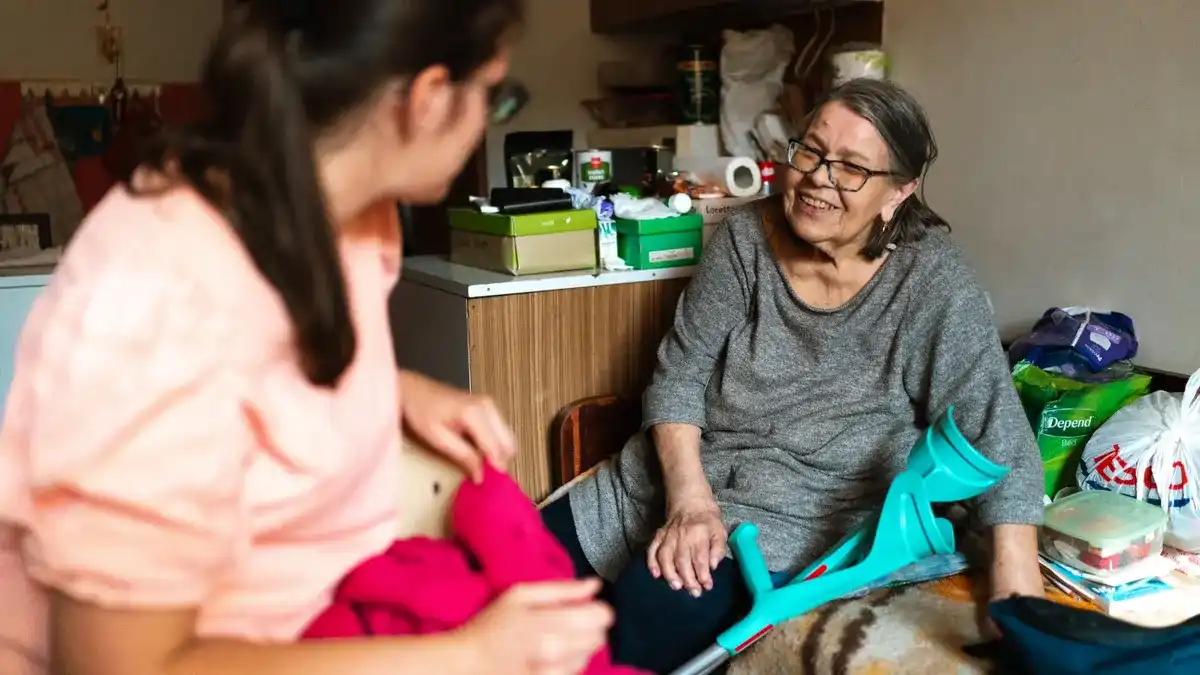
You need the answer to this before you talk to any agency or hire anyone privately. Picture this: you’re trying to keep the house running, but the real problem is not the dishes — it’s that someone can’t safely shower, remember pills, or get to appointments without help. The question is not abstract. It is practical.
The right help usually falls into one of four buckets: household help, companion help, personal care, or skilled care. Each one solves a different problem.
- Household help: cleaning, laundry, dishes, changing linens, light meal prep
- Companion help: conversation, rides, errands, supervision, staying present
- Personal care: bathing, dressing, toileting, transfers, skin care
- Skilled care: wound care, injections, medication management, therapy support, nurse oversight
Here’s the catch: the wrong bucket can leave a real need uncovered. A cleaner may keep the kitchen tidy, but that does nothing if the person is unsteady in the shower. A companion may be kind and attentive, but that does not make them a substitute for a licensed nurse.
The simple rule that keeps families from overbuying
Choose the least intensive help that safely covers the hardest task. If the hardest task is carrying trash bags and vacuuming stairs, you do not need a nurse. If the hardest task is a catheter or a post-surgery dressing, you do.
That sounds plain, but it prevents two common mistakes: paying for medical care when the need is mostly practical, and hiring low-level help when the real need is safety or clinical oversight. When the choice affects medication, wounds, falls, or recovery, consult a professional and check reliable guidance before you decide. CMS and state health rules are a good place to start. Medicare
A good starting question is this: What task would cause the biggest problem if it went wrong today? That answer usually points to the right category.
Home help, home care, and home health are not the same thing
Home help wins for chores, home care wins for personal support, and home health wins for clinical tasks. Picture this: you want someone in the house three mornings a week, but you’re not sure if you need a cleaner, a helper, or a nurse. The titles blur together, and that is where families get misled.
The cleanest way to separate them is by training and legal scope. A housekeeper cleans. A companion helps with presence and errands. A home health aide may help with bathing and daily living tasks, depending on the agency and state rules. A nurse handles clinical work under a care plan.
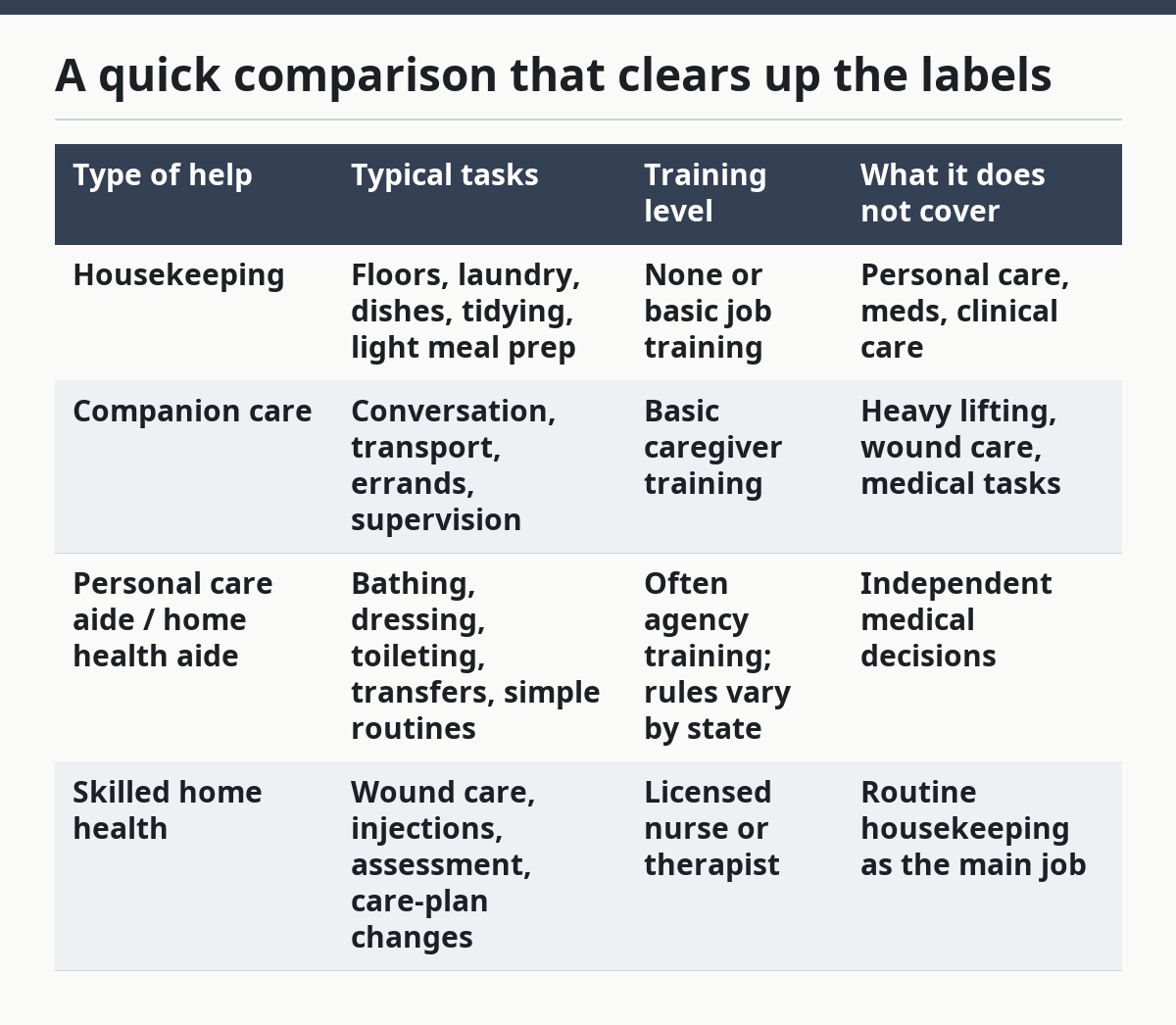
A quick comparison that clears up the labels
| Type of help | Typical tasks | Training level | What it does not cover |
|---|---|---|---|
| Housekeeping | Floors, laundry, dishes, tidying, light meal prep | None or basic job training | Personal care, meds, clinical care |
| Companion care | Conversation, transport, errands, supervision | Basic caregiver training | Heavy lifting, wound care, medical tasks |
| Personal care aide / home health aide | Bathing, dressing, toileting, transfers, simple routines | Often agency training; rules vary by state | Independent medical decisions |
| Skilled home health | Wound care, injections, assessment, care-plan changes | Licensed nurse or therapist | Routine housekeeping as the main job |
The truth is, the title on the flyer matters less than the duty list. A family can hire “home care” and still get a worker who only does meals and light cleaning. That is fine if that is all you need. It is a bad fit if falls, dementia, or medicine errors are in play.
Once you name the task, the rest gets easier. You can ask the right question: “Can this person safely do the specific job I need, and are they allowed to do it?”
Where the line matters most
Some jobs sound small but actually require more skill than people think. Transferring someone from bed to chair, managing oxygen equipment, or helping with diabetes routines can go badly without training.
Watch for these red-flag phrases:
- “She can probably help.”
- “We usually figure it out.”
- “We don’t really do that, but we can try.”
That is not a plan. It’s a guess.
How do I choose between hiring privately and using an agency?

An agency wins when you want backup, screening, and someone else to handle absences. Picture this: you finally find a worker you trust, and then they call out sick on a Tuesday morning. If nobody replaces them, the whole week can collapse.
Private hiring can cost less in some cases, but it puts more burden on you. You handle recruiting, vetting, payroll, taxes, scheduling, replacements, and problem solving. An agency usually takes on more of that load and often has a care coordinator who can adjust the plan if the person’s needs change.
The honest side-by-side
| Criteria | Private hire | Agency | Winner for this condition |
|---|---|---|---|
| Screening | You do it yourself | Agency screens first | Agency if you want less guesswork |
| Backup coverage | You arrange a substitute | Agency usually sends a replacement | Agency if missed shifts would be a crisis |
| Control over one person | High | Moderate | Private hire if you want the same helper every time |
| Payroll and taxes | Your job | Agency handles it | Agency if paperwork is a burden |
| Cost structure | Often simpler on paper | Usually higher due to overhead | Private hire if you can manage the admin |
| Training standards | Depends on you | More consistent | Agency if task safety matters |
| Supervision | You direct the work | Agency may supervise | Agency if you want oversight |
| Flexibility | Very flexible if the person agrees | Depends on agency rules | Private hire for unusual schedules |
Private hire can be the right move for someone who already knows the worker, has a stable routine, and can manage employment tasks. It is weaker when the job is complex or unpredictable. If the person falls often, forgets meds, or needs changing care, the lack of backup can become a real problem fast.
What to ask before you hire privately
Before you hire privately, use plain questions. No jargon needed.
- What exact tasks will you do?
- What will you not do?
- What happens if you are sick?
- Can you give references from recent clients?
- Are you insured?
- Are you allowed to drive clients, and is your license current?
If the answer to any safety question is vague, stop there. A nice manner does not replace a clear job boundary.
What makes a good home-care agency?
A good agency is the one that gives you clarity, not just a cheerful phone call. Picture this: you call three agencies, and each one says they can “customize support.” That sounds helpful until you ask who does the scheduling, what happens on holidays, and whether the worker has training in mobility or dementia care.
A better agency is specific. It can tell you what kind of aide it sends, how it screens, what oversight exists, and how it handles complaints. It also tells you what it does not do.
Signs the agency is worth a closer look
- It gives you a written service list.
- It explains supervision and backup in plain language.
- It asks about stairs, pets, mobility, behaviors, and medication routines before starting.
- It has a process for late arrivals, missed shifts, and complaints.
- It can explain whether staff are employees or contractors.
- It can name whether workers are bonded or insured, if that applies.
A poor agency often sounds smooth at first and thin on detail later. That is a bad trade. You want the agency that asks hard questions before taking your money.
Ask these before you sign
- Who do I call after hours?
- What happens if the assigned worker quits?
- Can the schedule change as needs change?
- Does the agency supervise care plans, or only send people out?
- What training do workers get before entering the home?
- Is there a minimum visit length?
Fit matters too. A worker who is calm with dementia, for example, may not be the best match for a very high-energy client who needs lots of conversation and errands.
How do I know what tasks are safe for a helper to do?
A task is safe when the person is trained, allowed, and physically able to do it without creating a new risk. Picture this: you need someone to help with a shower, but the bathroom floor is slick, the tub has no grab bar, and the person needs help standing. That is not just a comfort issue. It is a fall risk.
The practical test is simple: can the helper do the task without guessing, without lifting beyond their training, and without crossing into medical work they are not allowed to do?
Tasks that often need extra caution
- Bathing and showering
- Moving someone from bed to chair
- Toileting help
- Medication reminders versus medication administration
- Wound dressing changes
- Using lifting devices
- Driving clients in unfamiliar conditions
Here’s the catch: the same task may be fine in one home and unsafe in another. A transfer that works with a gait belt and two grab bars may be risky in a tight hallway with no equipment.
A practical home-safety check
Look at the room before you decide the job:
- Are there loose rugs or cords?
- Are there grab bars or a stable chair?
- Is lighting good enough for evening use?
- Can the helper move around without twisting awkwardly?
- Is there a plan for emergencies?
If the answer to any of those is no, the task may need a higher-skill helper or a safer setup first. A better worker is not the only fix. Sometimes the home itself needs changing.
What should be in the care plan, even for simple help?
A care plan should say who does what, when they do it, and what to do if things change. Picture this: you think you booked “morning help,” but the worker thinks their job is only breakfast and laundry, while you expected bathing and an escort to the doctor. That mismatch causes frustration before it causes real harm.
Even simple help needs a written agreement. Not a novel. A clear page will do.
The plan should cover these points
- Exact tasks
- Days and hours
- Who opens the door
- Food allergies or diet needs
- Mobility issues
- Dementia, anxiety, or behavior notes
- Pet concerns
- Emergency contacts
- What counts as a problem worth reporting
A plan also needs a backup line. If someone becomes weaker, starts wandering, or stops eating well, the arrangement may need to move from companion help to personal care or clinical support.
A good plan protects the worker too. When the job is written down, nobody has to guess whether a task is expected.
If the need is changing, do not wait
You should revisit the plan if:
- there has been a fall
- medicines are being missed
- bathing is becoming unsafe
- confusion is getting worse
- the caregiver is burning out
That is not overreacting. It is how families avoid crisis hiring.
When should I choose more structured support instead?
Structured support wins when the risk is higher than a casual arrangement can handle. Picture this: the person at home is still living independently on paper, but they are forgetting meals, leaving the stove on, or struggling with toileting. At that point, “just a little help” is often too small.
The main signs are plain:
- repeated falls
- skin breakdown
- missed medications
- trouble with transfers
- wandering
- confusion about time or place
- exhaustion in the main family caregiver
That is when a more structured setup starts to make sense. It may mean a licensed home health agency, scheduled personal care, or a mix of day help and short overnight support.
Why structure matters
Structure gives you three things casual help often cannot:
- Consistency in who shows up and what they do.
- Accountability if tasks are missed.
- Escalation when the person’s needs increase.
On the flip side, structure can feel less flexible. You may have set visit lengths, fixed routines, and less freedom to change things on the fly. That trade-off is worth it when safety is on the line.
A simple threshold to remember
If the home problem can be fixed with cleaning, rides, or supervision, start there. If the problem is physical safety, medicine, or confusion, raise the level of help.
That is the line many families cross too late.
The honest verdict: which type of help fits which situation?
Home help for chores. Companion help for presence and errands. Personal care for bathing, dressing, and toileting. Skilled home health for medical tasks and changing conditions. Picture this: you are trying to choose in one phone call, but the real answer depends on the hardest thing that needs doing each day.
Choose household or companion help if the person is mostly safe, needs lighter tasks covered, and can handle personal care alone. Choose personal care or skilled home health if safety, mobility, medication, or confusion has become the main issue. Neither if the home is unsafe, the job is unclear, or the care need has outgrown what one helper can reasonably cover.
Where the choice turns
The right fit is less about price and more about risk. A lower-level helper is the better move for a stable routine with chores, meals, and company. A higher-level provider is the better move when the cost of a mistake is a fall, an infection, or a medication error.
The three questions that settle it fast
- What is the hardest task?
- What happens if that task goes wrong?
- Who is allowed and trained to do that task?
If you can answer those three, the rest gets much easier. Easier.
What if the situation changes?
The verdict can flip when the person’s condition changes, the home setup changes, or the caregiver burns out. Picture this: the plan worked for six months, then one fall, one hospital visit, or one bad week changed everything.
Three situations where you should rethink the plan
-
After a fall or near-fall
A simple helper may no longer be enough if transfers or bathing are now risky. The plan may need more hands, better equipment, or a trained aide. -
After a hospital stay
Discharge plans often come with new routines, new meds, or wound care. That can push the need from companion help into skilled support. -
When the main caregiver is exhausted
If the family caregiver is running on fumes, the issue is no longer just the older adult or patient. The whole setup is unstable.
When to escalate quickly
- The person cannot stand safely
- Pills are being missed or doubled
- There is sudden confusion
- The bathroom has become dangerous
- The worker keeps calling out and there is no backup
Do not wait for the perfect plan. An imperfect plan that matches the risk is better than a polished one that ignores reality.
Where to check the rules and get reliable guidance
The right help at home should fit the person, the task, and the local rules that govern care. Picture this: you know what kind of support you need, but you still need to confirm what a worker may legally do in your state and what safety guidance applies.
Two reliable places to start are the U.S. Centers for Medicare & Medicaid Services and your state’s health or labor department. Professional groups such as the National Association for Home Care & Hospice also publish plain-language guidance on home care roles and expectations.
- U.S. Centers for Medicare & Medicaid Services: https://www.medicare.gov/
- National Association for Home Care & Hospice: https://www.nahc.org/
Those pages won’t choose the helper for you, but they can keep you from confusing a housekeeper with a licensed care provider. That distinction matters.
What should I ask before I agree to care at home?
You should ask who will do the work, what exactly they will do, and what happens when the plan changes. Picture this: the first visit is tomorrow, and you still do not know whether the helper will bathe, cook, or just keep the person company.
Questions worth asking out loud
- What tasks are included?
- What tasks are excluded?
- Who supervises the helper?
- What happens if the person falls or refuses care?
- Is there backup if the worker cannot come?
- Are there written notes after visits?
- How do you handle changes in condition?
If the answers stay vague, stop and reset. Good care at home starts with plain language, not hopeful assumptions.
FAQ
How do I tell if I need a cleaner or a caregiver?
A cleaner handles the house; a caregiver handles the person. If the main problem is dust, laundry, and dishes, start with cleaning. If the main problem is bathing, dressing, meals, or supervision, you need caregiver support.
Can one person do everything?
Sometimes one person can do a lot, but not safely do everything. A helper may be fine for meals, housekeeping, and companionship, yet still not be the right person for bathing, transfers, or anything medical. The task list should decide that, not convenience.
Is private hiring always cheaper?
Private hiring can look cheaper because the hourly rate may be lower, but you may also take on payroll, taxes, screening, and backup coverage. If you value time, reliability, and replacement support, an agency can be the better fit even when the upfront cost is higher.
What is the biggest mistake families make?
The biggest mistake is matching the title instead of the task. Families often hire “help” and only later realize they needed safe bathing, medication oversight, or backup when the worker misses shifts. Start with the hardest task and build from there.
When should I move beyond light help?
Move beyond light help when falls, confusion, missed pills, or toileting problems start to appear. That usually means the job has changed from convenience support to safety support, and the level of care should change with it.
Drafted with AI; not yet reviewed by a person.