
Last updated: November 19, 2026
Key Takeaways
- A one-day backup care plan covers one missed day from breakfast to bedtime when the main plan breaks.
- You plan one missed day by writing a timeline, naming one backup caregiver, and setting the exact tasks for specific times.
- A short backup care plan should list names, times, phone numbers, and the few tasks that cannot slip.
- You cover meals, medication timing, and transport by linking each task to a clock time and a named person.
A one-day backup care plan keeps one missed day from turning into a mess when an appointment runs long, a storm hits, or a ride falls through. This guide on how to make a one-day backup care plan for appointments, storms, or delays gives you a short plan with named people, timed tasks, and one backup for meals, meds, and transportation. The steps below settle who does what, by what time, and what to do when the day slips.
What a one-day backup care plan actually covers

A one-day backup care plan covers the gap from breakfast to bedtime when the main plan breaks for a single day. It is not a disaster binder. Instead, it is a same-day handoff that tells another adult how to cover meals, medication timing, transportation, and check-ins without guessing.
Picture this: you have an appointment that may run 2 hours late, and the usual caregiver cannot stay. You need a plan that works from the kitchen table, not a 20-page file. So keep it to 3 to 5 named tasks, one backup caregiver, and a clear start and stop time for the day.
The catch? Most people write down names and forget the clock. Then the backup person knows who to call, but not when to act. A usable one-day plan should answer four things in plain words: who covers, what they cover, when each task happens, and what to do if weather or traffic delays the handoff.
Use this as the scope:
- One day only, not a week
- One main backup caregiver, plus one extra contact
- Morning, midday, afternoon, and evening checkpoints
- A transport fallback if the ride is late
- A simple food plan and daily medication schedule notes
Need something bigger later? The hub on caregiver crisis planning can hold the longer version. This page stays on the short, same-day job.
How do I plan care for one missed day?
Start with the day itself, not the worst case every time. You plan care for one missed day by writing a timeline, assigning one backup caregiver, and naming the exact tasks that must happen by specific times. A single page is enough if it says who handles the first 12 hours, who can step in if the first person is stuck, and what cannot be skipped.
Picture this: your appointment starts at 10 a.m. and may run into the afternoon. The person who normally helps is tied up, and a storm watch is on the weather alert. The plan has to survive delays without turning into a full emergency file.
Here is the core procedure:
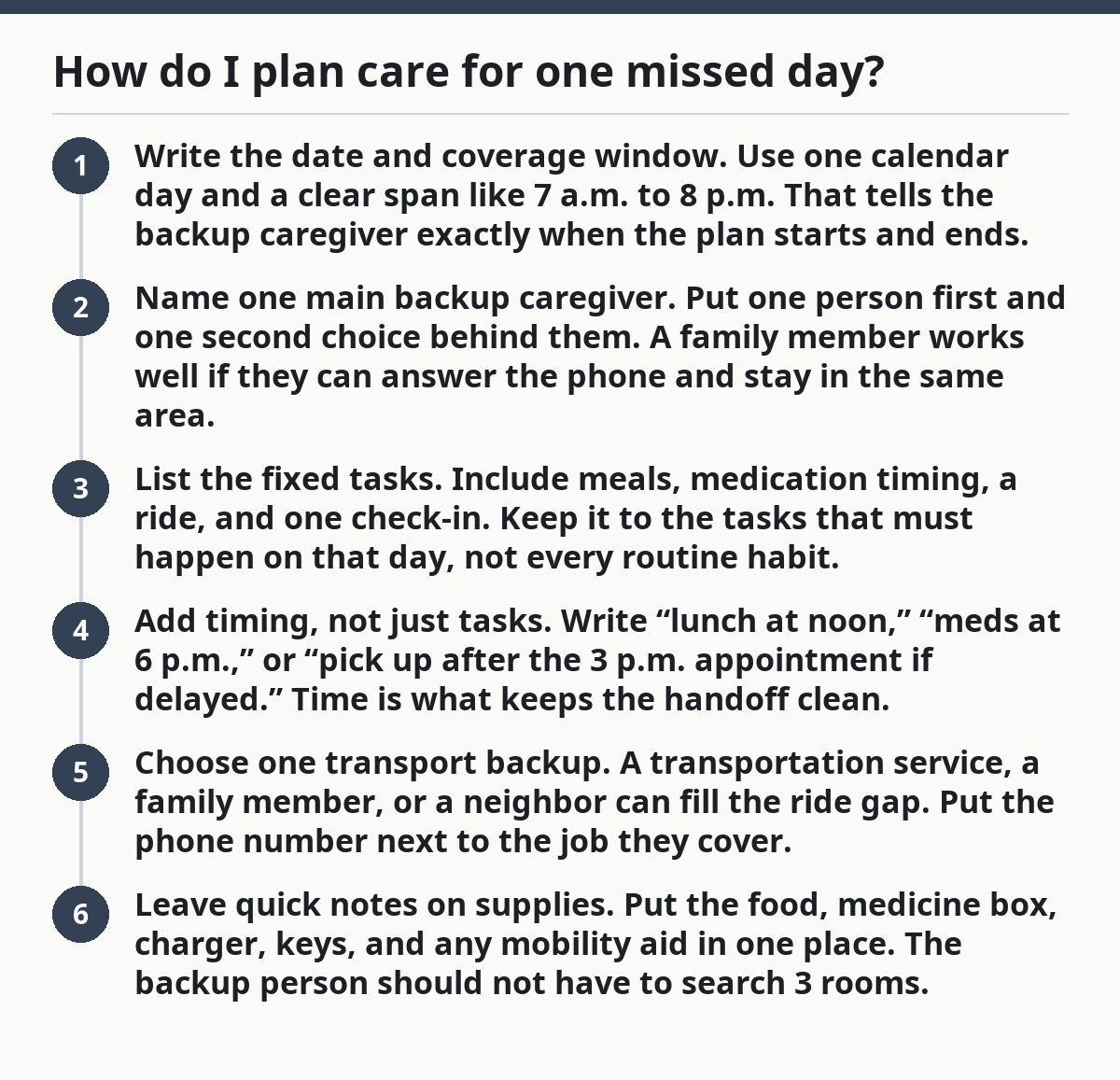
- Write the date and coverage window. Use one calendar day and a clear span like 7 a.m. to 8 p.m. That tells the backup caregiver exactly when the plan starts and ends.
- Name one main backup caregiver. Put one person first and one second choice behind them. A family member works well if they can answer the phone and stay in the same area.
- List the fixed tasks. Include meals, medication timing, a ride, and one check-in. Keep it to the tasks that must happen on that day, not every routine habit.
- Add timing, not just tasks. Write “lunch at noon,” “meds at 6 p.m.,” or “pick up after the 3 p.m. appointment if delayed.” Time is what keeps the handoff clean.
- Choose one transport backup. A transportation service, a family member, or a neighbor can fill the ride gap. Put the phone number next to the job they cover.
- Leave quick notes on supplies. Put the food, medicine box, charger, keys, and any mobility aid in one place. The backup person should not have to search 3 rooms.
This is the part people skip: the plan should name who takes over if the appointment runs 90 minutes late or the road closes. One small line there makes the whole thing usable as a one-day backup care plan.
What should a short backup care plan include?

A short backup care plan should include names, times, phone numbers, and the few tasks that cannot slip. Anything longer gets ignored when the phone rings. Keep it tight enough to fit on one sheet of paper, or in one note on a phone, with room to read it at a glance.
Picture this: the power flickers, the house is cold, and someone needs to know where the evening medicine is stored. A good plan still works when the person reading it is tired, rushed, or not familiar with the home.
Use this checklist:
- Primary contact and backup caregiver
- Start and end time for the day
- Daily medication schedule with exact times, not “morning” and “evening”
- Meal plan for breakfast, lunch, and dinner
- Transportation backup and phone number
- Door code, key location, or entry note
- One emergency contact for a delay that lasts past the day
A one-day plan should also say what doesn’t need attention. If the person does not need a bath that day, leave it out. If the dog already has water and food for the evening, no one should waste time wondering about it. Specific limits keep the plan short enough to use.
Honestly, a short plan falls apart when it tries to act like a full care manual. A 1-page sheet works better than a packet because the backup person can read it in under 2 minutes and act. If the plan needs more than that, it is too broad for this page’s job.
How to cover meals, medication timing, and transport
Tie each task to a clock time and a named person; that is the whole trick. You cover meals, medication timing, and transport by linking each task to a clock time and a named person. That sounds plain, and it is. Plain is what works when an appointment runs long or roads slow down.
Picture this: lunch should happen at noon, meds at 2 p.m., and the ride home may not arrive until 4:30. Without written timing, each task gets pushed a little later until the day is off track. With timing, the backup caregiver can do the next right thing without asking for permission every 10 minutes.
Use these rules:
- Meals: Write the meal and the backup food, such as soup, sandwiches, or a frozen entrée that only needs heating.
- Medication timing: List the exact time for each dose and where it sits. If a dose must be given with food, say so plainly.
- Transport: Name one ride option first and a second if that fails. A transportation service is useful when family traffic is heavy, but it can still run late.
- Drop-off and pickup: Put the address and the expected pickup window in the note.
If the person depends on an exact medication schedule, the handoff should say whether the dose is time-specific or tied to meals. This avoids the common mistake of giving the right pill at the wrong moment. It also helps the backup caregiver know whether a 30-minute delay matters or not.
Food prep can be the bottleneck, and that is the trade-off people miss. If the backup person has to cook from scratch, the plan is already too slow. Pack food that can be served in 5 to 10 minutes, or the day will start slipping before noon.
What backup care should look like during storms or delays
Backup care during storms or delays should assume the schedule will shift by at least 1 to 2 hours and still keep the day on rails. The point is not perfect timing. It is keeping the person fed, reached, and safe while the weather alert or traffic delay plays out.
Picture this: the forecast changes at 7 a.m., the appointment is still on, and the pickup driver texts that they are late. A good plan already says what happens if the delay is short, what happens if it stretches, and who gets called first.
Build in these weather and delay moves:
- If the weather alert changes the route, switch to the transport backup before the road gets bad.
- If the appointment runs over, move the meal and medication times to the new handoff order.
- If the backup caregiver cannot get there, name the family member who can stay by phone until someone arrives.
- If travel is unsafe, change the plan to an at-home day and cancel the unnecessary trip.
On the flip side, do not assume a storm means everything stops. A one-day plan should still say which tasks continue at home. Meals still happen. Meds still happen. A check-in still happens.
A short delay plan is easier to follow than a general emergency plan because it stays close to the day at hand. You are not solving a week-long crisis. You are covering 1 day, which means the answer can be simple and still be good enough.
Common mistakes that make a one-day plan fail
A one-day plan fails when it names people but leaves out times, or when it lists tasks but forgets the ride. Those errors cost hours, and hours matter on a day with an appointment, a storm, or a late pickup. The fix is usually boring, and that is a good thing.
Picture this: the backup caregiver arrives, but nobody knows whether lunch was supposed to be before or after the 1 p.m. call. That kind of gap creates confusion fast. Confusion is what turns a short delay into a missed dose or a missed ride.
Watch for these mistakes:
- Vague timing: “Afternoon” is too loose. Write 1:30 p.m. or 3 p.m.
- No backup ride: If the first ride falls through, the day stalls.
- Too many contacts: A long contact list hides the one person who can actually help today.
- Food that takes work: Raw ingredients are not a plan if the person cannot cook.
- No weather note: If the roads are likely to close, the plan should say when to switch to phone-only care.
Use one simple rule: if a step would force someone to guess, rewrite it. A one-day plan should read like instructions for a tired adult, not a puzzle. That is the whole point.
A simple one-page template you can fill in today
A one-page template is enough if it fits on one side of paper and can be read in under 2 minutes. That size forces the plan to stay useful. If it spills across three pages, it probably contains too much detail for same-day backup care.
Picture this: you are leaving for an appointment in 20 minutes, and the backup caregiver needs the essentials now. A short template lets you hand off the day without rewriting everything from scratch.
Use this format:
- Date:
- Coverage window:
- Main backup caregiver:
- Second contact:
- Transportation backup:
- Morning meal:
- Midday meal:
- Evening meal:
- Medication times:
- Appointment time and location:
- Weather or delay note:
- Where keys, meds, and food are kept:
- When to call for help:
Fill it in the night before if you can. If the plan is for a storm, fill it in when the weather alert is still manageable, not when the rain is already hard. For a delayed appointment, write the plan before leaving the house.
A short template works best when the same person updates it each time. Keep the old version on the fridge or in a phone note, then change only the date, times, and names that matter. That saves time and keeps the plan from drifting.
A one-day backup care plan is enough if it is specific
A one-day backup care plan works when it is short, dated, and tied to real times. It does not need to solve every caregiving problem. It just needs to keep meals, medication, transport, and check-ins covered when one day goes sideways.
The verdict is simple: specific beats detailed. A plan with 1 clear page and a named backup caregiver will usually do more good than a thick packet no one wants to read.
Need the longer version for a bigger disruption? The caregiver crisis planning hub belongs next. This page stays on the smaller job: appointments, storms, and delays that last a day, not a week.
How do I plan care for one missed day?
Write the date, the coverage window, and the few tasks that cannot be skipped. Keep it to meals, medication timing, transport, and one check-in. If the plan needs more than one page, it is too broad for a single-day handoff.
A good one-day backup care plan names one main backup caregiver and one second contact. It also says what happens if the appointment runs late or weather slows the trip home. Speed matters more than completeness here.
What should a short backup care plan include?
A short backup care plan should include names, phone numbers, timing, food, medication, and a ride backup. That gives the person stepping in enough information to act without hunting through notes or guessing about the schedule.
Keep the plan to the day itself. Add the start and end time, the location of keys or supplies, and a simple weather note if roads may change. A one-page note is usually easier to use than a longer document.
How do I cover meals and meds for a single day?
Cover meals and meds for a single day by tying each one to a clock time and putting the supplies in one place. Use food that can be served in 5 to 10 minutes, and write each medication time exactly as it should be given.
Do not rely on “morning” or “later.” That wording causes mistakes when someone is covering from memory. If a medication must be taken with food or at a fixed time, write that next to the dose so the backup caregiver does not have to interpret it.
Drafted with AI; not yet reviewed by a person.