
When a Caregiver Can Speak for Someone at Medical Appointments

Last updated: November 19, 2026
Quick Answer: In many routine visits, a caregiver can speak for someone at medical appointments if the patient is present and agrees, or if the patient has already given permission in a form the clinic can use. This guide explains what usually happens, what medical staff may say back, and when a caregiver is only a helper, not a spokesperson.
Key Takeaways
- A caregiver may speak at the visit with the patient’s permission, but the patient still makes the decisions.
- Staff usually share only what is needed for that appointment unless broader permission exists.
- Ask plainly before the visit or at the start of it to avoid confusion.
- Written permission is not always required if the patient is present and clearly agrees.
If you want the bigger picture on caregiver legal authority and medical decision access, this page fits inside that hub. It covers communication at the appointment itself, not every form of legal authority.
This is general information, not legal advice. Rules vary by jurisdiction, and a qualified lawyer should be consulted if the situation is disputed or formal authority is unclear.
Who can speak at a doctor visit?

A caregiver can speak for someone at medical appointments when the patient allows it, but that does not make the caregiver the decision-maker. The key issue is patient permission, and the permission can be spoken, written, or shown by the patient’s conduct in the room.
Picture this: you’re sitting next to the patient in an exam room, the medical assistant has asked about medications, and you’re trying to tell the doctor what changed last week. That is usually fine if the patient agrees. It becomes a problem when the patient objects, looks away, or clearly wants privacy. A brief nod is not the same as open-ended authority.
Here is the simple rule set:
- The patient is present and agrees. A caregiver may speak as part of the visit.
- The patient is present but stays quiet. Staff may treat silence as permission for limited help, but they can still ask the patient directly; consult the clinic or a professional if the situation is unclear.
- The patient is not present. Staff usually need prior permission, a health care proxy, or another lawful basis before they disclose information.
What a generic article gets wrong is treating every caregiver like a spouse, every spouse like a legal agent, and every helpful voice like a right. Those are different things; consult a professional or the clinic if you are unsure. A caregiver can help explain symptoms, but formal authority is a separate legal step. The U.S. Department of Health & Human Services explains that disclosure under HIPAA can depend on the patient’s agreement or objecting status, and only the minimum necessary should be shared in many cases. HHS HIPAA guidance
A few terms matter:
- Verbal permission means the patient says, “You can talk to me,” or something close to that.
- Written permission means a signed form or similar record.
- Medical appointment communication permission is not a single universal legal label; it is the practical right to speak with staff during the visit.
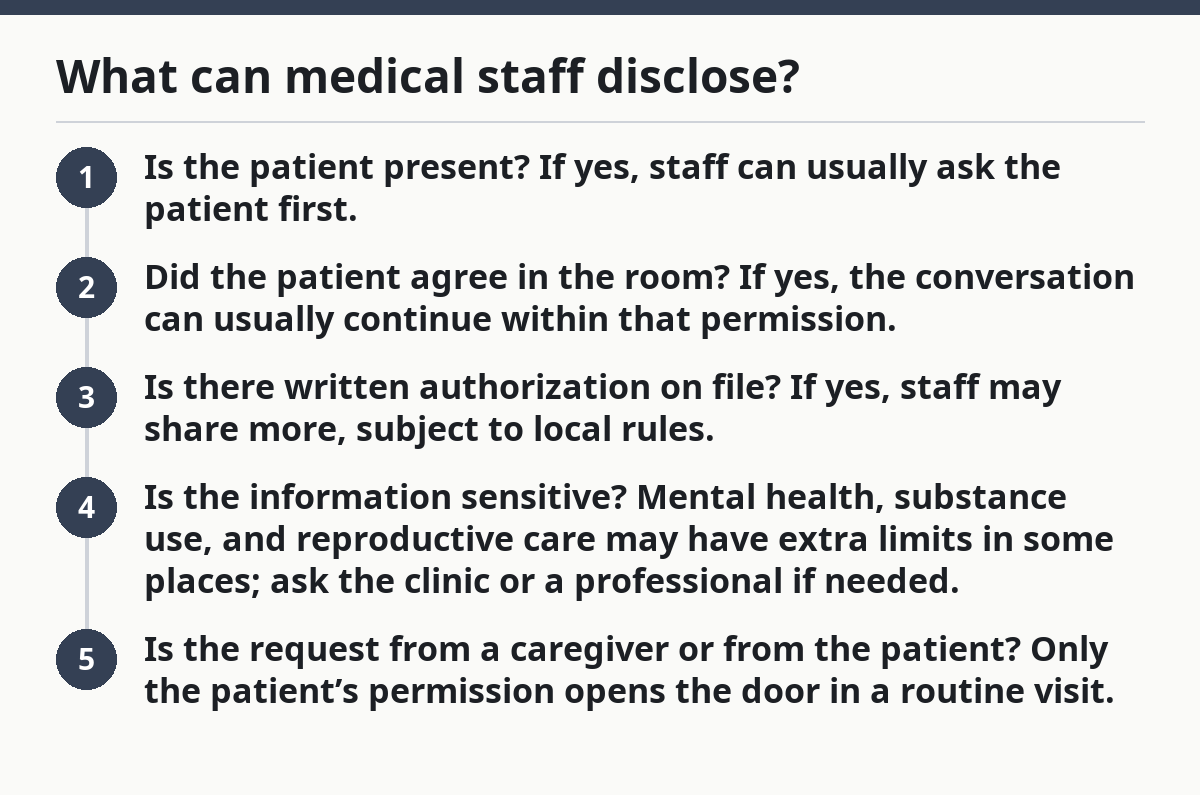
What can medical staff disclose?
Medical staff can usually disclose only the minimum needed for the visit unless the patient has given broader permission. That often means the doctor, nurse, or medical assistant can discuss scheduling, symptoms, current medications, test plans, and follow-up instructions, but not every record or diagnosis detail by default.
Picture this: you’re at the desk, and the front office staff asks who is allowed to hear results. That question is not rude; it is often a privacy checkpoint. The staff member may be protecting the patient’s records under the clinic’s privacy rules and the law of the jurisdiction. If the patient is there and says, “You can talk to my daughter,” the staff can often continue. If the patient says nothing, the staff may need to stop. HHS says a provider may use professional judgment about sharing information with family or caregivers when the patient is present and does not object. HHS HIPAA guidance
Use this practical filter:
- Is the patient present? If yes, staff can usually ask the patient first.
- Did the patient agree in the room? If yes, the conversation can usually continue within that permission.
- Is there written authorization on file? If yes, staff may share more, subject to local rules.
- Is the information sensitive? Mental health, substance use, and reproductive care may have extra limits in some places; ask the clinic or a professional if needed.
- Is the request from a caregiver or from the patient? Only the patient’s permission opens the door in a routine visit.
A common mistake is assuming staff can freely disclose because the caregiver is “family.” That is not how privacy works in many settings. The better approach is to let the patient speak first, then add context. Under HIPAA, a clinic may disclose only information relevant to the person’s involvement in care in many situations. HHS HIPAA guidance
How do I get permission without making the visit awkward?
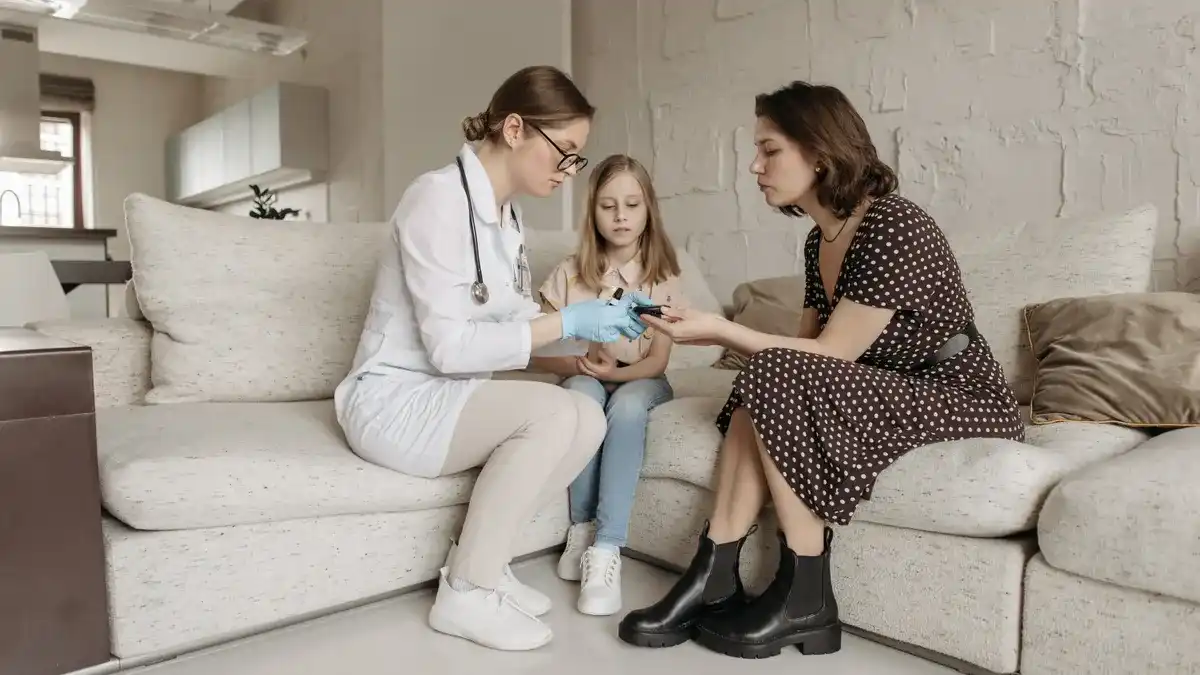
You get permission by asking plainly before the visit or at the start of the appointment. A short sentence is enough: “Do you want me to answer questions with you here?” If the patient says yes, the caregiver can usually take part in the conversation while the patient remains in the room.
Picture this: you’re in a 20-minute appointment, the doctor is moving fast, and the patient has trouble hearing or remembering details. A calm request at the start saves time later. It also keeps the medical assistant from having to guess who may speak.
A simple process usually looks like this:
- Ask the patient first, before the room visit starts, whether they want help speaking. Verify they understand the question. A problem is vague agreement like “maybe,” which leaves staff unsure.
- Have the patient say, in front of staff if possible, that the caregiver may speak. Verify the staff member heard it. A problem is speaking only in the hallway where the clinician never hears it.
- State the scope: medication changes, symptoms, memory, or discharge instructions. Verify the scope is narrow enough for the visit. A problem is asking for blanket access to “everything.”
- Let the patient stay in the room unless they ask for private time. Verify the patient still wants the caregiver present. A problem is staying in the room after the patient signals discomfort.
- Wait for staff to ask the patient the core questions first. Verify the patient can still answer in their own words. A problem is answering so quickly that the patient is erased from the conversation.
- Repeat important facts only when needed, using the patient’s own words where possible. Verify accuracy on medications, allergies, and dates. A problem is guessing at details or filling gaps from memory.
- Ask the clinician or medical assistant to note the permission if the clinic uses chart notes for it. Verify the permission is reflected somewhere the clinic can rely on. A problem is assuming oral permission will be remembered next month.
Overall, this approach respects the patient and makes the visit smoother. It also avoids the awkward moment when a caregiver talks too much and staff have to reset the room.
Do doctors need written permission to talk to a caregiver?
Doctors do not always need written permission to talk to a caregiver if the patient is right there and clearly agrees. Written permission becomes more useful when the patient is absent, has memory problems, or wants the clinic to keep speaking with the caregiver after the visit.
Picture this: you’re trying to help an older parent who repeats the same symptoms from visit to visit. A note or form can prevent confusion at the front desk and in the exam room. It can also help the medical assistant know who may hear results or instructions if the patient misses a follow-up call. In 2024, HHS continued to say that providers may use professional judgment in many everyday disclosure decisions. HHS HIPAA guidance
Written permission usually helps when:
- the caregiver attends visits regularly,
- the patient wants someone else to hear instructions,
- the clinic has tight privacy rules,
- the patient may be confused, tired, or hard of hearing,
- there is a need to share information outside the room.
Written permission is not the same as full legal authority. A form may let the caregiver hear or repeat information, but it may not let the caregiver consent to treatment or refuse care. If that line is unclear, consult a professional or the clinic. The Office for Civil Rights notes that HIPAA allows some disclosure to family members or others involved in care, but not unlimited sharing. HHS OCR
The truth is, clinics vary. Some rely on an oral okay in the room. Others want a signed authorization in the chart. If the situation involves a hospital admission, memory loss, or a disputed family dynamic, the clinic may ask for more documentation than a simple doctor visit.
What can a caregiver say at a medical appointment?
A caregiver can usually say what they have personally observed, what the patient has asked them to repeat, and what helps the clinician understand the visit. That includes symptom changes, missed doses, falls, confusion, appetite, sleep, pain patterns, and whether home instructions are being followed.
Picture this: you’re in the room and the doctor asks, “What changed since last time?” You can answer with facts, not guesses. The most useful caregiver comments are concrete, brief, and tied to a timeline. “The patient started coughing three days ago” is better than “things got worse recently.”
Use these guardrails:
- Say observed facts. “The patient missed two doses,” not “the medication doesn’t work.”
- Use dates or time frames. “Since Monday” or “for 10 days.”
- Stick to the visit topic. If the appointment is about blood pressure, save the full family history unless asked.
- Let the patient answer first. Then add what they forgot or could not hear.
- Correct records carefully. If the chart says something wrong, say so plainly and politely.
A caregiver should not present themselves as the patient’s legal stand-in unless that is actually true. That is where people get into trouble. A helpful voice is not the same as a surrogate decision-maker. If the patient is capable and present, the patient still leads.
When does a caregiver need to stop talking?
A caregiver needs to stop talking when the patient asks for privacy, staff redirect the conversation to the patient, or the clinic says it cannot share more without the right permission. Those are not personal snubs; they are boundary lines.
Picture this: you’re in the exam room, and the doctor turns to the patient and says, “I need to hear this from you.” That is a signal to pause. The caregiver may still be there, but the patient is being given the floor. If the patient cannot answer and there is no permission on file, staff may limit the discussion until the legal basis is clear.
Specific stop points:
- The patient says “I want to speak alone.” This means privacy now — step out.
- The patient looks uneasy or says you’re overstepping. This means permission is not clear — stop and let staff reset.
- Staff asks for written authorization and none exists. This means disclosure may be limited — do not press.
- The patient is not present and you have no legal role. This means the clinic may not talk freely — wait or provide contact details if requested.
- The conversation shifts to a sensitive issue. This may require private time with the patient — let the clinician decide the next step.
On the flip side, if the patient is present, wants you there, and the clinician invites your input, you can keep helping. The line is not “family” or “caregiver.” The line is permission.
Common mistakes people make at the desk and in the room
People usually get this wrong in predictable ways, and each mistake has a cost. The fix is usually simple, but the mistake can delay care or shut down the conversation.
Picture this: you’re at check-in, the line is moving, and you try to answer every question for the patient before staff asks for it. That can make the visit harder, not easier. A better approach is to answer only the question asked, then wait.
Common errors:
- Speaking over the patient. The cost is that staff may stop addressing the patient directly. The better move is to let the patient speak first, then fill gaps.
- Assuming family status equals permission. The cost is a privacy refusal from staff. The better move is to ask the patient out loud for permission.
- Using vague help instead of facts. The cost is confusion about symptoms or timing. The better move is to give specific observations and dates.
- Treating oral permission like permanent authority. The cost is trouble when the patient is absent later. The better move is to ask whether written permission is needed.
- Ignoring a patient’s wish for privacy. The cost is trust damage and possible removal from the conversation. The better move is to step out immediately.
- Trying to force disclosure at the front desk. The cost is a hard no from staff. The better move is to ask what form or process the clinic uses.
One source worth reading on privacy rules is the U.S. Department of Health & Human Services’ HIPAA guidance on who may receive information about a patient. The exact rule can still vary by setting and jurisdiction, so local practice matters too.
When the standard rule does not apply
The standard rule changes when the patient lacks capacity, the setting has special privacy rules, or the jurisdiction uses a different legal structure for medical consent and disclosure. In those cases, the caregiver may need more than casual room permission.
Picture this: you’re dealing with memory loss, a hospital stay, or a patient who cannot follow the conversation. A normal doctor visit is not always a normal permission setting. A clinician may need to identify a surrogate, check a proxy document, or limit what can be shared until the right authority is shown.
These edge cases often need a different approach:
- The patient cannot understand the questions. Staff may need a legal surrogate or proxy, not just a caregiver.
- The patient is unconscious or severely confused. The clinic may rely on emergency rules or prior instructions.
- There is family conflict. Staff may keep communication narrow until authority is clear.
- The visit crosses borders or jurisdictions. The local rule may change what counts as permission.
- The patient has already limited disclosure. The caregiver may be allowed to attend but not hear certain details.
This is where a lawyer or local legal aid source may matter if the issue is contested. The clinic’s front desk is not the place to sort out a disputed authority question.
FAQ
Can a caregiver ask questions if the patient is in the room?
Yes, if the patient allows it. The caregiver can ask questions when the patient is present and the clinician is willing to include them in the conversation. The safer pattern is to let the patient answer first, then add one focused question so the visit stays clear and short.
Do doctors need written permission to talk to a caregiver?
No, not always. A doctor may rely on the patient’s oral permission in the room in many ordinary visits, but a clinic may still ask for written permission when the patient is absent or the information is sensitive. Rules vary by jurisdiction and by clinic policy.
What can a caregiver say at a medical appointment?
A caregiver can usually say what they saw, heard, or did, and what the patient asked them to repeat. The best comments are specific: symptoms, timing, medicines, falls, confusion, or changes at home.
Drafted with AI; not yet reviewed by a person.