Last updated: November 19, 2026
Key Takeaways
- The medicine organizer still has pills, the next meal is unready, and the usual family backup is at work.
- After a sudden caregiver resignation, assign one adult to each urgent task for the rest of the day.
- Call the people who can change today’s care first, not the people who only want an update.
- Keep medicine, food, and the organizer together, because they affect the same hours of the day.
A caregiver quits with no notice and the day falls apart fast. Quick answer: cover the next 4 to 8 hours, then call the people who can change care today, then sort medicine, food, and backup help. What to do when a caregiver quits with no notice is to stabilize the next few hours first, then build the rest of the day around the person’s immediate needs. The steps below show what to do first, what to skip, and how to keep the situation from getting worse.
What to do in the first 24 hours
Picture this: you wake up, or come home, and the paid caregiver is gone. The pills are still in the organizer, the next meal is not ready, and the family caregiver who usually fills in is already at work. The next 24 hours are about triage, not perfection.
Start with the person’s immediate needs. If they need help with walking, toileting, eating, or medication, stay with them or get someone in the room right away. If they are alone and unsafe, call a family member, neighbor, or emergency contact now—not later.
- Check for urgent needs first. Look at breathing, chest pain, falls, bleeding, confusion, and missed medication. If any of those are present, call emergency services or the doctor’s on-call line.
- Secure the next 4 to 8 hours. If needed, consult a professional or local care agency about coverage for the next 4 to 8 hours. Put one adult in charge of food, toilet support, and medication timing until the gap closes.
- Find the medication organizer. Confirm what was taken, what is due next, and whether any refill is already late.
- Make one phone list. Put the home care agency, family caregiver, backup contacts, and the prescribing office on the same page or note app.
- Reduce nonessential tasks. Skip bathing, errands, and housekeeping if they add risk. Stability beats routine for one day.
- Tell the rest of the household. Use one clear message so nobody assumes someone else has the job.
A sudden loss of care is not the time to “wait and see.” A missed transfer or missed dose can snowball in a single afternoon. If the person needs hands-on care and nobody can stay, call the home care agency and the emergency contacts right away. The U.S. Administration for Community Living and the National Institute on Aging both emphasize planning ahead for care gaps and emergency contacts.
The best source for a calm next step is often the same one used in any crisis plan: the home care crisis page in this site’s caregiver crisis planning hub. That page gives the bigger framework; this one keeps the focus on the immediate gap.
How do I cover care after a sudden caregiver resignation?
You cover care after a sudden caregiver resignation by assigning one adult to each task for the rest of the day. The point is not to replace the caregiver at once; it is to stop the day from breaking into pieces.
A useful split is simple:
- one person handles medication access
- one person handles meals and water
- one person handles toileting, transfers, and fall watch
- one person handles calls and paperwork
If there are only two adults, combine the paper tasks and keep the body-care tasks separate. A single person trying to cook, answer the phone, and help with a transfer is where mistakes start.
The truth is, most families lose time because they try to hold on to the old schedule. A family caregiver may be able to cover mornings while a relative covers evenings. A neighbor may bring lunch for one day. A paid caregiver from another agency may be able to fill a short shift if the schedule is flexible. Even a 2-hour bridge helps.
Use a plain written handoff note:
- what time medicine is due
- what food the person will eat today
- whether the person can walk alone
- any skin, toileting, or lift needs
- who to call if the person refuses care
If needed, consult a nurse, pharmacist, or other professional before relying on the handoff note for medication timing. That note prevents the next helper from starting blind. The Agency for Healthcare Research and Quality recommends clear handoff communication to reduce errors.
One limitation matters here: if the person needs two people for transfers, or if they are at risk of wandering, a casual fill-in is not enough. In that case, a trained helper or a higher level of care may be the safest short-term answer for the day.
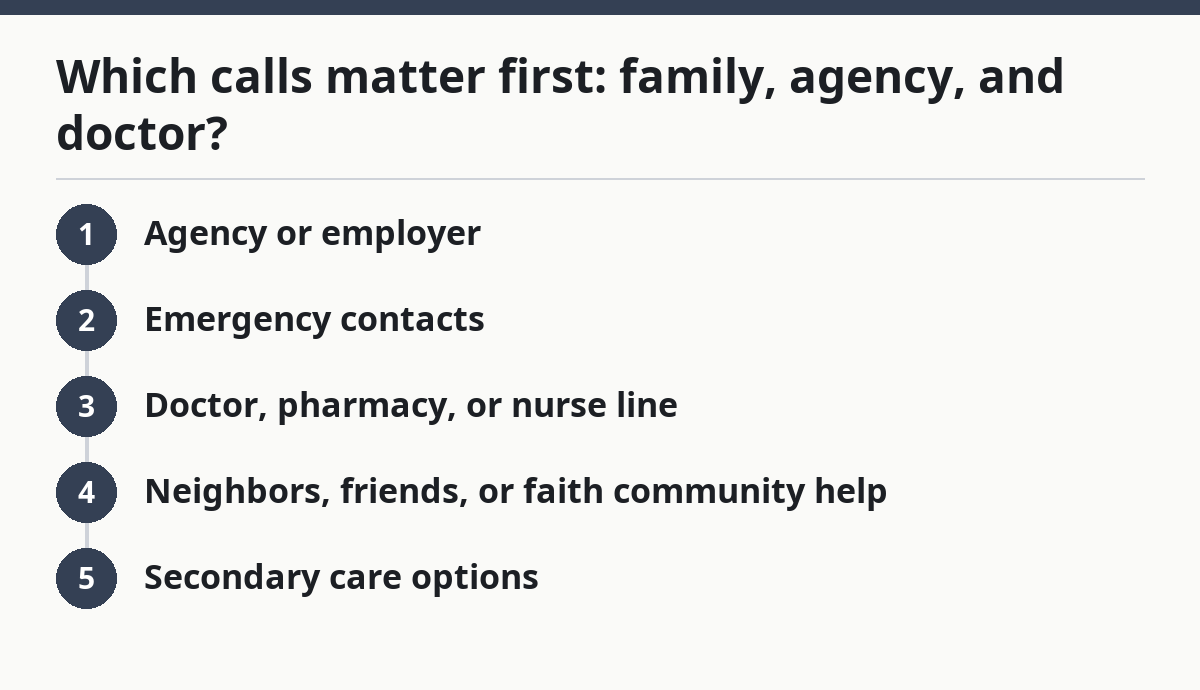
Which calls matter first: family, agency, and doctor?
The first calls should go to the people who can change the day, not the people who only want updates. That usually means the home care agency, the emergency contacts, and the prescribing office if medication timing is at risk.
Start with the home care agency if the caregiver was placed through one. Ask for three things in one call: why the worker left, whether a replacement exists, and what the agency can do today. Ask them to confirm the cancellation in writing by text or email so you have a record.
Then call the family caregiver or the person named as backup. Be direct: “The caregiver quit with no notice. I need coverage for today.” Don’t give a long story first. Say what time the gap started, what the person needs, and what hours still need help.
After that, call the doctor, pharmacy, or nurse line if medicine is involved. A missed dose, a late refill, or confusion about which pill was taken can become a bigger problem than the staffing gap. Keep the medication organizer in front of you during the call.
Use this order:
- Agency or employer
- Emergency contacts
- Doctor, pharmacy, or nurse line
- Neighbors, friends, or faith community help
- Secondary care options
Here’s the catch: if the person is alone and unsafe, skip the phone tree and get someone physically there first. A callback can wait. A fall cannot. The National Institute on Aging advises calling for help right away when safety is at risk.
If the caregiver was a private hire, the call list changes a little. You still contact the emergency contacts and the doctor if needed, but you may also need to text the worker’s last known number, check the written agreement, and cut off access to keys, codes, or cash until the situation is sorted.
What to do about medicine, food, and the medication organizer
You handle medicine, food, and the medication organizer together because they affect the same hours of the day. If one part slips, the rest usually follows.
Begin with the medication organizer. Read it slowly and match every dose to a time. If there is any gap between what is in the box and what the label says, stop and confirm with the pharmacy before giving the next dose. That check matters even more when the usual caregiver is gone.
Then make the day’s food plan from what is already in the house. Keep it plain:
- breakfast if it is still morning
- lunch that does not need much prep
- dinner that can be served without a long stove watch
- water within reach
If the person has swallowing trouble, diabetes, or a strict diet, don’t improvise a new menu because the caregiver quit. Use the same foods and timing already known to work. A sudden change in care is not the day to experiment.
If medicine delivery is stuck at the pharmacy, ask whether a same-day refill is possible or whether a short supply can be released. If the person uses a pill organizer filled for the week, check the original bottles as well. That helps confirm what is missing and what is already taken.
Common mistakes show up fast:
- giving a dose twice because nobody wrote it down
- skipping meals because “it’s only one day”
- moving pills from bottle to box without checking the label
- guessing at insulin, blood pressure pills, or sleep medicine timing
Those mistakes cost time and can create a second crisis. The fix is boring but strong: one list, one organizer, one person checking the dose.
If the person cannot safely swallow, stand, or self-medicate, the issue is no longer “who quit.” It is immediate coverage and possibly a higher level of help for that day.
How to tell family without making the situation worse
You tell family clearly, in one short message, and you assign a task in the same breath. Long group texts create confusion. A direct note creates action.
Use a message like this: “The caregiver quit with no notice. The person needs coverage now. Please reply with what time you can take a shift, bring food, or make calls.” That gives people a job and a clock.
You do not need agreement from everyone before acting. You need one person at the bedside, one person handling calls, and one person checking supplies. If a relative wants details, send them after the urgent tasks are covered.
Set one rule for family replies:
- reply with a yes or no
- name the time
- say which job you can do
- do not ask to be updated unless you can help
That rule saves time. It also stops the family caregiver from becoming the only adult who answers messages while trying to cover care.
If relatives disagree about what should happen next, keep the conversation on the short horizon: today, tonight, tomorrow morning. This is not the time for a full argument about long-term placement, the agency contract, or past mistakes. Those can wait until the person is safe.
A plain text thread or shared note app is enough for one day. If the family is large, appoint one point person so the same question is not answered five times.
When the gap is bigger than a one-day fix
You need a different plan when the person cannot safely wait for the next shift. If there is dementia, frequent falls, oxygen use, or dependence for toileting and transfers, a no-notice quit can create a real safety problem in minutes.
Look for these signs:
- the person is alone and cannot toilet safely
- there is no one who can stay for a full 8-hour block
- essential medicine is due now and no one can confirm it
- the home care agency cannot send replacement help today
- the family caregiver is already stretched past what is safe
When any of those are true, the goal shifts from “cover the day” to “stabilize the setting.” That might mean moving the person to a relative’s home for the night, getting a trained temporary helper, or changing the care level until regular support returns.
Do not assume a friend can step in if the person needs lifting, wound care, or careful medication timing. Good intentions do not replace training. That is one of the biggest mistakes families make after a sudden caregiver loss.
If the person’s condition is medically fragile, call the clinician or nurse line for guidance on what must not be missed in the next 12 hours. Keep the call focused on immediate risk, not on the history of the quitting worker.
For the larger planning framework after the day is stable, use the caregiver crisis planning hub on this site. This page is about the shock of the quit; that hub is where the longer backup structure belongs.
What not to do after a caregiver quits with no notice
You should not pretend the old schedule still works. That is the fastest way to miss medicine, meals, or a transfer. A schedule built for two people does not survive if one of them vanishes.
Skip these moves:
- do not wait until afternoon to start calling
- do not leave the person alone if they need hands-on help
- do not guess about medication timing
- do not let one family member carry every task
- do not assume the agency will fix it without pressure
The cost of waiting is usually a second crisis: a missed dose, a fall, a fight over who was supposed to help, or a long delay before replacement care shows up. The fix is to act before the day gets crowded.
One more thing: keep a short written record of who you called and when. Not a legal brief. Just a note with the time, the person spoken to, and the answer. If the home care agency later sends a different story, you will know what was promised.
That record also helps the next shift. A family caregiver coming in at 6 p.m. can see what already happened and what still needs doing.
FAQ
What should I do if my caregiver stops showing up?
Treat it as a same-day gap in care and start covering the person’s immediate needs. Call the caregiver, the home care agency if there is one, and your emergency contacts right away. If the person needs help with medicine, toileting, walking, or eating, get someone physically present before the day gets harder.
How do I cover care after a sudden caregiver resignation?
Cover the next shift first, not the whole week. Split the day into tasks, assign one adult to each task, and use the medication organizer to confirm what has already been given. If the person needs hands-on help that no family member can safely provide, ask the agency for replacement help or a temporary higher level of care.
Who do I call first when caregiving falls apart?
Call the person or organization that can change the next hour: the home care agency, if there is one, or the emergency contact who can come right away. If medicine is involved, call the pharmacy or prescribing office next. If the person is unsafe alone, get someone to the home before finishing the call list.
Drafted with AI; not yet reviewed by a person.