Last updated: November 20, 2026
Quick answer: in most cases, 1 signed authorization is enough to start a records request, but the right form depends on the record, the jurisdiction, and the holder’s rules. This article, Caregiver legal access and records — The Complete Guide, explains the general process for getting permission, proving authority, and requesting records. The exact rule depends on jurisdiction, but the core idea is the same: access comes from consent, legal authority, or a law that allows disclosure in a narrow situation. This is general information, not legal advice, and a qualified lawyer should be consulted for any real case. For background, see the HHS HIPAA access guidance at https://www.hhs.gov/hipaa/for-professionals/privacy/guidance/access/index.html and the National Institute on Aging caregiver resources at https://www.nia.nih.gov/health/caregiving.
Key takeaways
- Access to someone else’s records is not automatic, even for a spouse, child, or long-time caregiver.
- The fastest path is often written authorization, but the right form depends on the record type and the country or state.
- A health-care proxy, power of attorney, and guardianship are not the same thing, and each one has limits.
- Good paperwork matters because a missing signature, date, or witness can stop disclosure at the front desk.
- A caregiver should check the record holder’s rules first, then the relevant law, then the scope of authority on the document.
- If the person is incapacitated, a minor, or in a dispute, the standard process may no longer fit and legal help becomes more important.
What does caregiver legal access mean?
Caregiver legal access means the legal right to obtain, discuss, or manage another person’s records under a specific authority. That authority may be a signed release, a health-care proxy, a power of attorney, a court order, or a rule that allows disclosure in limited situations such as emergency treatment. In the United States, for example, medical records are often controlled by privacy rules such as HIPAA, while other countries use different privacy laws and consent standards. For a broader overview, see the HHS patient access page and the AMA overview of medical record access at https://www.ama-assn.org/delivering-care/ethics/patient-privacy-and-confidentiality.
The key idea is simple: being a caregiver does not by itself create access. A daughter helping at appointments may still be blocked from seeing notes, lab results, billing files, or discharge papers unless the patient has named her or the law gives her a role. The same pattern shows up with bank records, insurance claims, school files, and long-term care records, though the exact rules differ by record type.
Next, it helps to think about caregiver legal access in layers. First comes consent from the person whose records are involved. Second comes a legal instrument, such as a power of attorney, that gives decision-making authority. Third comes a court process, such as guardianship, when the person cannot act and no less formal route works. Each layer opens some doors and leaves others closed.
This matters because the wrong label can cause delays. A “caregiver letter” may help at the front desk, but it may not satisfy a hospital privacy office. A power of attorney may work for money matters but not for health information unless it says so. A court order may solve the access problem, but it usually takes time and filing steps that a simple release does not.
The guide below describes the general process and the most common documents, using the U.S. HIPAA model as a reference point where helpful. For a record in a different jurisdiction, the names and forms can change even when the logic stays similar. For a quick jump to the process, see How do you get records step by step?
Who needs access, and who does not?
Legal access is often needed by family caregivers, hired caregivers, adult children, spouses, and anyone managing bills or treatment for another person. It is also relevant for people helping with a parent’s clinic portal, a sibling’s rehab paperwork, or a resident’s nursing home records. The question is not whether the helper is responsible in practice; it is whether the helper has legal authority on paper. When in doubt, consult the record holder or a qualified professional before sharing paperwork.
Not everyone needs full access. Some people only need appointment reminders, medication lists, or the ability to speak to staff by phone. Others need broader access to full records, including diagnoses, medication history, test results, discharge summaries, claims, and payment files. The right level depends on what the caregiver is actually trying to do, because overbroad access can create privacy problems while too little access can slow care. For related limits, see Which document actually gives access?
There are also people who should not try to force this through a casual form. If the person whose records are involved refuses consent, a caregiver cannot simply sign on their behalf unless a valid legal role already exists. If the person is deceased, access rules usually shift to estate, probate, or local privacy law. If there is family conflict, one relative’s informal permission may not override another legal document on file.
A common trap is assuming “next of kin” is enough. In many settings, that phrase carries social meaning but little legal power. A hospital may still ask for an authorization form, a proxy document, or proof of guardianship before sharing more than a limited update. The same issue appears with online portals, where a login is not the same as authority to act.
This part of the process is where many readers save time by pausing for 10 minutes and checking what they need: one appointment update, one year of records, or ongoing authority for daily care. The narrower the need, the simpler the route can be. For a related checklist, see How should the paperwork be stored?
Which document actually gives access?
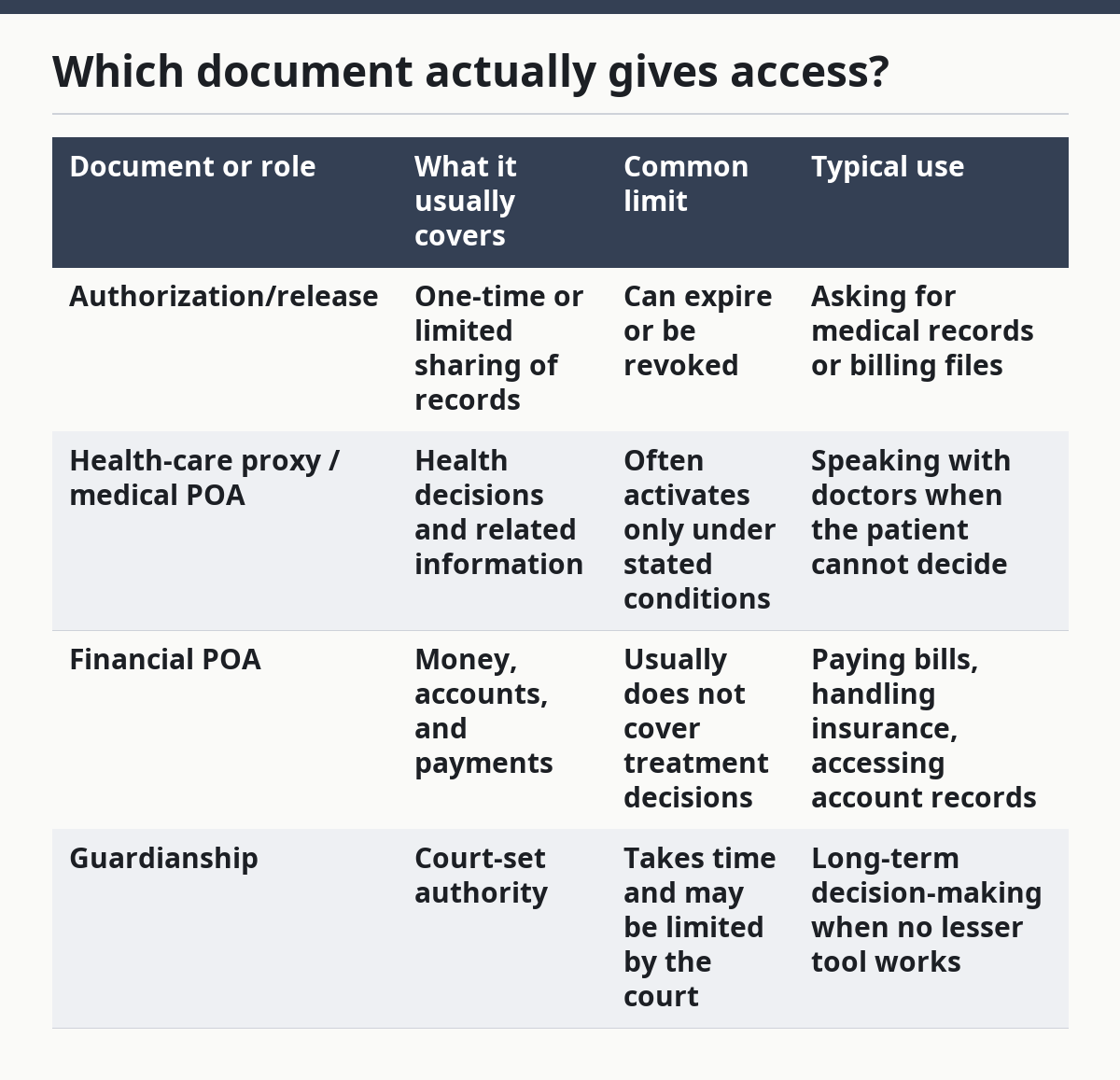
The document that gives access depends on the record type, the task, and the jurisdiction, but four terms come up most often. A signed authorization is a permission slip for records. A health-care proxy or medical power of attorney gives someone authority to make health decisions if the person cannot. A financial power of attorney gives authority over money matters, not medical care, unless the document says otherwise. Guardianship is a court-appointed role that can cover one or both areas.
Here is the practical difference:
| Document or role | What it usually covers | Common limit | Typical use |
|---|---|---|---|
| Authorization/release | One-time or limited sharing of records | Can expire or be revoked | Asking for medical records or billing files |
| Health-care proxy / medical POA | Health decisions and related information | Often activates only under stated conditions | Speaking with doctors when the patient cannot decide |
| Financial POA | Money, accounts, and payments | Usually does not cover treatment decisions | Paying bills, handling insurance, accessing account records |
| Guardianship | Court-set authority | Takes time and may be limited by the court | Long-term decision-making when no lesser tool works |
The wording on the document matters as much as the title. A form that only says “contact person” may let staff leave a voicemail, but it may not let them hand over full records. A health-care proxy may let a caregiver discuss treatment, yet still not permit release of every note without a separate records authorization; when the line is unclear, consult the privacy office or a lawyer. Some facilities also want their own form, even when a broader document exists, because their privacy office uses a standard intake process.
A good check is to read the scope clause line by line. Look for who is named, what records are covered, whether the authority includes “obtain,” “inspect,” “receive,” or “disclose,” and whether there is a start and end date. If the document is silent on the exact record type, the record holder may refuse to guess.
This is why a generic “caregiver letter” can be weak. It may help with simple communication, but it is often too soft for full access to protected records. For the next step, see How do you get records step by step?
How do you get records step by step?
The safest general process is usually to identify the record, identify the legal basis, use the holder’s form, and keep the scope narrow enough to fit the need. In the United States, privacy offices often ask for written proof rather than a phone call, and many institutions will not rely on informal explanations alone. The steps below are general and should be adjusted to the local law and the specific record holder. For U.S. federal guidance, the HHS access page remains the main starting point.
- Identify the exact record type. Write down whether the request is for medical charts, lab results, portal access, billing statements, insurance files, or facility notes. Verify the holder’s name, department, and mailing or upload method. A problem shows up when the request is too broad, because the office may reject it or ask for a narrower form.
- Find the legal basis for access. Check whether access comes from written consent, a proxy, a power of attorney, or a court order. Verify the authority matches the task, not just the relationship. A problem shows up when a financial POA is used for medical records or a health proxy is used for bank files. If the fit is uncertain, consult a professional before sending the request.
- Use the holder’s own release form if one exists. Many clinics, hospitals, and insurers use their own template, often with required fields such as name, date of birth, signature, date signed, and expiration. Verify whether a witness or notary is required. A problem shows up when a form is missing one line and gets returned unread.
- Keep the scope as narrow as the task allows. Request only the dates, departments, or file types needed, such as “primary care records from January 2024 to March 2024” instead of a full lifetime chart. Verify that the scope still covers the care task. A problem shows up when the request is so broad that processing takes longer or privacy rules block part of it.
- Submit proof of identity and authority together. Include a government ID if the holder asks for one, plus the legal document and any required contact details. Verify that names and dates match across all pages. A problem shows up when the record holder cannot match the authority document to the patient profile.
- Ask how delivery will happen. Confirm whether records will be sent by portal access, secure email, mail, fax, or in-person pickup. Verify timing, copying fees if any, and whether the record holder will send originals or certified copies. A problem shows up when the caregiver assumes immediate electronic access but the office only offers paper copies.
- Check the expiration and revocation rules. See when access ends and how the person can revoke it. Verify whether the authorization expires on a date, after one release, or when a condition changes. A problem shows up when the caregiver keeps using an expired form and the next request is denied.
- Save a complete record of the request. Keep copies of what was sent, when it was sent, who received it, and any confirmation number or email. Verify the file includes the exact version of the form used. A problem shows up when later staff ask for proof and no paper trail exists.
For example, a caregiver who needs discharge instructions for a follow-up visit may need only one release, one ID copy, and one portal proxy approval. A caregiver who manages a parent’s ongoing care may need the facility’s release, the proxy document, and a separate request for portal access. The fewer moving parts there are, the less room there is for delay.
For U.S. medical records, the HHS page on patient access rights is a useful reference point: https://www.hhs.gov/hipaa/for-professionals/privacy/guidance/access/index.html. For another authoritative source, see the Office for Civil Rights complaint and guidance pages at https://www.hhs.gov/ocr/privacy/hipaa/administrative/enforcementrule/index.html. For privacy rules in a different jurisdiction, the local health or privacy authority may use a different process and vocabulary.
When is a caregiver not enough?
A caregiver is not enough when the law wants a specific legal role or a court order. That usually happens in at least five situations, and each one changes the path.
The person has capacity and says no: Capacity means the person can understand and decide, even if the decision is unwise — the caregiver cannot override the refusal without a different legal basis.
No signed authorization exists: The helper has practical responsibility but no paper authority — the record holder may refuse disclosure and ask for a release, proxy, or court order.
The document covers the wrong subject: A financial POA does not automatically open medical records, and a health proxy does not automatically open bank files — the caregiver needs the document that matches the task.
The authority has expired or been revoked: Many releases end on a date or after one disclosure, and a revoked form stops working — the caregiver must rely on a fresh document or another lawful route.
The person is a minor under local law: Parents often have broad access, but school, mental health, sexual health, or reproductive records can have special rules in some places — the office may require a different form or limit disclosure.
The person is incapacitated and no proxy exists: When the person cannot decide and no valid delegate is in place, institutions often turn to the nearest lawful substitute or a court process — access may pause until the right authority is established.
There is family conflict or competing documents: If two relatives bring different papers, the record holder may freeze disclosure until the conflict is sorted — the safer route is to have the controlling document reviewed by a qualified lawyer.
This is the point where general guidance stops being enough. A front-desk staff member can tell a caregiver what the office wants, but that does not settle the legal authority behind the file. If the situation involves incapacity, contested family claims, sealed records, or a dispute over who can decide, qualified legal help is the right next step.
For U.S. elder-law and capacity concepts, the National Institute on Aging’s caregiver resources and the American Bar Association’s aging and disability materials are useful starting points, but local law still controls the outcome. For related planning, see What questions do caregivers ask most?
What mistakes do caregivers make?
Caregivers usually make the same few mistakes, and each one has a predictable cost. Most of them are paperwork problems, not bad intentions, which is why they can be avoided with a careful read of the form.
One common mistake is using the wrong form for the wrong job. A caregiver may hand over a note that says “I’m the daughter” and expect full chart access. The cost is delay or denial, and the correct alternative is a release or proxy document that names the exact authority.
Another mistake is leaving dates blank. A form without a start date, end date, or signature date can be rejected because staff cannot tell whether it is active. The cost is a return trip, and the correct alternative is a fully completed form with all required dates.
A third mistake is asking for everything at once. A request for “all records” may trigger extra review, copying fees, or a slower process, especially if the holder must search multiple departments. The cost is time, and the correct alternative is a narrower date range or record type.
A fourth mistake is assuming one document works everywhere. A hospital may accept a proxy, while an insurer asks for its own authorization. The cost is duplicated paperwork, and the correct alternative is to ask each holder what it needs before sending the packet.
A fifth mistake is forgetting revocation and expiration. A caregiver may keep using a form that expired six months ago. The cost is a denied request, and the correct alternative is to track the end date and renew the authority when needed.
A sixth mistake is over-sharing identity details or sending papers to the wrong fax or inbox. The cost is a privacy breach, and the correct alternative is to use the facility’s secure channel and confirm the recipient before sending.
These errors look small, but they can stall care for days or weeks. The fix is usually not more force; it is better scope, cleaner paperwork, and the right authority for the exact file in question.
What about emergencies, portals, and long-term care?
Special settings change the access rules, and the standard form often needs a tweak. Emergencies may allow immediate disclosure of limited information needed for treatment, but that is not the same as ongoing access to the full file. A hospital may share what is necessary in the moment and still require written authority for later records.
Patient portals create another layer. A portal login can make records easy to view, but access is still governed by the account settings and the institution’s consent rules. A proxy account may allow a caregiver to see messages, medication lists, or test results, yet the portal may still block some sensitive notes or add-on functions. If the patient revokes access, the portal settings should change too.
Long-term care facilities often use their own admission paperwork, care conferences, and privacy notices. A caregiver may need the facility’s release form for daily communication, a proxy for care decisions, and a separate authorization for billing records. The paperwork can be split across departments, which means one signature may not solve every problem.
There are also records that sit outside the health system. School files, employment records, insurance claims, and public benefit records each have their own rules. A caregiver who can get clinic notes may still be blocked from those other files because the privacy law or the agency’s process is different. That is normal, not a sign that the first form was wrong.
Overall, the best rule is to match the tool to the setting. For one appointment, a narrow release may be enough. For ongoing care, a proxy or broader authorization may be better. For a disputed or high-risk situation, a court process or lawyer review may be the only stable route. For a related example, see Which document actually gives access?
How should the paperwork be stored?
The paperwork should be stored in one place, with dates, names, and copies of every submission. A caregiver who keeps the release, proxy, ID copy, and confirmation together can re-send the packet quickly if the office asks for it again. A paper folder and a scanned folder both help, as long as the versions match.
The best practice is to keep the most recent version on top and note the date it was signed, delivered, and acknowledged. If the form has an expiration date, mark it clearly. If the person revokes authority, keep proof of the revocation with the old form so the record is clear.
A second practical point is to record where the document was accepted. One hospital may accept a faxed authorization, while another wants an original or secure upload. That detail matters because the same form may work in one place and fail in another if the channel is wrong.
A third point is to keep contact details current. If the record holder needs to reach the caregiver, stale phone numbers or email addresses can stop a release from moving forward. For portal access, the email on file often matters as much as the legal paper.
A well-kept file does not guarantee access, but it removes avoidable friction. It also helps if a lawyer later needs to review the chain of authority, because the dates and documents are already in order. For a quick reminder of the core sequence, see How do you get records step by step?
What should a caregiver do first?
A caregiver should start by matching the need to the smallest legal tool that fits. If the task is one disclosure, a written authorization may be enough. If the task is ongoing communication about care, a health-care proxy or similar authority may fit better. If the person cannot act and no document exists, the route may shift toward a court process.
Next, the caregiver should ask the record holder what it requires. A clinic, hospital, insurer, or care facility can often say which form it wants, whether it needs a witness, and how it accepts the request. That reduces guesswork and avoids sending the wrong packet twice.
Then the caregiver should check the scope, the expiration date, and the identity details. Names must match, dates must be complete, and the authority must cover the specific record type. A missing middle name does not always matter, but a mismatch in the patient name or signature often does.
This is also the point to slow down if the case is disputed, the person refuses consent, or the document has never been reviewed. In those cases, informal help and formal authority are not the same thing. The right next step is usually a qualified lawyer who knows the local rules, especially where capacity, guardianship, or family conflict is involved.
The general principle is simple: use the lightest tool that actually fits the task. That keeps the process narrower, faster, and easier to defend if anyone later asks why the records were released.
What questions do caregivers ask most?
Can a caregiver get medical records without power of attorney?
A caregiver can sometimes get records without power of attorney if the patient signs a release or gives portal access. A power of attorney is only one route, and in many places it is not required for every request. The record holder will still look for written authority that fits the file and the local privacy rule.
Does being next of kin give access by itself?
Being next of kin does not usually give automatic access by itself. Many offices still ask for a signed authorization, proxy, or court paper before they release more than a small update. The exact rule varies by jurisdiction and by record type, so the relationship alone is not a complete answer.
What is the difference between a caregiver and a legal decision-maker?
A caregiver provides practical help, while a legal decision-maker has formal authority to act. That authority may come from a proxy, a power of attorney, guardianship, or a similar document. A person can be one without being the other, which is why paperwork matters.
What if the patient cannot sign?
If the patient cannot sign, the next step usually depends on whether a valid proxy, agent, or guardian already exists. If no one has been named, the record holder may require a court process or another lawful substitute. Because this is a legal-rights issue, a qualified lawyer should be consulted.
Can a clinic refuse to share anything with a caregiver?
Yes, a clinic can refuse if the caregiver lacks the right authority or the request is too broad. The office may still share limited information in an emergency or after a proper release is submitted. If the refusal is based on a legal dispute or incapacity issue, the situation often needs formal review. For more context, see When is a caregiver not enough?
Drafted with AI; not yet reviewed by a person.