Choosing and setting up the right care at home: the complete guide

Last updated: November 19, 2026
Quick answer: for most families, choosing and setting up the right care at home means identifying the top 3 daily risks, matching the care model to those risks, and reviewing the plan after 1 to 2 weeks of real use. Choosing and setting up the right care at home is less about the fanciest option and more about the one that keeps the person safe, covered, and able to stay at home.
Choosing the right care at home means matching the person’s daily needs, the home layout, and the budget before you hire anyone. The right setup is the one that covers the tasks that are failing now, not the one with the most hours. The sections below will help you sort the care type, the schedule, the safety checks, and the handoff for choosing and setting up the right care at home.
Key takeaways
- Start with the tasks that are actually slipping: bathing, meals, medication prompts, mobility, or overnight supervision.
- Match the care type to the risk level. Light help is not enough for falls, confusion, or night-time wandering.
- A good home setup is part person, part environment, part paperwork.
- If the home is hard to move through, no care plan will fix that by itself.
- The best first hire often changes after the first 2 weeks of real-world use, so review the plan early.
- A plan that looks tidy on paper can still fail if no one owns the handoff.
What kind of care at home do you actually need?
The right care at home is the one that fills the gap between what the person can still do and what keeps going wrong at 7 a.m., 3 p.m., or 2 a.m. Picture this: you’re trying to help someone stay at home, but the real problem is not “more help” in the abstract. It’s missed lunches, skipped pills, a bath that has become unsafe, or a spouse who can’t keep lifting. That’s the level that matters.
Here’s the catch: “home care” is not one thing. A few hours of companionship is very different from hands-on personal care or a live-in setup. The wrong match usually shows up fast — the person is still unsafe, the family is still exhausted, and the care worker is being asked to do tasks they were never meant to cover. That is not a small mismatch. It is the whole problem.
A simple way to sort it is to name the jobs first:
- Meal prep and cleanup
- Bathing, dressing, and toileting help
- Medication reminders
- Transfer help and walking support
- Light housekeeping and laundry
- Overnight supervision
- Dementia-related redirection and cueing
If the list includes falls, confusion, pressure sores, or trouble using the toilet, the care level needs to be much higher than a friendly check-in. For those situations, a family-only plan often breaks down inside a week. If the list is mostly errands, meals, and company, the plan can stay lighter and cheaper.
The truth is, the task list tells you more than the label on the brochure does. The label can be wrong.
A good first pass:
- Write down the top 3 problems that happen in a normal week.
- Mark which ones are dangerous if no one steps in.
- Mark which ones happen at night.
- Decide whether the person needs cueing, hands-on help, or full supervision.
Which care model fits the need?
The best care model is the one that matches the risk, not the one that sounds nicest in a sales call. Picture this: you’re comparing a few hours of help, daily visits, and live-in support, and the price gap is big enough to make your head spin. The answer is not automatically the cheapest one. It’s to pick the one that can actually cover the hard parts of the day. That’s the real test.
The main options usually fall into three buckets:
- Companion or housekeeping help for errands, meals, light cleaning, and social contact
- Personal care aide support for bathing, dressing, toileting, transfers, and meal help
- Live-in or near-constant care for severe mobility limits, dementia, or unsafe nights
A companion can be enough if the person is mostly independent but lonely, unsteady with chores, or forgetting meals. That setup falls apart if someone needs help standing from a chair, getting to the toilet in time, or staying oriented at night. The consequence is simple: the risk stays in the house.
Personal care is the middle ground for many families. It can handle hands-on help, but the schedule still matters. If the need is spread across the whole day, a short visit can leave a dangerous gap. If the need is mostly morning and evening, this model can give a workable balance of coverage and cost.
Live-in care or round-the-clock coverage is the right call when the person is not safe alone for long stretches. That often includes advanced dementia, repeated falls, or a pattern of nighttime wandering. It is a heavier setup, and it also brings a practical cost: more coordination, more privacy loss, and more people touching the same household routines. Still, if the person cannot safely wait for the next visit, a lighter model is the wrong model.
A useful rule:
- Choose lighter care if the person needs mostly reminders and supervision.
- Choose personal care if they need hands-on help with body care.
- Choose near-constant care if missing even one task creates a real safety risk.
How do you choose the right provider?
The right provider is the one that can do the work you need on the days you need it, with staff who are trained for that kind of home. Picture this: you’re on a call with two agencies. Both sound polite. One offers “flexibility,” and the other says it can cover dementia care, transfers, and backup shifts. The second one is usually closer to the truth of the job. Specific beats vague.
A provider should be able to answer concrete questions without dodging:
- What tasks are included?
- Are aides trained for transfers, toileting, and dementia cueing?
- Who handles call-outs?
- How are schedules changed?
- What happens after a fall?
- How are notes shared with family?
If a provider can’t say who covers a missed shift, that is not a minor admin issue. It is the part that decides whether the plan works on a Tuesday morning. Ask how they screen staff, whether a supervisor checks the plan, and how quickly they can replace someone who is not a fit.
The honest downside of many providers is inconsistency. Even a decent agency can send different people, and some clients handle that well while others do not. A person with dementia may get upset by constant rotation. A person with anxiety may do better with the same aide every visit. That means the “best” provider on paper may still be a poor match if staffing changes too often.
You also want clear boundaries. If you need transportation, medical reminders, or help with a lift, the provider should say exactly what is allowed. A vague yes can turn into a hard no after the first incident. That is how families get stuck.
Look for these signs:
- Clear task list in writing.
- Backup plan for missed visits.
- Supervisor contact, not just a scheduling desk.
- Basic training for the risks in the home.
- A note system the family can actually read.
How do you set up the home so care can work?
The home setup is what makes care easier or harder, and in many cases it matters as much as the person you hire. Picture this: you’ve lined up support, but the hallway is crowded, the bathroom is slippery, and the favorite chair sits too low for safe standing. A good worker can help a lot. They cannot fix a bad layout alone. The room has to cooperate.
Start with the high-risk spots:
- Bathroom
- Bedroom
- Stairways
- Kitchen
- Entry path
The bathroom usually needs the fastest changes because falls happen there and the room is small. A grab bar, a non-slip surface, good light, and a clear path matter more than decorative clutter. If the person needs help getting in and out of the tub, a tub bench or shower chair may be more useful than a “fancier” bathroom refresh. The bedroom should support safe transfers, a reachable phone, and enough light to see the floor at night.
The kitchen setup should cut down on hard reaches and confusion. Put cups, plates, and basic snacks where the person can reach them without climbing or bending. If medication reminders happen at the kitchen table, keep that space uncluttered and predictable. Small changes reduce the number of times an aide has to improvise.
A few changes are cheap compared with a bad fall. A bad setup can also make care visits shorter because the worker spends time clearing paths, searching for supplies, or helping the person move around obstacles. That means the plan costs more without looking more expensive on paper. Not good.
A practical setup checklist:
- Remove loose rugs and cords from walking paths.
- Improve lighting in hallways, stairs, and bathrooms.
- Keep shoes, walkers, and canes in the same place every day.
- Put daily supplies within easy reach.
- Label drawers or bins if memory is slipping.
- Make a simple emergency list visible near the phone.
The National Institute on Aging and the CDC both publish home-fall-prevention advice. Their checklists are worth reading before you buy equipment or rearrange furniture. For home safety guidance, see the National Institute on Aging and the CDC, and pair that with any equipment advice from the care provider.
What paperwork and communication do you need in place?
The right paperwork is what keeps the plan from falling apart when one person is sick, late, or confused. Picture this: the aide knows what to do, the family thinks someone else has the schedule, and the person receiving care gets different instructions from three people in one day. That chaos is common, and it is avoidable. Write it down.
At minimum, set up a plain-language care sheet:
- Name and role of each helper
- Visit days and hours
- Tasks for each visit
- What to do if the person refuses care
- What counts as an emergency
- Which family member gets called first
- Medication reminders and timing, if applicable
If the person has memory problems, the sheet should be visible but not cluttered. If the person has many providers, one shared log helps. The log can be paper or digital, but it has to be easy to use. If it is too complicated, nobody keeps it current.
One important limit: home care aides are not a substitute for clinical care, and families should not assume the aide can handle every medical need. If the person has wound care, complex medication changes, or new symptoms, the care plan should be checked with the appropriate clinician. Don’t guess. That is how small problems become big ones.
A good handoff also includes a 10-minute walk-through on the first day:
- Where supplies are kept
- How the door lock works
- Where the person sleeps
- What time meals happen
- What to do if the person falls
- Who handles pets, mail, and trash
That first handoff sounds basic. It isn’t. It is the difference between “I think this is covered” and a plan that people can follow when nobody is thinking clearly.
When should you choose more care than you first planned?
Choose more care as soon as the current plan leaves a gap that repeats, even if the gap looks small. Picture this: you started with a few morning visits, then you notice the person is missing lunch, leaving the stove on, or trying to walk to the bathroom alone at night. That is not a scheduling annoyance. It is the plan telling you it is too light. Escalate early.
There are a few signs that the setup needs to move up:
- Two or more falls or near-falls
- Missed medication that changes the day’s safety
- Wandering or getting lost indoors
- Trouble using the toilet without help
- Weight loss from skipped meals
- Family caregivers getting exhausted or resentful
The first mistake is waiting for a “big event” before changing the plan. The second mistake is adding hours without changing the type of help. An extra companion visit will not solve unsafe transfers. More time does not fix the wrong skill set.
On the flip side, some families overbuy care because they are afraid of being unprepared. That can drain money fast and still not solve the real issue if the person mainly needs better routines and a safer home layout. In other words, adding hours is not the same as adding the right help.
A better move is to review the plan after the first 1 to 2 weeks and again after any health change. Ask:
- What tasks still go undone?
- Which part of the day is hardest?
- Did the home setup reduce the work?
- Are the same problems repeating?
- Does the helper’s skill match the task?
The honest side-by-side: lighter help, personal care, or live-in support
The best choice is not the one with the longest list of services. It is the one that covers the risk without wasting money on the wrong kind of coverage. Picture this: you’re down to two realistic paths, and both have pros and cons. One is cheaper and lighter. The other is steadier and harder to arrange. The right call depends on where the real danger sits in the day. That’s the whole comparison.
| Criteria | Light help / companion care | Personal care support | Winner for this condition |
|---|---|---|---|
| Main use | Meals, errands, company, light cleaning | Bathing, dressing, toileting, transfers | Personal care support for hands-on needs |
| Falls risk | Only helps indirectly | Can assist with safe movement | Personal care support when walking is unsafe |
| Night coverage | Usually limited | Usually limited unless scheduled often | Neither if nights are the main problem |
| Dementia cueing | Basic reminders only | Better for redirection and routine support | Personal care support for confusion |
| Household chores | Often stronger here | Can do some, but not the main job | Light help / companion care for chores |
| Privacy impact | Lower | Higher because of hands-on tasks | Light help / companion care for privacy |
| Cost pressure | Lower strain | Higher than companion care | Light help / companion care for tight budgets |
| Need for lifting | Not a fit | Sometimes a fit if trained and allowed | Personal care support |
| Need for same routine daily | Moderate | Better fit | Personal care support |
| Best match | Mostly independent person | Person who needs body-care help | Depends on the task |
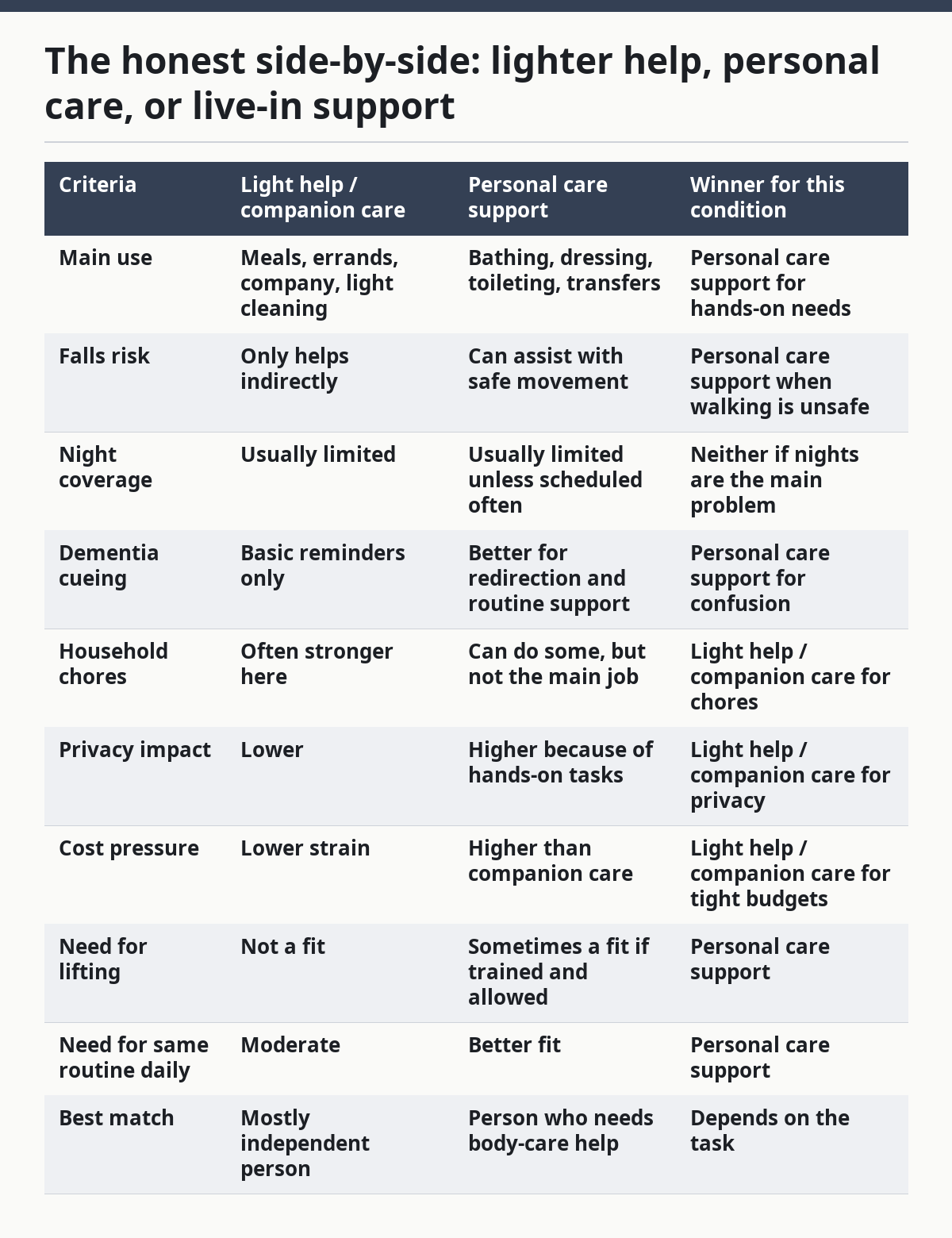
Light help wins when the person still manages toileting, transfers, and most personal care. It is the better fit for someone who mainly needs structure, company, and the basics of daily life handled. The downside is plain: it cannot cover a true safety problem. If the person needs hands-on support, this option is too thin.
Personal care support wins when the body-care tasks are the problem. It is the better fit for someone who needs help bathing, getting dressed, or moving safely from bed to chair. The drawback is that it is more intrusive, and it is not always enough if the person needs overnight supervision or constant redirection.
Live-in or near-constant care becomes the answer when missing a few hours is the danger. That includes severe dementia, repeated nighttime wandering, or a person who cannot be left alone safely. It is the least flexible option, and it can be hard on household privacy. Still, when the risk is all-day or all-night, the lighter models are not enough.
The verdict: which one to choose and why
Choose light help / companion care if the person is mostly independent, the main problems are meals, chores, or reminders, and the home is already safe. Choose personal care support if the person needs help with bathing, dressing, toileting, or transfers. Neither if the person is unsafe alone at night, needs round-the-clock supervision, or has repeated falls without a higher-care plan.
What are the exception cases that change the answer?
The right answer flips fast when a single risk changes the whole day. Picture this: you’ve picked a care model that looks right on paper, then one detail makes it wrong. A new diagnosis, a bad fall, or a staircase the person can no longer manage can change the setup overnight. That is not rare.
Three common exceptions matter:
- Dementia with wandering — Even if personal care sounds enough, night wandering can push the plan toward more supervision.
- A post-hospital period — A temporary setback after surgery or illness can demand short-term higher care, then a step-down later.
- A fragile spouse as the main caregiver — If the only helper can’t lift, drive, or stay awake, the plan has to match the helper’s limits too.
- A home with stairs only — If the person can no longer manage stairs safely, even a good aide plan may need a room change or a different living setup.
That last point is the one families miss most often. A care plan that ignores the house is half a plan. If the home cannot support the care, you may need more than an aide. You may need equipment, a room swap, or a different arrangement altogether.
The truth is, the “best” home care is sometimes the one that buys time while the family prepares the next move. That might mean recovery support for 2 weeks, not a permanent plan. It might mean stepping up after a fall and stepping back later. A fixed answer is comforting. A correct answer is better.
How do you keep the plan working after week one?
The plan keeps working when someone checks it against real life, not just the original schedule. Picture this: the first week goes fine, then the aide starts arriving late, the person refuses baths, or the same pile of laundry keeps sitting there. That is the moment to review the plan, not wait for another crisis. Small failures become big ones.
A simple weekly check is enough for many families:
- Are all scheduled visits happening?
- Are the hardest tasks getting done?
- Is the person eating, bathing, and taking reminders as planned?
- Are there new safety issues?
- Is the helper getting enough direction?
- Is anyone burning out?
If the same problem shows up twice, change the setup. Don’t just ask for “more effort.” Add a clearer task list, a different time slot, a safer room setup, or a different level of care. The goal is not to make the system look good. The goal is to keep the person safe at home for as long as that remains realistic.
If the care is paid through a program, policy, or benefits plan, the rules can change the options. Check the current program requirements directly, because coverage terms and service categories vary. If the care is private-pay, the review should still happen on a calendar, not only when there is a problem.
Frequently asked questions
How do I know if I need home care or just help around the house?
Home care is the better fit when the problem is personal safety or daily body care, not just chores. If the person mainly needs cleaning, rides, meals, or company, lighter help may be enough. If bathing, toileting, transfers, or memory issues are part of the problem, the plan needs more than housekeeping support.
Should I start with fewer hours and add more later?
Starting smaller can work if the need is truly light and the home is already safe. It fails when the person already has falls, confusion, or missed medication, because those problems do not usually improve by waiting. If you start small, set a review date in the first 1 to 2 weeks and be ready to raise the level fast.
What should be written into the care plan?
The care plan should list the exact tasks, the visit times, who opens the door, what to do if the person refuses help, and who gets called in an emergency. It should also note where supplies are kept and any mobility or memory issues that affect the day. A vague plan causes missed tasks.
Do I need to change the home before care starts?
Yes, if the home has obvious trip hazards, poor lighting, or a hard bathroom setup. Simple changes like removing loose rugs, clearing cords, and improving light can make a big difference right away. If the person has trouble standing or walking, the bathroom and bedroom usually need the first changes.
What if the person does not want help at home?
Resistance is common, especially when the person feels the help means loss of control. Start with the least intrusive support that still covers the risk, and be clear about the goal: staying at home safely. If the person is refusing help because of confusion, fear, or dementia, the plan may need more structure and more supervision.
Drafted with AI; not yet reviewed by a person.