Last updated: November 20, 2026
Hire a private duty nurse by starting with the care tasks that need licensed nursing, then checking credentials, shift needs, and the nurse’s fit with the home. If the person needs medication management, wound care, feeding tube support, or other skilled care at home, private duty nursing is the right lane to explore.
Key takeaways
- Private duty nursing is for hands-on skilled care, not just help with meals or bathing.
- A written care plan keeps the search focused on the exact tasks and shift length needed.
- A registered nurse and a licensed practical nurse do not fill the same role.
- License checks matter before any shift starts, even if the nurse comes through an agency.
- Private duty nursing and home health are different services with different rhythms and goals.
What is a private duty nurse?
A private duty nurse is a licensed nurse who provides skilled care in the home on a scheduled basis, often for one person at a time. That care may be delivered by a registered nurse or a licensed practical nurse, depending on the tasks and the plan of care.
This is the right choice when the home setting needs nursing tasks that go beyond routine help. Think medication setup, catheter care, wound dressing changes, monitoring symptoms, or support after a hospital discharge. It is not the same as homemaker care, companionship, or personal care services.
A simple way to frame the difference is this: private duty nursing is about clinical care in the home, while home care often includes help with daily living. That is why the term “private duty nurse” matters. The person is not there just to keep someone company for 4 hours or help with a shower. The person is there to perform nursing work that belongs under a care plan.
Private duty nursing also tends to be scheduled by shift. One family may need 8-hour daytime coverage. Another may need overnight support or intermittent visits that match a medication schedule. The exact setup depends on the person’s condition, the home, and the level of nursing skill required.
This is also where many searches go wrong. A reader may think “I need someone at home” and start with the wrong service. If the job needs a nurse, not a helper, the search should start with nursing credentials, a care plan, and the tasks that only licensed staff can do. For a broader overview of paid help at home, the site’s home care services and paid help hub is the right place to start, then come back to this page for the nursing piece.
When does skilled nursing at home make sense?
Skilled nursing at home makes sense when the person needs clinical care that must be done by a licensed nurse, not just supervised by one. The need is often tied to a diagnosis, a recent hospital stay, a changing medication list, or a condition that can turn quickly.
Common examples include complex wound care, injections, tube feed support, tracheostomy care, catheter care, symptom checks, and medicine management when timing matters. A nurse may also watch for changes that need a doctor’s call, such as swelling, confusion, fever, shortness of breath, or a sudden drop in function.
A private duty nurse is often used when the home needs a steady nurse presence, not a short visit. That can matter when the person needs 1:1 attention for many hours, or when the family cannot safely manage overnight care alone. The draw is continuity: one nurse, or a small team, following the same care plan and routine.
This option is not the best fit for every home. If the need is mainly meals, errands, cleaning, or reminders, skilled nursing is usually too much service and too much cost for the problem. If the person only needs occasional check-ins from a clinician, home health may fit better than private duty nursing.
A useful rule is to ask, “Does this task require licensed nursing judgment, or just hands-on help?” If the answer is nursing judgment, this is the right search. If the answer is day-to-day support, this is probably the wrong hire.
Private duty nursing also fits best when the family wants a clear care plan instead of a loose arrangement. That plan should list the nursing tasks, the shift length, the backup contact, and what to do if the person’s condition changes during the shift.
How do I hire one?
You hire a private duty nurse by matching the care plan to the nurse’s license, then verifying the person, the schedule, and the duties before the first shift. Use the steps below as a working checklist.
-
Use the care plan to list the exact nursing tasks. Write down what must happen in the home, such as medication administration, wound care, or tube care, plus the shift length, such as 4 hours, 8 hours, or overnight.
-
Use the discharge papers or doctor’s orders to confirm the level of care. Put the hospital or clinic instructions next to the home needs so the nursing job is based on the current plan, not memory.
-
Use the state nursing board to verify the license. Check that the nurse is active and in good standing before any start date. If you need the official state board lookup, use the board’s license verification page, since every state board controls its own records.
-
Use a written interview to ask about the exact tasks. Ask how the nurse has handled similar care, what equipment they know, and what they would do if the person’s breathing, blood pressure, or alertness changed.
-
Use references or the agency file to confirm reliability. Ask how often the nurse has worked the same shift pattern, whether they were on time, and whether they communicated changes clearly.
-
Use the home setup to check fit before the first shift. Make sure there is space for supplies, a clean work surface, and a place to store meds or equipment safely.
-
Use a written agreement to lock in the schedule and duties. Spell out start time, end time, break coverage, who calls the doctor, and what happens if the nurse cannot make a shift.
A nurse who sounds good on paper but cannot follow the care plan is a weak hire. A nurse who understands the tasks, the home routine, and the limits of the assignment is usually the stronger choice, even if the interview is brief.
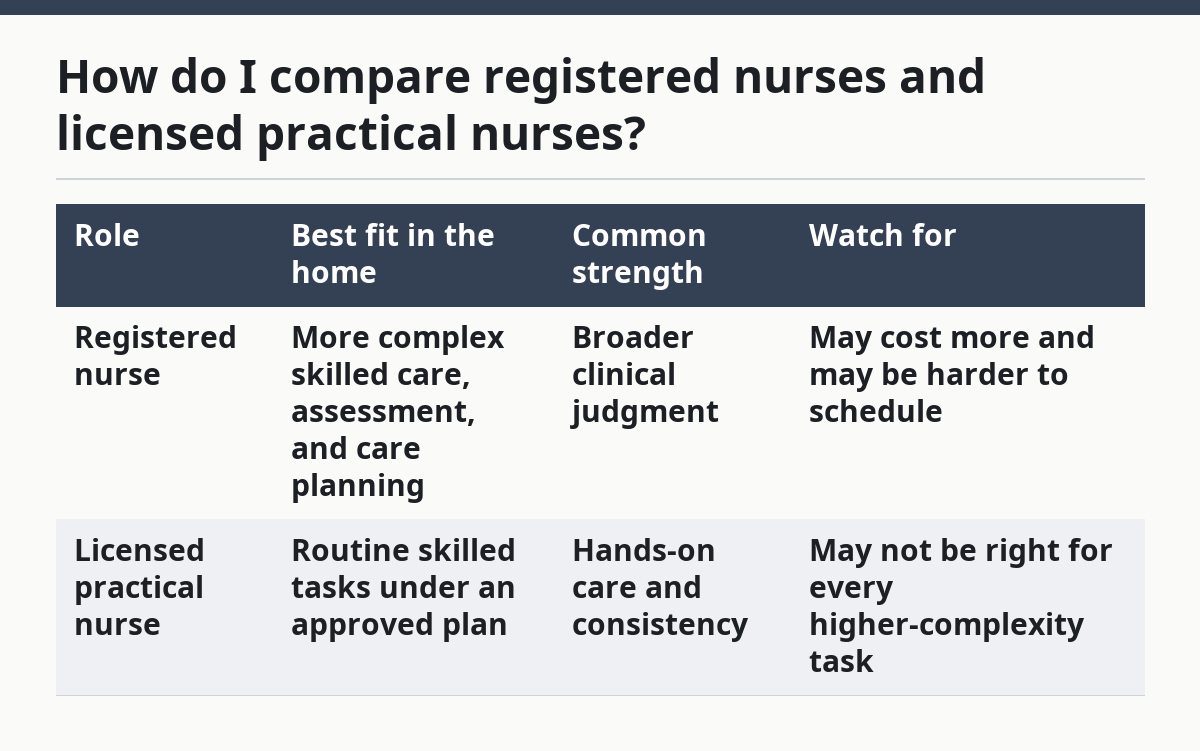
How do I compare registered nurses and licensed practical nurses?
A registered nurse and a licensed practical nurse can both work in private duty nursing, but they do not always handle the same tasks. The right one depends on the care plan, the complexity of the condition, and the supervision model used by the employer or agency.
Here is the practical comparison:
| Role | Best fit in the home | Common strength | Watch for |
|---|---|---|---|
| Registered nurse | More complex skilled care, assessment, and care planning | Broader clinical judgment | May cost more and may be harder to schedule |
| Licensed practical nurse | Routine skilled tasks under an approved plan | Hands-on care and consistency | May not be right for every higher-complexity task |
The distinction matters because families often use the title “nurse” loosely. That can lead to the wrong hire if the person really needs clinical monitoring, not just task-based care. It can also lead to overhiring, which wastes money and can crowd the schedule with skills the home does not need.
A private duty nurse is the wrong choice if you only need 30-minute check-ins for a simple routine. It may also be the wrong choice if the home needs a broad mix of household help and companionship rather than licensed care. In those cases, a different home care service may fit better.
A good question to ask during hiring is, “Which tasks can this license cover in this home, and which tasks need a higher level of nurse?” That one question can prevent a bad match before the first paycheck or the first shift.
If the person’s condition is changing fast, or if the care plan leaves room for judgment calls every day, the registered nurse side of the comparison often deserves more weight. If the needs are stable and the tasks are clearly spelled out, a licensed practical nurse may fit the job well.
What should I ask before I sign?
You should ask about license, task experience, schedule, and emergency handling before you sign anything. The goal is to find out whether the nurse can do the job safely in the real home, not just on a resume.
Ask these questions in plain language:
- What licensed role do you hold, RN or LPN?
- What similar home tasks have you handled before?
- How do you document meds, wounds, or changes in condition?
- What do you do if the person refuses care?
- How do you handle a shift handoff at 7 a.m. or 7 p.m.?
- What equipment do you expect to see in the home?
- Who should I call if you spot a new problem?
These questions matter because private duty nursing runs on routine and judgment. A nurse who can explain a 12-hour shift, a medication schedule, and a backup plan is giving a clearer answer than one who only says “I’ve done this before.”
Also ask what is not included. Some nurses do not handle heavy lifting, some do not manage certain devices, and some only work with specific kinds of cases. That is not a flaw. It is a boundary, and it is better to know it before the first night shift than after the first incident.
A written checklist helps here. Keep it to one page if possible. Include the 3 most important tasks, the contact list, the backup plan, and the start date. That piece of paper does more to prevent confusion than a long verbal conversation.
What does private duty nursing do at home?
Private duty nursing at home covers skilled tasks that belong on a nursing care plan, not just basic household help. That can include medication support, wound care, symptom monitoring, catheter care, tube feeding support, and documentation of changes that matter to the doctor.
It can also include watchful care during high-risk hours, such as overnight or after discharge from a hospital. The nurse may be there for 4 hours, 8 hours, or longer, depending on the assignment and the need for continuity.
This service is different from home health in both rhythm and purpose. Home health usually centers on intermittent visits tied to a clinical plan. Private duty nursing is more like scheduled bedside coverage in the home. The nurse is present to carry out the care plan during the shift, not simply to stop in and leave.
A key trade-off is cost versus consistency. Private duty nursing gives the home more continuous skilled attention, but that can make it a heavier commitment than shorter services. That is why it should be reserved for cases where the nursing task load justifies it.
For a quick reference, here is the basic split:
| Service | What it usually focuses on | Visit pattern |
|---|---|---|
| Private duty nursing | Ongoing skilled nursing in the home | Scheduled shifts, often longer blocks |
| Home health | Intermittent skilled visits | Shorter, planned visits tied to treatment goals |
The right choice depends on the care plan, the schedule, and the level of nursing skill the home actually needs.
Is private duty nursing the same as home health care?
No, private duty nursing is not the same as home health care, even though both can involve licensed nurses in the home. Home health usually refers to skilled care delivered on a visit basis, while private duty nursing usually means longer, more continuous nursing coverage in the home.
That difference changes the hiring process. For home health, the question is often whether the person qualifies for intermittent skilled visits under a treatment plan. For private duty nursing, the question is whether the home needs a dedicated nurse on a shift schedule for one person’s care needs.
The two can overlap in skill level, but they are not the same service. A home health nurse may come for a specific task and leave. A private duty nurse may stay for hours and manage the full nursing picture during that time.
This matters because many families start with the wrong service label. They want “someone at home” and end up asking for the wrong kind of help. If the issue is skilled care during long blocks of time, private duty nursing is the clearer fit. If the issue is short, ordered visits, home health may be the better lane.
The difference also affects expectations. In private duty nursing, the family should expect more attention to the daily routine and closer tracking of what happens during the shift. In home health, the rhythm is usually less continuous and more tied to specific clinical goals.
A good hiring decision starts with the right bucket. Once that bucket is clear, the license, the care plan, and the schedule become easier to match.
What does a private duty nurse do at home?
A private duty nurse does skilled nursing tasks at home under a care plan, such as medication support, wound care, monitoring, and help with device-related care. The nurse may work one shift or a series of shifts, depending on the person’s needs and the home setup. It is clinical help, not household help.
Is private duty nursing the same as home health care?
No, private duty nursing is usually more continuous and shift based, while home health care is usually visit based and tied to a treatment plan. The services can both involve licensed nurses, but they are set up differently and solve different problems.
How do I check a nurse’s license?
Check the nurse’s license on the state nursing board’s official verification page before the first shift. The license record should show the active status and the correct name. If the board record does not match the paperwork, pause the hire and ask for clarification before anyone starts work.
Drafted with AI; not yet reviewed by a person.