
How to Track Symptoms After a Doctor Changes a Treatment Plan

Last updated: November 20, 2026
Quick answer: start tracking symptoms the same day the treatment plan changes, and review the notes over the next 7 days so the care team can see whether the change is helping or causing side effects. If you are unsure what to record or whether a symptom is serious, check with a qualified professional. For general guidance on monitoring medicine effects and side effects, see MedlinePlus and the NHS advice on side effects.
Post-visit symptom tracking for how to track symptoms after a doctor changes a treatment plan means writing down what changes after the treatment plan changes, starting the same day, so the care team can tell whether a new medicine, stop, switch, or dose change is helping or causing side effects. If the change affects pain, sleep, mood, breathing, bathroom habits, or skin, tell a qualified professional about your own situation before you guess at the cause.
Key takeaways
- Start notes on the day the treatment plan changes, not “when you remember,” unless a qualified professional gives you different instructions.
- Track symptoms, side effects, and daily function in plain words, not just one-word labels, if you can do so clearly.
- Write down the time, what changed, what you saw, and what happened next.
- Report urgent or unusual changes right away instead of waiting for the next doctor follow-up.
- Simple notes on paper or in a phone are better than a perfect system you never use.
Who should track symptoms this way?

This applies to anyone who has just had a doctor change a treatment plan and needs to watch for side effects, symptom shifts, or new problems over the next few days, and a qualified professional can help tailor the approach to the person’s situation. It fits caregivers who are helping with daily routines, including people who notice bathroom changes, sleep changes, or confusion after a medicine change.
It assumes you already know the treatment was changed, know the care team’s main contact method, and can record notes once or twice a day for at least 7 days, unless a qualified professional recommends a different schedule. It is not for replacing medical advice, reading symptoms as a diagnosis, or deciding on a medicine change alone.
If the person has trouble breathing, severe pain, chest pain, fainting, a seizure, or a sudden change in thinking, do not wait on a tracking system. Get qualified help right away and use the notes only to share what happened. The same is true if the person cannot keep fluids down, cannot wake normally, or has a new rash that spreads fast.
This page belongs to the broader caregiver coordination and daily routines work, where small notes can prevent confusion later. A plain record helps the doctor follow-up go faster because the details are already there.
How do you track symptoms after a doctor changes a treatment plan?
Track symptoms by writing down the change, the time, the exact symptom, and what happened next in a simple 2-column or 3-column note, and ask a qualified professional if you are unsure what matters most. The goal is not a perfect chart; it is a clear record the care team can use.
- Set up a note page, app, or paper sheet before the first dose change: Use one place only, so the record does not scatter across texts and scraps. Include the date, the treatment name, and the time of the change. Verify that each entry has a date stamp; if it does not, the note will be hard to use at doctor follow-up.
- Write the exact change in the treatment plan: Record what changed, such as started, stopped, switched, or adjusted, without guessing why. Add the time of the change and any instructions you were given. Verify that the note matches the care team’s instruction; if it does not, stop and confirm before assuming the plan.
- List the baseline symptoms first: Before the new change has time to work, write what was already present, such as pain, nausea, fatigue, dizziness, sleep trouble, or bathroom changes. This gives you a comparison point. If you cannot tell whether a symptom is new or old, mark it as “same as before” rather than leaving it blank.
- Track symptoms at 2 to 3 set times each day: Pick times you can keep, such as morning, afternoon, and evening, and use the same times for at least 3 days. Consistency matters more than volume. If notes are missing large parts of the day, the pattern may look better or worse than it is.
- Rate each symptom in plain language: Use a simple scale such as mild, moderate, or severe, or a 0-to-10 note if that is already familiar in the care setting. Add the body part or body system, like stomach, skin, head, or sleep. A note that says “bad” is too vague; a note that says “headache, moderate, noon, lasted 2 hours” is useful.
- Record side effects separately from the main symptom: Side effects are unwanted effects that appear after a treatment change and may or may not be serious. Note whether the change was new, getting worse, or fading. If a side effect makes it hard to eat, walk, think clearly, or sleep, that detail matters more than the label itself.
- Capture what happened before and after the symptom: Write the trigger, the setting, and the result, such as after a meal, after walking, after a bathroom trip, or after rest. Include anything obvious that may have changed the symptom, like dehydration, missed food, or a long nap. If a symptom improves after a repeat pattern, that pattern is worth sharing with the care team.
- Share the note with the care team at the next check-in or sooner if needed: Bring the notes to doctor follow-up, send a photo, or use the clinic’s preferred message method. Keep the last 24 hours and the first day of change easy to find. If the note shows a new urgent problem, do not wait for the next appointment; contact the care team promptly.
A good record is short enough to keep up and complete enough to show change. If the person’s symptoms are stable, you may only need brief notes twice a day. If the symptoms shift quickly, more frequent entries are useful, but only if they stay accurate.
What symptoms should I write down after a treatment change?
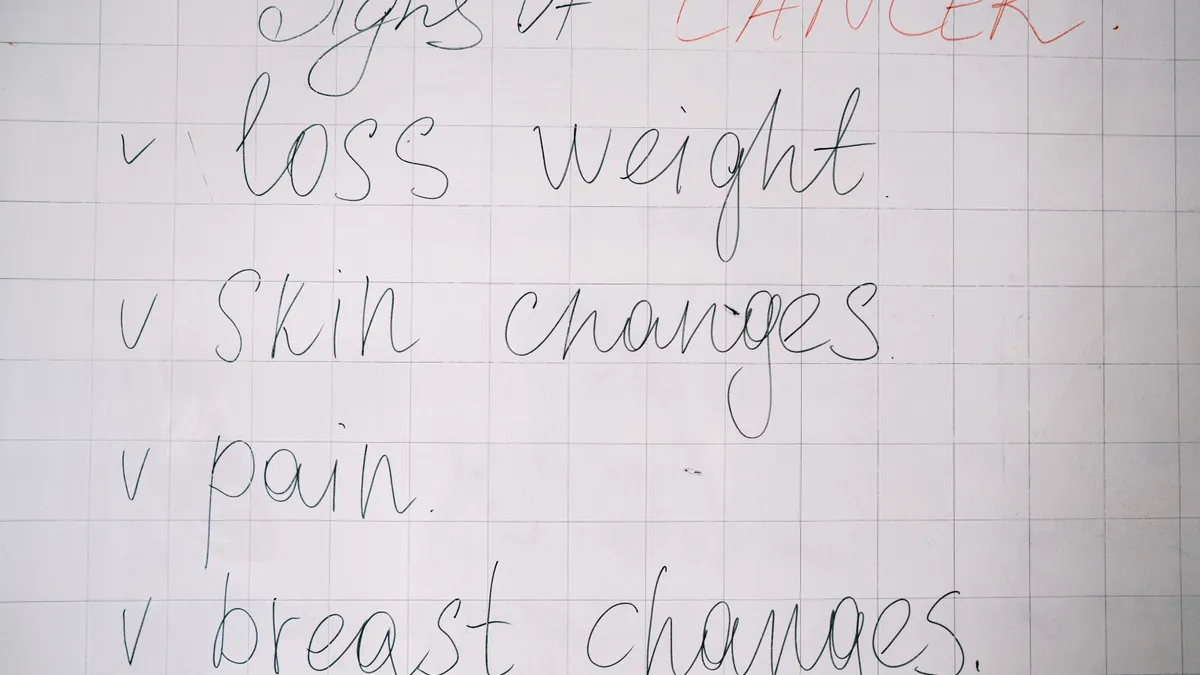
Write down any symptom that is new, worse, or different from the baseline, especially if it affects daily function. That includes pain, nausea, dizziness, sleep changes, appetite changes, mood shifts, skin changes, swelling, bathroom changes, confusion, and trouble moving.
The safest approach is to include both the symptom and the effect it has. “Tired” is less useful than “too tired to finish breakfast” or “slept 4 hours instead of 7.” If the person uses a cane, needs help standing, or starts missing usual tasks, note that too.
A practical rule is to focus on what changed in the first 72 hours, then keep watching the symptoms that persist. If the doctor changed more than one thing at once, write each change separately if you can. That helps the care team sort out which part of the plan may be linked to which symptom.
What details matter most in the notes?
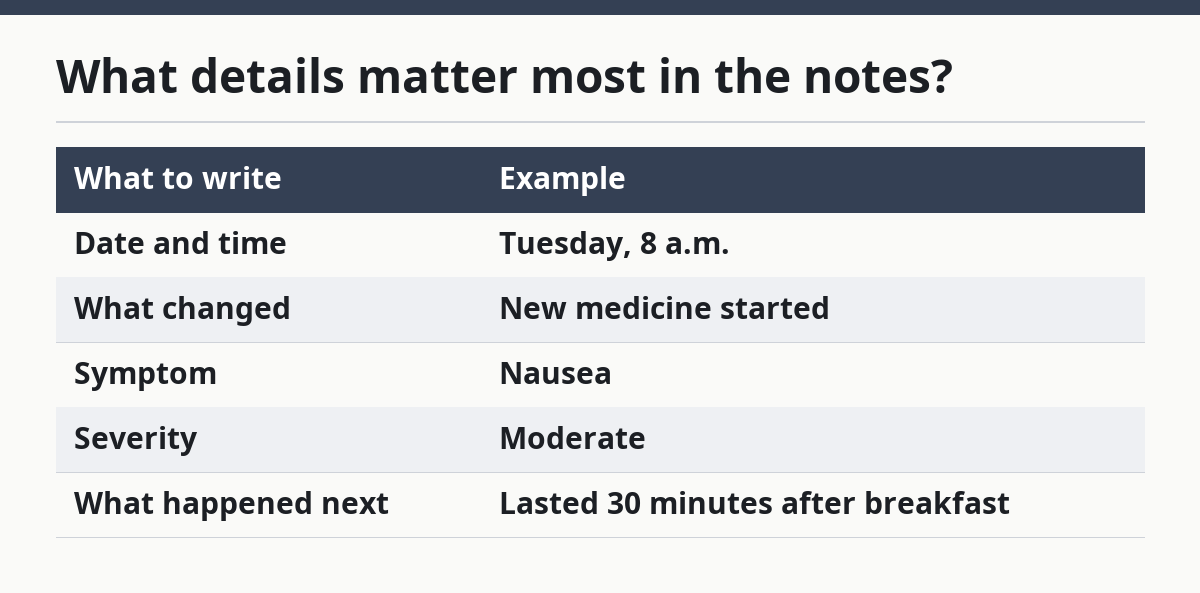
The most useful notes have 5 details: time, symptom, severity, duration, and what happened next. These details are the difference between “felt off” and a note that helps during doctor follow-up, according to general medication-monitoring guidance from MedlinePlus and the NHS.
Use the same wording for the same symptom when possible. If you say “lightheaded” one day and “dizzy” the next, add a short clue such as “when standing” or “at rest.” For bathroom changes, note frequency, urgency, pain, and any visible change, because those details can matter more than a broad label.
A simple format works well:
| What to write | Example |
|---|---|
| Date and time | Tuesday, 8 a.m. |
| What changed | New medicine started |
| Symptom | Nausea |
| Severity | Moderate |
| What happened next | Lasted 30 minutes after breakfast |
If you are comparing options, this table shows the trade-off clearly:
| Format | Strength | Weakness |
|---|---|---|
| Paper notes | Easy, fast, no battery needed | Easy to misplace |
| Phone notes | Time-stamped, easy to carry | Can get buried in other apps |
| Clinic portal message | Direct to the care team | May limit how much detail fits |
Use the format that you will actually keep up for 7 days. A fancy system that gets abandoned on day 2 is worse than a plain notepad.
When should you report changes right away?
Report changes right away when the symptom is severe, sudden, or clearly different from the expected pattern. Do not wait for the next scheduled doctor follow-up if the note shows a problem that could need same-day guidance.
Breathing trouble, chest pain, fainting, or a seizure: These are urgent changes and can point to a serious problem — seek qualified help immediately.
Fast-spreading rash, swelling of the face, or trouble swallowing: These can signal a dangerous reaction — get urgent medical help right away.
Confusion, extreme sleepiness, or a sudden change in alertness: These changes can affect safety and judgment — contact the care team promptly and do not ignore them.
Repeated vomiting, inability to keep fluids down, or signs of dehydration: These can become serious quickly — report them the same day.
New bleeding, black stools, or blood in urine or stool: These need prompt medical review — contact the care team without delay.
Sudden worsening of pain, swelling, or trouble walking: This may mean the plan is not fitting the person’s needs — share the note quickly and ask for guidance.
When a symptom seems urgent, the note is still useful, but it is not the first step. Safety comes first; documentation comes second. If you are unsure whether a change is serious, treat it as important enough to ask about now rather than later.
What mistakes do people make?
The most common mistake is waiting until the end of the week to remember everything. That loses timing, and timing is what helps the care team connect a symptom to a treatment change. The fix is to write short notes the same day, even if they are only 2 lines long.
Another mistake is writing only labels like “bad day” or “okay.” Those words do not tell the doctor whether the issue is pain, sleep, appetite, mood, or bathroom function. The better alternative is to name the symptom, the severity, and the time.
A third mistake is recording too much unrelated detail. A long story can hide the useful facts. Keep the note focused on the change, the symptom, and the result.
A fourth mistake is assuming a side effect is “just part of getting used to it” and not reporting it. Some changes are common, but common is not the same as harmless. If the symptom affects eating, walking, thinking, or breathing, the care team should know.
A fifth mistake is using several places to track the same thing. That creates mixed versions of the truth. One note system, used every day, is easier for the doctor follow-up and easier for the caregiver to maintain.
When does the usual approach need to change?
The usual approach needs adjustment when the person cannot describe symptoms well, takes more than one treatment change at once, or has a condition that makes small changes harder to judge. In those cases, the notes should be simpler, more frequent, and tied to visible signs.
If the person has memory trouble or confusion, focus on observable facts: sleep, appetite, walking, bathroom use, skin changes, and alertness. If language is a barrier, use a short checklist with yes/no boxes and a few common terms. If several medicines changed on the same day, label each change separately so the care team can sort the timeline later.
If the symptom is mild but persistent, note the pattern over 3 to 7 days instead of reacting to one bad hour. If the symptom is sharp and sudden, do not wait for a pattern to form. The point of post-visit symptom tracking is to make the next clinical decision better, not to delay one that should happen now.
How do you share the updates with the care team?
Share the updates by giving the care team a short summary plus the notes, not just a full page of text. Lead with the 3 most important changes, then show the dates and times behind them.
A clean summary might include: what changed, when it started, whether it is better or worse, and whether it affected sleep, eating, movement, or bathroom habits. If the office prefers portal messages, keep the wording direct and brief. If the person has a doctor follow-up soon, bring the notes to the visit and ask which patterns matter most.
Do not wait until the next appointment if the record shows a red-flag change. If the issue is not urgent but keeps repeating, the notes still matter because they help the care team see the trend, not just one bad day. That is the whole point of keeping post-visit symptom tracking in one place.
What symptoms should I write down after a treatment change?
Write down anything that is new, worse, or different enough to affect daily life. That includes pain, nausea, dizziness, sleep changes, appetite changes, mood shifts, skin changes, swelling, bathroom changes, and confusion. If you also note the time and what happened next, the care team gets a clearer picture.
How soon after a doctor visit should I start tracking changes?
Start the same day the treatment plan changes. The first 24 hours often give the clearest baseline for what is new and what was already there. If you wait several days, early side effects and short-lived symptoms can be lost from the record.
What is the best format for symptom notes?
The best format is the one you can keep using for 7 days without trouble. A simple paper sheet, a phone note, or a clinic portal message can all work if each entry has the date, time, symptom, severity, and what happened next. Clear and regular beats elaborate and abandoned.
What if I am not sure whether a symptom is important?
If you are unsure, write it down and ask a qualified professional whether it needs attention. General guidance from MedlinePlus and the NHS is to monitor changes and seek help when symptoms are severe, sudden, or concerning.
How long should I keep tracking symptoms after the change?
A practical starting point is at least 7 days, unless the care team gives different instructions. Keep going longer if the symptom is still changing or if the treatment plan is still being adjusted.
Drafted with AI; not yet reviewed by a person.