
Last updated: November 19, 2026
Key Takeaways
- The biggest risks are falls, transfer injuries, and medication errors, and those are the ones to fix first.
- Reduce fall risk by making floors, lighting, and transfer paths predictable.
- Safe lifting usually means using transfer aids instead of treating every move like a dead lift.
- A bathroom safety setup should include grab bars, non-slip flooring, a shower chair, and a safer way to sit and stand.
Home caregiving injuries usually come from falls, lifting strain, cuts, burns, and medication mistakes. In Home Caregiving Safety and Injury Prevention — The Complete Guide, the safe answer is to remove trip hazards, use proper transfer help, keep hot surfaces and sharp tools under control, and follow a simple medication system. The sections below settle what to fix first, what to buy, and when the home setup needs a second look.
If you care for someone at home, you need Home Caregiving Safety and Injury Prevention — The Complete Guide to keep both of you out of the emergency room. I write on home care, aging-in-place safety, and injury prevention, so I know where the real failures happen.
Home caregiving safety starts with the biggest risks

The biggest risks are falls, transfer injuries, and medication errors, and those are the ones to fix first. A tidy room helps, but a safe home care plan starts with the places where people get hurt: the bed, the bathroom, the hallway, the kitchen, and the medicine shelf.
Picture this: you’re helping someone stand from a chair, and the walker is two steps away, the floor rug shifts, and the person reaches for your shoulder. That moment is where home care gets dangerous fast. A good plan removes the reach, the slip, and the surprise.
The clearest place to begin is a room-by-room walk-through. Look for one hazard at a time, not every hazard at once.
- Loose rugs and curled edges
- Cords across walking paths
- Poor lighting near stairs and bathrooms
- Slippery tub and shower floors
- Clutter beside the bed
- Medications stored in mixed bottles
- Sharp kitchen tools left where a confused person can reach them
The truth is, many injury-prevention guides talk in broad safety language and skip the small details that matter at 2 a.m. The small details are the issue.
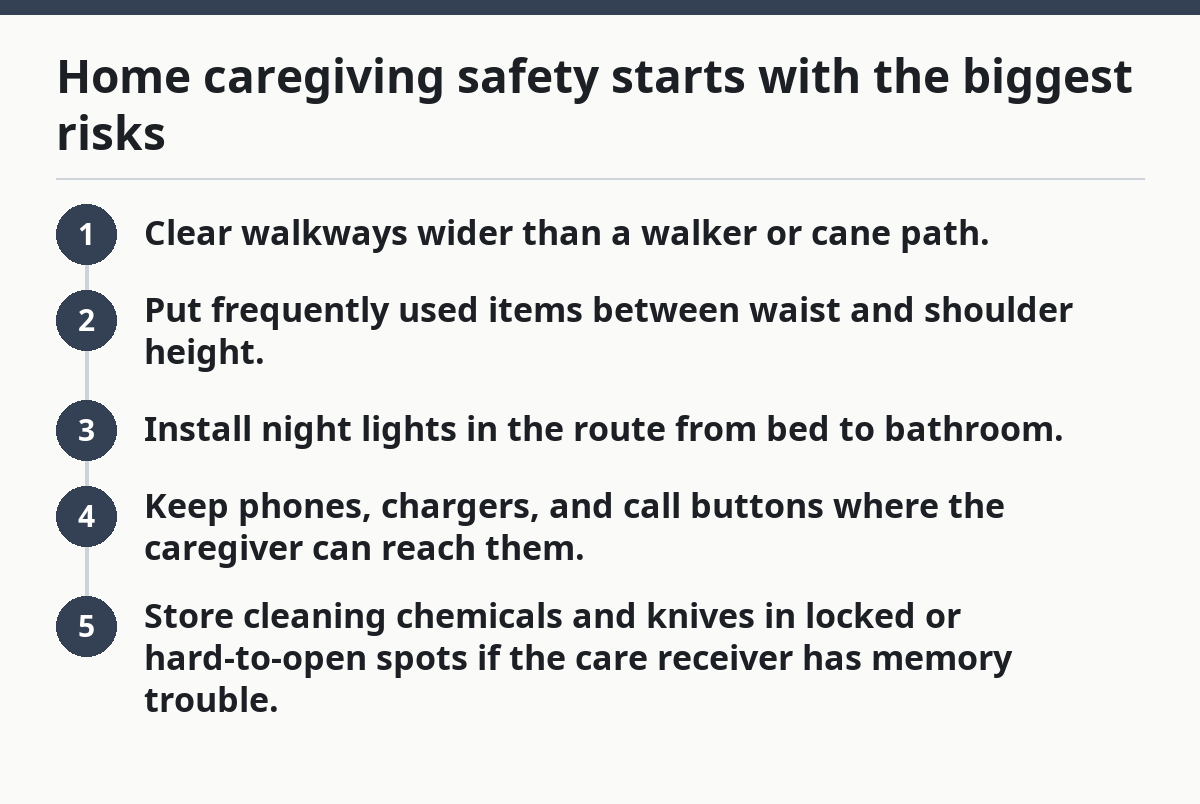
Here are the fixes that usually give the fastest payoff, but the right priority depends on the home and the person:
- Clear walkways wider than a walker or cane path.
- Put frequently used items between waist and shoulder height.
- Install night lights in the route from bed to bathroom.
- Keep phones, chargers, and call buttons where the caregiver can reach them.
- Store cleaning chemicals and knives in locked or hard-to-open spots if the care receiver has memory trouble.
A home care space does not need to look medical. It does need to be predictable.
How do I stop falls before they happen?
You stop falls by making the floor, the light, and the transfer path boring. Falls happen when a person has to turn fast, step over clutter, or grab the wrong support.
Picture this: you’re in a hallway at dusk, one hand on a grocery bag and one hand on a door handle, while the care receiver shuffles behind you toward the bathroom. If the hall is dark, the odds of a misstep jump. Light matters more than decor.
The most useful fall-prevention moves are practical, not fancy.
- Add bright lighting at beds, stairs, and entryways, and ask a professional to review the setup if balance or vision is poor.
- Use non-slip mats only if they lie flat and do not curl, and ask a professional about better flooring if the room stays slick.
- Remove throw rugs unless they are truly secured
- Keep cords out of all walking lanes
- Make sure shoes fit well and have a closed heel
- Put a stable chair near the bed for dressing and rest
Stairs need special attention. A single missing handrail can turn a routine step into an injury. If a person uses stairs daily, both sides of the stairway are better than one, especially if balance is poor.
The standard advice from the Centers for Disease Control and Prevention’s fall resources is plain: reduce hazards, improve strength and balance, and review medicines that affect alertness. See the CDC’s falls page here: https://www.cdc.gov/falls/index.html
What a generic article often misses is the timing. Falls are more likely when people rush to the bathroom at night, stand after long sitting, or carry something while walking. The fix is not just gear. It is route design and habit design.
A good home setup answers three questions:
- Can the person get up without twisting?
- Can they see where they are going?
- Can they hold something stable the whole way?
If the answer to any of those is no, the fall risk is still there.
Safe lifting and transfers without hurting your back
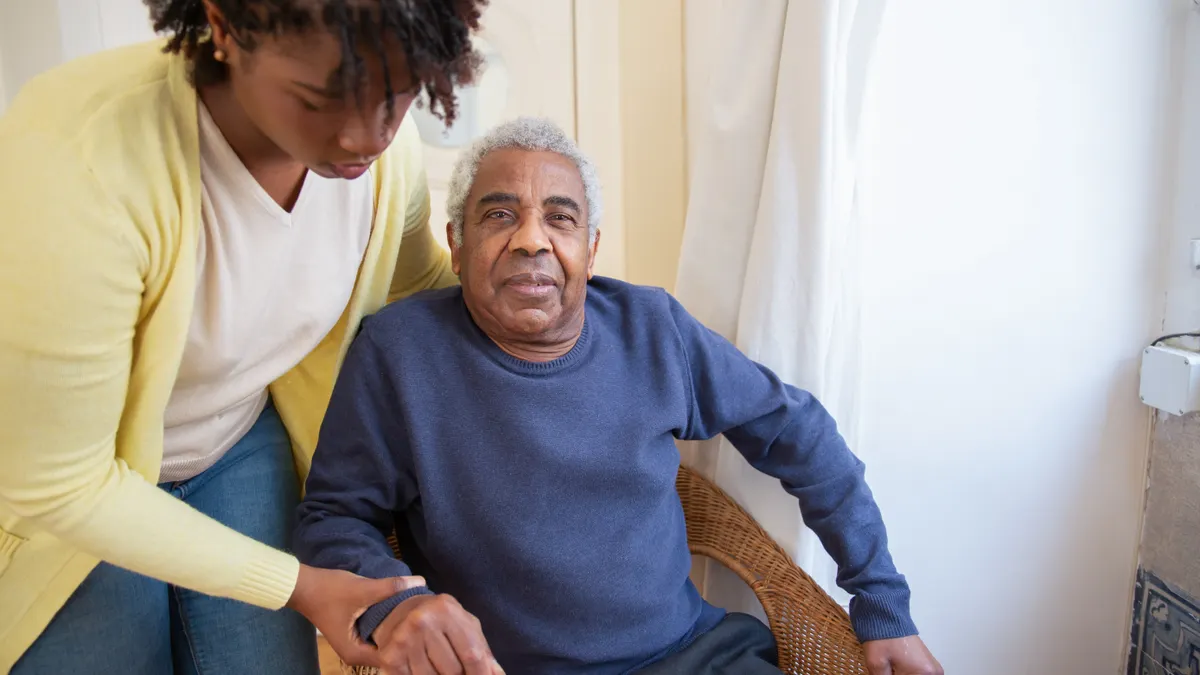
Safe lifting means you stop treating every move like a dead lift, but the safest method depends on the person and the room, so consult a professional if you are unsure. The right move is usually a transfer technique, a gait belt, a slide aid, or a second person — not raw strength.
Picture this: you bend at the waist to pull someone upright from a low couch, and your back takes the full load while the person loses balance halfway up. That is how caregiving turns into a back injury. Bad body mechanics are not a badge of effort. They are a hazard.
The key rule is simple: if the person cannot rise safely with one controlled motion, change the method.
Common safer options include:
- A gait belt for guided standing and short walking support
- A transfer board for lateral moves between surfaces of similar height
- A raised toilet seat or bedside commode to reduce squat depth
- A shower chair to reduce standing time in wet areas
- A hospital bed or adjustable bed for harder bed transfers
A gait belt is not a magic fix. It can slip if used loosely, pinch skin if handled badly, and fail if someone grabs the caregiver’s torso instead. It works best when the caregiver has training and the person can bear at least some weight.
The National Institute for Occupational Safety and Health has long warned about manual lifting injuries in care work. That warning still applies at home, where the furniture is often worse and the staffing is worse too. NIOSH materials are available through CDC occupational safety pages.
Here’s the catch: the most dangerous transfer is the one done in a hurry. If the person is dizzy, weak, confused, or already halfway off balance, do not improvise.
Use this decision rule:
- Can stand with help? Use a gait belt and clear verbal cues.
- Cannot stand but can slide? Use a transfer board or slide sheet.
- Unable to help at all? Get a hoist or trained help, if available.
- Any pain, panic, or resistance? Stop and reset.
The right transfer method protects both bodies. The wrong one can injure the caregiver first and leave the person on the floor second.
What should a bathroom safety setup include?
A bathroom safety setup should include grab bars, non-slip flooring, a shower chair, and a safer way to sit and stand. Bathrooms are where falls, burns, and privacy mistakes stack up in one small room.
Picture this: you’re helping someone step over a tub wall while the floor is wet, the towel is on the far hook, and the person is reaching for the sink instead of a real handhold. Bathrooms reward planning and punish guesswork.
Grab bars are better than towel bars because they are built for weight. Towel bars are not. That distinction sounds obvious, yet it is one of the most common home-care errors. A towel bar can rip out of the wall under load.
The American Occupational Therapy Association and many fall-prevention programs favor bathroom changes that reduce single-leg standing and twisting. A few reliable upgrades do most of the work:
- Install grab bars beside the toilet and in the shower
- Use a shower chair or bath bench
- Add a handheld shower head
- Keep soap, shampoo, and towels within easy reach
- Use a raised toilet seat if sitting low is difficult
- Add non-slip strips or a textured mat inside the tub or shower
A bathroom mat on the floor is not enough if the tub surface stays slick. The wet walking path matters more than the tile finish.
The cleaning step matters too. Soap film makes slips worse. Shower floors should be scrubbed regularly so residue does not build up. If a helper cleans quickly and leaves a slick cleaner behind, the room is still unsafe.
A bathroom should also have:
- A clear path from bed to toilet
- A night light
- A way to call for help
- A locked cabinet for medicines if confusion is an issue
If the person has frequent falls, severe arthritis, or poor balance, the bathroom is not the place to “try harder.” It is the place to lower the demand.
Kitchen and medication safety: small mistakes, big harm
Kitchen and medication safety matter because tiny errors can cause burns, poisoning, choking, or missed doses. The home care kitchen should be set up like a low-stress work zone, not a crowded restaurant line.
Picture this: you leave a pan handle pointing out, the person reaches for it, and hot liquid tips toward both of you. Or a pill bottle gets mixed with vitamins, and the wrong dose goes down at the wrong time. Those are ordinary home errors with serious consequences.
The safest kitchen habits are concrete, though the best arrangement still depends on the person’s abilities:
- Turn pan handles inward
- Use rear burners when possible
- Keep hot drinks away from the edge of counters
- Store knives in a block, drawer insert, or locked spot
- Put step stools away if balance is poor
- Keep only the needed items on the counter
For medications, a simple system beats memory every time.
Use one of these:
- A labeled pill organizer for daily doses
- A written med list with dose times
- A timer or phone alarm
- One pharmacy when possible, so refills are easier to track
Do not keep loose pills in kitchen cups, coin trays, or unmarked containers. That is how errors happen. The FDA’s medication safety guidance and many pharmacy organizations stress keeping an accurate list and checking labels every time.
A medication list should include:
- Drug name
- Strength
- Time taken
- Reason for use
- Prescriber name
- Allergies and past reactions
The most dangerous part is not just the pill mix-up. It is the combination of medication effects and home hazards. Drowsiness, dizziness, low blood pressure, and confusion make falls more likely. A person who started a new sedative or pain medicine may need a safer walking route for a few days.
Food safety matters too. Choking risk rises when someone eats too fast, has missing teeth, or has swallowing trouble. If coughing happens during meals, get medical advice quickly.
How do I protect my back, hands, and shoulders?
You protect your body by treating caregiving like physical work with limits, and it helps to ask a professional if a task keeps causing pain. Good body mechanics are not about perfect form. They are about reducing repeated strain on the same joints.
Picture this: you are opening jars, lifting laundry baskets, reaching into low drawers, and bracing a person during every transfer. By the end of the week, your wrist, shoulder, and lower back all complain at once. That is not weakness. That is load.
The best prevention is to change the task, not just toughen up.
Use these rules:
- Keep elbows close when lifting small objects
- Avoid twisting while carrying weight
- Raise frequently used items to a better height
- Slide, don’t lift, when you can
- Use both hands for larger loads
- Take micro-breaks before fatigue changes your posture
A plain kitchen stool can help if it is stable and used for sitting while chopping or folding laundry. But it should not replace a true transfer aid, and it should never be used on slick floors.
The consequence of ignoring strain is usually gradual: sore back, tendon pain, numb hands, and lost grip strength. Once that starts, caregiving gets less safe for everyone.
Hand safety matters too. Gloves help with cleaning chemicals and bodily fluids, but they do not make someone invincible. Fit matters. A loose glove can snag; a too-tight glove can reduce dexterity. Keep gloves near the cleaning supplies, not buried in a different room.
For shoulder protection, the rule is to keep tasks close to the body and below shoulder height when possible. High shelf work adds strain fast.
If a task needs force, reach, or repetition, ask whether a tool can replace muscle.
When should the home setup change completely?
The home setup should change completely when the person has repeated falls, confusion, severe weakness, or a transfer that can no longer be done safely at the current level of support. At that point, small tweaks are not enough.
Picture this: the same fall happens twice in a month, the same bathroom grab gets missed, and the same transfer leaves both of you shaken. That is the signal that the problem is no longer a loose rug or a bad lamp. It is the whole setup.
Here are signs the plan is no longer working:
- The person needs near-full body support to stand
- The person cannot follow step-by-step directions
- The caregiver is sore after ordinary care tasks
- Bathroom trips are causing panic or near-falls
- The bed height makes standing up unsafe
- The home has stairs the person can no longer manage
At that point, the options may include a hospital bed, bedside commode, walker reassessment, more home health support, or a move to a more accessible space. That is not a failure. It is a safety decision.
Many of these changes can be made before the first major injury. Waiting for a fall to “prove” the need is a bad bet.
A home should be reconsidered if:
- The person’s needs changed after illness, stroke, or surgery
- The caregiver is alone for long stretches and cannot safely assist
- The bathroom or bedroom cannot be made accessible
- Medications or cognition make supervision much harder
Occupational therapists, physical therapists, and home health teams can help match the setup to the actual level of need. That advice is worth more than guesswork from a catalog or a neighbor.
The honest verdict: what to fix first and what to skip
Choose fall prevention and transfer safety first if the main risk is walking, standing, or getting to the bathroom. Choose bathroom and medication changes first if the person is most likely to get hurt during washing, toileting, or pill taking. Neither is enough if the caregiver is being injured during every assist.
The wrong move is trying to “make do” with a dangerous transfer, a slick bathroom, or a medicine system based on memory. Those are not small flaws. They are the injury engine.
Here is the practical order:
- Clear walkways and improve lighting.
- Fix the bathroom.
- Put medication into a visible system.
- Replace unsafe lifting with the right aid.
- Recheck the plan after any health change.
Skip the decorative fixes if the basics are still bad. A prettier room does not stop a fall.
Which changes pay off first in a real home?
The changes that pay off first are the ones that remove daily strain and daily risk, not the ones that look the most medical. That usually means lighting, grab bars, a better toilet setup, and a transfer aid before anything else.
Picture this: you have limited energy, limited money, and only one afternoon to improve the house. You cannot fix everything. So you fix the route from bed to bathroom, the sitting and standing points, and the medicine setup. That is where the danger repeats.
The highest-value changes usually include:
- Motion lights or bright lamps
- Grab bars anchored into studs
- Raised toilet seating
- A shower chair
- A proper walker path
- A written medication chart
The lowest-value changes are often the flashy ones that do not match the actual problem. A safety device that gets in the way is not a safety device for long.
If there is one principle to keep, it is this: reduce the number of times a tired body must balance, bend, twist, or guess.
What should I do if I can’t afford to change everything now?
You should start with the cheapest high-risk fixes first, then build the rest in layers. A full home remodel is not required to make the home safer.
Picture this: you do not have the money for a bathroom renovation, but you do have a roll of tape, a night light, and the ability to move furniture. That still buys real safety.
Low-cost steps that often help right away:
- Move cords off floors
- Remove loose rugs
- Add brighter bulbs
- Shift daily items to easy-reach shelves
- Use a written med list
- Put a sturdy chair where dressing happens
- Clear one direct path to the bathroom
Some items should never be improvised. A grab bar must be anchored properly. A towel bar is not a substitute. A flimsy chair is not a transfer aid.
If money is tight, ask a clinic, hospital discharge planner, area agency on aging, or local caregiver support program about loan closets, used durable medical equipment, or home-safety resources. Availability varies, so the local source matters.
The best low-cost plan is one that cuts risk today and leaves room for upgrades later.
FAQ
What is the most common caregiving injury at home?
The most common pattern is a mix of falls and lifting strain, often during transfers or bathroom trips. The injury may be to the care receiver, the caregiver, or both. A good home setup reduces both risks at the same time.
Do I need grab bars or will a towel bar work?
Grab bars are the right choice, and a towel bar is not built for that load. A towel bar can pull out of the wall or bend. If balance is poor, proper mounting matters as much as the bar itself.
What is the safest way to help someone stand up?
The safest way is the one that matches the person’s strength, balance, and alertness. For many people, that means a gait belt, clear instructions, a stable surface, and no twisting. If the person cannot help much, get a better aid or trained support.
How do I know if the home is no longer safe?
The home is no longer safe when the same hazard keeps causing near-falls, injuries, or caregiver strain. Repeated bathroom trouble, unsafe stairs, and transfers that need more than one person are strong warning signs. At that point, the setup needs a deeper change, not another quick fix.
Should I ask a professional to check the home?
Yes, if the person falls often, has new weakness, has memory problems, or needs help with standing and toileting. An occupational therapist or home health team can spot problems a family may miss. That review is especially useful after surgery, stroke, or a major health change.
Drafted with AI; not yet reviewed by a person.